
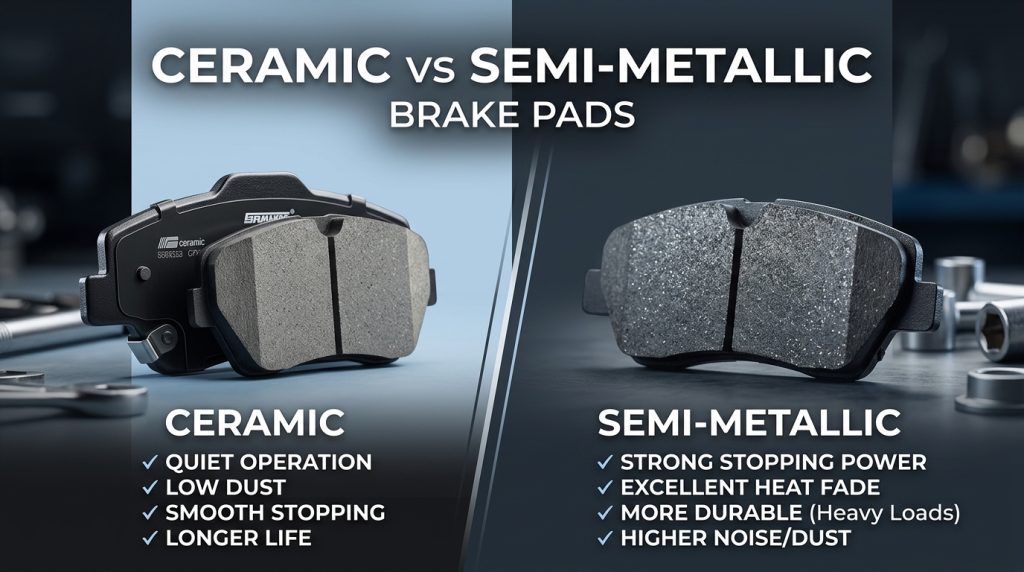
Walk into any auto parts store — or scroll through Amazon’s brake pad listings — and you’ll quickly face a choice that trips up a lot of car owners: ceramic or semi-metallic? Both stop your car. Both fit your calipers. But they behave very differently, and choosing the wrong type for your driving style can mean excessive dust on your wheels, noisy cold-morning stops, or pads that overheat when you push them hard.
This guide cuts through the confusion. We’ll break down exactly how each compound works, who each one is best suited for, and point you to the best option in each category available right now on Amazon.
The Short Answer (If You’re in a Hurry)
- Daily driver, commuter, or street car? → Go ceramic. Quieter, cleaner, longer-lasting.
- Truck, SUV, performance car, or track use? → Go semi-metallic. More bite, better heat handling.
Now, here’s why.
What Are Ceramic Brake Pads?
Ceramic brake pads are made from a dense ceramic compound embedded with copper fibers. They were developed in the 1980s as an alternative to the asbestos-based pads of earlier decades, and they’ve become the dominant choice for passenger cars and light crossovers ever since.
The ceramic compound is harder and less porous than semi-metallic material, which means it generates far less brake dust — and the dust it does produce is light-colored and doesn’t cling to wheel surfaces the way dark metallic dust does. If you’ve ever noticed a fine black powder coating the inside of your alloy wheels after a week of driving, that’s semi-metallic dust. Ceramic pads largely eliminate that problem.
Ceramic pads also operate more quietly across a wider temperature range. The compound dampens vibration rather than transmitting it, which is why vehicles equipped with ceramic pads rarely produce the squealing or squeaking that makes passengers uncomfortable.
On the downside, ceramics don’t handle extreme heat as well as metallic compounds. In applications where brakes are repeatedly stressed — towing heavy loads, repeated high-speed stops, mountain descents, or track driving — ceramic pads can begin to glaze and lose bite. They’re also generally more expensive upfront than comparable semi-metallic sets.
👉 Shop Ceramic Brake Pads on Amazon
What Are Semi-Metallic Brake Pads?
Semi-metallic brake pads are composed of 30–65% metal content — typically a blend of steel wool, copper, iron powder, and graphite — mixed with a binding resin. The metallic content is what gives them their defining characteristic: superior heat transfer and high-load braking performance.
Because metal conducts heat efficiently, semi-metallic pads can absorb and dissipate large amounts of thermal energy without fading. This is why they’re the standard choice for heavy trucks, performance-oriented vehicles, and any application that involves repetitive hard braking. If you’ve ever felt confident pushing through mountain switchbacks with no brake fade, or hauled a loaded trailer down a long grade without the pedal going soft, semi-metallic pads deserve much of the credit.
They also tend to provide more immediate, aggressive initial bite compared to ceramics — a characteristic that performance and towing drivers appreciate, but everyday commuters often find too grabby for smooth stop-and-go traffic.
The tradeoffs are real, though. Semi-metallic pads are noisier — especially during cold starts and low-speed maneuvers when the compound hasn’t reached operating temperature. They produce significantly more brake dust, which is dark, fine, and stubborn on alloy wheels. And because they’re harder than rotor material in many cases, they can wear rotors faster than a softer ceramic compound would.
👉 Shop Semi-Metallic Brake Pads on Amazon
Head-to-Head Comparison
| Feature | Ceramic | Semi-Metallic |
|---|---|---|
| Noise level | Very quiet | Moderate to loud (especially cold) |
| Brake dust | Minimal, light-colored | Heavy, dark |
| Heat tolerance | Moderate | Excellent |
| Rotor wear | Low | Moderate to high |
| Initial bite | Smooth, progressive | Firm, aggressive |
| Cold weather performance | Good | Excellent |
| Pad lifespan | Long | Moderate |
| Price | Higher upfront | Generally lower |
| Best use case | Daily commuting, city driving | Towing, performance, track |
Ceramic Brake Pads: The Full Picture
Who Should Buy Ceramic Pads
The overwhelming majority of daily drivers — sedans, coupes, hatchbacks, smaller SUVs and crossovers — are best served by ceramic pads. If your typical week involves commuting to work, running errands, occasional highway driving, and maybe the odd road trip, you will genuinely never need the thermal ceiling of a semi-metallic compound.
Beyond the cleaner wheels and quieter operation, ceramic pads are gentler on rotors. This is significant because rotors are considerably more expensive to replace than pads. Over the life of a vehicle, running ceramics can actually save money despite the higher upfront cost per set, simply because you’ll go longer between rotor replacements.
Modern ceramic formulations have also closed the cold-bite gap that used to make them feel sluggish on chilly mornings. Quality ceramic pads from reputable brands now provide confident stopping power from the first press of the pedal regardless of ambient temperature.
Where Ceramics Fall Short
If you regularly tow a boat, camper, or work trailer, ceramics are the wrong choice. The sustained heat generated by braking with thousands of pounds of load pushing your vehicle will overwhelm a ceramic compound and cause glazing — a hardening of the pad face that dramatically reduces friction and makes the pedal feel wooden and unresponsive.
Similarly, if you track your car even occasionally, ceramics will disappoint you. Repeated hard stops from high speed generate more heat than ceramic compounds are engineered to handle, and you’ll experience noticeable fade within a session.
👉 Check Ceramic Pad Prices on Amazon
Semi-Metallic Brake Pads: The Full Picture
Who Should Buy Semi-Metallic Pads
There’s a specific group of drivers for whom semi-metallic is simply the right answer, and they usually know who they are: truck and SUV owners who tow or haul regularly, performance car owners who drive enthusiastically on mountain roads, anyone who participates in autocross or track days, and drivers in cold climates who need maximum bite during winter conditions.
Semi-metallic pads are also the smart choice for vehicles with larger displacement engines or heavier curb weights, where the kinetic energy that needs to be converted to heat during a stop is proportionally greater. A full-size pickup loaded with gear needs a brake compound that can handle repeated hard stops — ceramics simply weren’t designed for that.
The noise and dust downsides are very real, but for drivers in these categories, they’re an accepted trade-off for the confidence of knowing their brakes will perform when pushed.
Where Semi-Metallics Fall Short
For the average commuter, the negatives outweigh the benefits. Morning squealing in a quiet parking garage is embarrassing. Black dust on freshly cleaned alloy wheels is frustrating. And the extra rotor wear means you may be looking at rotor replacement sooner than you otherwise would.
There’s also a comfort argument. The aggressive initial bite of semi-metallic pads makes smooth, linear stops harder to execute in everyday low-speed traffic — passengers notice jerky stops, and it’s generally not enjoyable to drive with pads that grab harder than the situation calls for.
👉 Check Semi-Metallic Pad Prices on Amazon
Does It Matter What Rotors You Have?
Yes — and this is a detail many guides gloss over. Your brake pads and rotors should be matched to the same use case.
Running aggressive semi-metallic pads against blank stock rotors on a daily driver accelerates rotor wear and can cause uneven pad deposits that lead to the pulsating pedal sensation. Conversely, pairing soft ceramic pads with slotted performance rotors on a track car wastes the rotor’s potential and may result in the ceramic compound getting shredded by the aggressive slot edges.
As a general rule: ceramics pair best with standard or lightly slotted rotors on street-driven vehicles. Semi-metallics work well across a wider range of rotor designs, including cross-drilled and heavily slotted surfaces designed to maximize heat evacuation.
What About Organic (Non-Asbestos Organic) Pads?
You’ll occasionally see a third category — NAO or organic pads — on Amazon listings. These are the softest compound, quietest, and cheapest, but they wear extremely fast and produce heavy dust. They’re typically found as OEM pads on economy vehicles and are best replaced with ceramics when they wear out. We don’t recommend organic pads as a deliberate upgrade choice for most drivers.
How to Install New Brake Pads (Quick Overview)
Replacing brake pads is one of the most accessible DIY car jobs. You’ll need a floor jack, jack stands, a lug wrench, a basic socket set, a C-clamp or brake piston tool, and about 90 minutes of time. The basic process:
- Loosen the lug nuts before jacking up the car
- Remove the wheel and locate the brake caliper
- Remove the two caliper mounting bolts and carefully hang the caliper with a wire hook — never let it hang by the brake line
- Slide out the old pads and inspect the rotor surface
- Compress the caliper piston fully using a C-clamp
- Install the new pads, reassemble, and torque the caliper bolts to spec
- Pump the brake pedal firmly several times before moving the car — this resets the piston against the new pad surface
Always bed in new pads properly: make 8–10 moderate stops from 35 mph, allowing 30 seconds between each for cooling. This transfers an even layer of pad material onto the rotor and ensures consistent friction from day one.
Final Verdict
The ceramic vs semi-metallic debate doesn’t have a single universal winner — it has a correct answer for each driver. The good news is that both options are readily available on Amazon at competitive prices, with fast shipping and straightforward return policies if something doesn’t fit.
Choose ceramic if: You drive a passenger car or light crossover, prioritize quiet operation and clean wheels, and your driving is primarily commuting and highway use.
👉 Shop Ceramic Brake Pads — Best for Daily Drivers
Choose semi-metallic if: You tow, haul heavy loads, drive a performance vehicle, track your car, or need maximum cold-weather bite and fade resistance.
👉 Shop Semi-Metallic Brake Pads — Best for Performance & Towing
Either way, upgrading from worn-out pads to a fresh quality set is one of the most immediate, noticeable improvements you can make to how your car drives. Your brakes are the most important safety system on your vehicle — they deserve a thoughtful upgrade.
As an Amazon Associate, we earn from qualifying purchases. Prices and availability are subject to change.

Benjamin Grey is an automotive engineer and writer at Car Parts Advisor. With years of experience in the automotive industry, he shares expert advice on car parts, maintenance, and repairs to help car owners keep their vehicles running smoothly.