
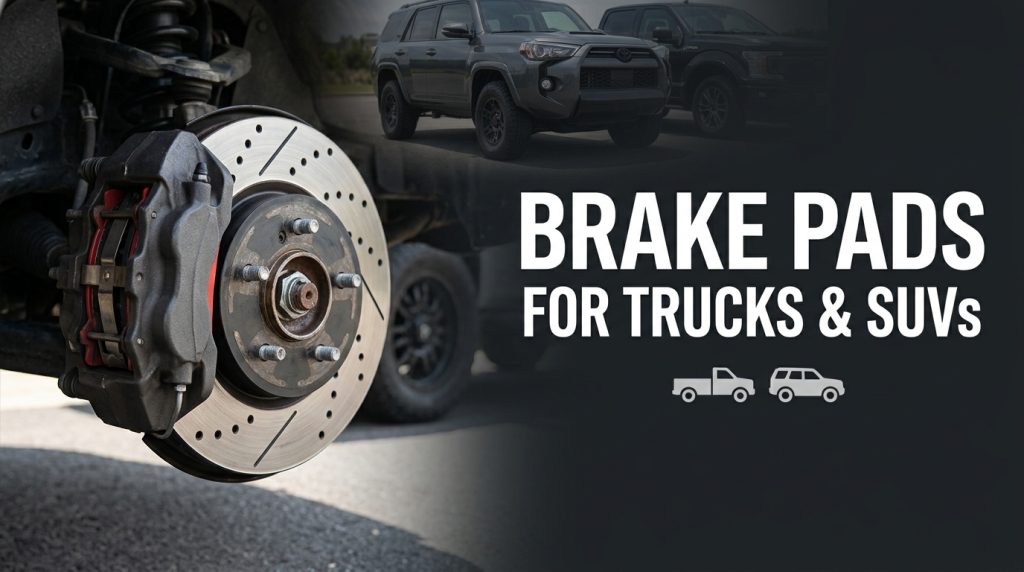
Trucks and SUVs are not passenger cars with bigger tires. They’re heavier, they haul more, they tow more, and when it comes time to stop — they demand a lot more from their brakes. Yet most brake pad guides lump all vehicles together as if a set of economy ceramics that works fine on a Honda Civic is an equally smart choice for a Ford F-150 pulling a loaded trailer down a mountain grade.
It isn’t.
If you drive a truck or SUV, your brake pads are working against significantly more inertia on every stop. A full-size pickup can weigh over 5,000 lbs unloaded. Add a trailer, a truck bed full of equipment, or five passengers and cargo in an SUV, and your braking system is managing enormous kinetic energy every time you press the pedal. Choosing the wrong pads means faster fade, longer stopping distances, and pads that wear out far sooner than they should.
This guide covers everything you need to know about brake pads for trucks and SUVs — what makes a pad right for heavy-duty use, the top pick available on Amazon right now, and how to get the most out of your brakes regardless of what you’re hauling.
What Makes Brake Pads Different for Trucks and SUVs?
Before diving into recommendations, it’s worth understanding why truck and SUV brake pads are a different conversation than pads for sedans.
Higher gross vehicle weight. More weight means more kinetic energy to convert into heat during braking. A compound that handles this well on a 3,200 lb car may glaze and fade under the sustained thermal load of a 6,000 lb SUV.
Towing and payload. When you’re towing a trailer or hauling a full bed, your brakes are fighting the momentum of everything behind and above them. This creates scenarios — repeated downhill stops, emergency braking with a load — where inferior pads fade dramatically or even fail to provide adequate stopping force.
Rotor size and caliper design. Trucks and SUVs typically have larger rotors and more aggressive caliper designs than passenger cars, which means the right pad needs to be matched to that hardware for optimal contact patch and heat management.
Duty cycle. Work trucks and frequently loaded SUVs see far more aggressive braking duty cycles than the average commuter car. The pads need to hold up across thousands of hard stops, not just easy suburban driving.
The right brake pad compound for a truck or SUV needs to handle high heat without fading, provide consistent pedal feel under load, and last long enough to justify the investment.
Our Top Pick: Best Brake Pads for Trucks & SUVs
PowerStop Z36 Truck & Tow Brake Pads — The Gold Standard
👉 Check Price & Availability on Amazon
If there’s one brake pad line engineered specifically for the demands of truck and SUV driving, it’s the PowerStop Z36 Truck & Tow series. PowerStop built the Z36 from the ground up to address the exact failure modes that destroy ordinary brake pads on heavy vehicles — fade under sustained load, glazing from high heat cycles, and inconsistent pedal feel when braking with a trailer pushing from behind.
The Z36 uses a carbon-fiber ceramic compound, which is a meaningful step above standard ceramics. The carbon-fiber reinforcement increases the pad’s thermal ceiling while retaining the low-dust and low-noise characteristics that make ceramic-based compounds pleasant to live with day to day. You get the bite and heat resistance of a semi-metallic without the constant brake dust coating your wheels or the morning squeal that wakes the neighborhood.
Carbon-Fiber Reinforced Formula
The carbon-fiber infusion in the Z36 compound is the key technical differentiator. Carbon fiber dramatically improves the pad’s ability to shed heat rather than absorb it, which means the compound maintains consistent friction levels even after repeated hard stops from highway speed. For drivers who regularly tow boats, campers, or work trailers, this is the characteristic that prevents the spongy, faded pedal feel that stock pads develop on long mountain descents.
In everyday driving without a load, the Z36 still behaves like a premium daily-driver pad — quiet, smooth initial bite, and minimal dust. But when you load up the truck, hitch up the trailer, or find yourself in a situation that demands everything your brakes have, the Z36’s true capability shows up immediately.
Chamfered and Slotted Design
The Z36 pads feature a chamfered edge and machined slots across the pad face. The chamfer — the angled cut at the leading edge of the pad — reduces noise by eliminating the abrupt edge contact that causes squealing. The slots serve double duty: they vent gas and heat generated at the pad-rotor interface, and they continuously clean the rotor surface by scraping away any glazing or debris that builds up during braking. This keeps friction levels consistent across the life of the pad rather than degrading as glazing accumulates on the rotor.
Stainless Steel Shims
Each Z36 pad comes fitted with multi-layer stainless steel shims bonded to the backing plate. These shims do two important jobs. First, they act as a thermal barrier that slows heat transfer from the pad into the caliper piston and brake fluid — the mechanism behind brake fade and the spongy pedal that experienced towers dread. Second, the shims dampen vibration at the pad-caliper contact points, which is the primary source of brake noise. This combination of thermal protection and vibration damping is why the Z36 stays quiet and firm even under the sustained heat of a loaded downhill run.
Hardware Included
One of the small but genuinely appreciated details about the Z36 kit is that it includes new hardware — the clips and shims that hold the pads in the caliper bracket. These components wear and corrode over time, and installing fresh pads into old, corroded hardware is a common cause of premature pad wear and noise. Getting new hardware with the pads eliminates this variable entirely and makes the installation cleaner.
Fitment
The Z36 is available for an enormous range of truck and SUV applications — Ford F-Series, Chevrolet Silverado, GMC Sierra, Ram 1500/2500/3500, Toyota Tundra and 4Runner, Jeep Grand Cherokee, Ford Expedition, Chevrolet Tahoe and Suburban, Nissan Titan, and many more. Make sure to select your specific year, make, and model from the Amazon listing to confirm fitment before ordering.
👉 Shop PowerStop Z36 Truck & Tow Pads on Amazon
Who Should Buy the PowerStop Z36?
Truck owners who tow regularly. If your truck spends meaningful time hooked to a trailer — whether that’s a boat every weekend, a camper on road trips, a work trailer during the week, or an ATV hauler — the Z36 is the single best upgrade you can make to your braking system. The fade resistance under sustained load is in a completely different class from stock or economy replacement pads.
SUV owners with full passenger loads. A seven-seat SUV loaded with passengers and cargo weighs substantially more than the same vehicle with one driver. If your SUV regularly carries a full family plus luggage — on road trips, school runs, or daily use — your brakes are working harder than they were designed for with budget pads.
Drivers in hilly or mountainous terrain. Repeated downhill braking is one of the most demanding scenarios for any brake pad. Whether you live in a hilly area or regularly drive mountain passes on road trips, the Z36’s thermal management keeps stopping power consistent when ordinary pads would begin to fade.
Work truck operators. Contractors, tradespeople, farmers, and anyone else whose truck is a work tool rather than just a commuter vehicle will appreciate pads that hold up to demanding duty cycles. Stock replacement pads on a hard-working truck wear out quickly. The Z36 lasts longer and performs better across the full pad lifespan.
Performance SUV drivers. If you drive a larger, performance-oriented SUV — a Jeep Grand Cherokee Trackhawk, a Ford Explorer ST, a Chevrolet Tahoe with a towing package — the Z36 pairs well with the more aggressive driving these vehicles encourage while still handling the weight penalty that comes with the platform.
Z36 vs. Standard Ceramic Pads: What You’re Actually Getting
It’s worth spelling out why the Z36 outperforms standard ceramic pads on heavy vehicles, because the difference goes deeper than marketing language.
A standard ceramic pad is formulated for vehicles in the 3,000–4,500 lb range with normal passenger car duty cycles. The compound is excellent at what it was designed for — quiet, clean, long-lasting stopping power for everyday commuting and highway driving.
The Z36’s carbon-fiber ceramic compound starts with that same foundation but adds carbon fiber to raise the thermal ceiling. Standard ceramics can begin to glaze somewhere around 400–500°F of sustained rotor temperature. On a loaded truck doing repeated stops from highway speed or descending a mountain grade, rotor surface temperatures can easily exceed 600–700°F. At that point, a standard ceramic pad has glazed and its friction coefficient has dropped significantly.
The Z36 is rated to maintain consistent friction performance well above the point where standard ceramics fade. That’s not a minor incremental improvement — in a real-world heavy braking scenario, it’s the difference between stopping when and where you intend to, versus discovering that your brakes have less bite than you expected at the worst possible moment.
What to Expect After Installation
The first thing most drivers notice after installing Z36 pads is the immediate improvement in pedal feel. Where worn-out or glazed pads produce a mushy, imprecise pedal, fresh Z36s give you a firm, confident response from the first millimeter of travel.
There will be a brief bedding period — a normal characteristic of any quality brake pad. For the first 300–500 miles, avoid aggressive stops from high speed and don’t come to a complete stop immediately after hard braking if possible. This transfers an even, thin layer of pad material onto the rotor face and establishes the friction interface that gives the pads their rated performance. Skipping the bedding process can result in uneven pad deposits, hot spots on the rotor, and the pulsating pedal sensation that most people associate with warped rotors.
After bedding, the Z36 compound settles into its full performance window. The bite becomes more consistent, heat fade becomes a non-issue under normal towing and hauling conditions, and the pads settle into a quiet, smooth operating character that stays out of your way — which is exactly what you want from brakes.
Pairing Your Pads with the Right Rotors
Brake pads and rotors work as a system, and upgrading one while leaving the other worn out limits how much benefit you’ll actually experience. If your rotors are at or near minimum thickness, grooved from worn-out pad backing plates, or showing significant heat cracks or hot spots, new pads alone won’t restore full braking performance.
For trucks and SUVs, PowerStop’s Z36 rotor line — which uses a slotted design optimized for the higher heat loads of heavy vehicles — is the natural pairing with the Z36 pads. The slots in the rotor complement the slots in the pad surface, maintaining clean, consistent contact across the pad face and maximizing heat evacuation.
If your rotors are in good condition with plenty of thickness remaining, fresh Z36 pads will still deliver a meaningful improvement. But if you’re already pulling the wheels off for a pad replacement, taking a few minutes to measure rotor thickness and inspect the surface condition can save you a second job in the near future.
Signs Your Truck or SUV Needs New Brake Pads Now
Don’t wait until performance degrades noticeably before replacing pads. Watch for these warning signs:
- Squealing or squeaking on the first few stops of the day, or continuously throughout driving — this is the wear indicator tab making contact with the rotor, and it’s telling you the pads are nearly gone
- Grinding metal-on-metal sound — the pad material is completely gone and the steel backing plate is contacting the rotor directly; replace immediately
- Vibration or pulsation in the brake pedal during stops, often a sign of uneven pad deposits or worn pads causing rotor damage
- Longer stopping distances — if you notice the truck isn’t stopping as crisply as before, or you’re reaching for the pedal earlier, pad wear is a likely culprit
- Pulling to one side when braking, indicating uneven pad wear or a stuck caliper on one side of an axle
- Visible thin pads through the wheel spokes — less than 3mm of remaining pad material means it’s time
For trucks and SUVs used for towing or hauling, make it a habit to do a quick brake check before every loaded trip. One moderately firm stop from 35 mph tells you a lot about pedal feel, noise, and straight-line tracking. Catching brake issues before a loaded trip is far safer and cheaper than discovering them mid-journey.
How to Install Brake Pads on a Truck or SUV (DIY Overview)
Swapping brake pads is one of the most beginner-friendly automotive jobs, and doing it yourself saves significant labor cost. Here’s the basic process:
- Safety first — loosen the lug nuts before jacking up the vehicle, then raise and properly support it on jack stands. Never work under a vehicle supported only by a floor jack.
- Remove the wheel and locate the brake caliper — the C-shaped housing that clamps over the rotor.
- Remove the caliper bolts (usually two) and carefully slide the caliper off the rotor. Hang it from the spring or frame with a wire hook. Never let it hang by the brake line.
- Slide out the old pads from the caliper bracket and inspect the rotor surface for deep grooves, cracks, or minimum thickness concerns.
- Compress the caliper piston using a C-clamp or dedicated piston tool. This pushes the piston back to accommodate the thickness of new pads. Important: crack open the brake fluid reservoir cap first to allow fluid to flow back in without overpressurizing.
- Install the new hardware (included with Z36 kits), then slide in the new pads.
- Reassemble in reverse order. Torque caliper bolts to the manufacturer’s spec — typically 25–44 ft-lbs depending on the vehicle.
- Pump the brake pedal firmly several times before moving the truck — this pushes the caliper piston back against the new pad surface. The pedal will feel soft initially and firm up after a few pumps.
- Bed the pads as described above before any hard use.
The whole job takes 60–90 minutes per axle for a first-timer, and less with experience. For rear disc brakes, note that some rear calipers have pistons that rotate inward rather than compress straight in — these require a special turning tool rather than a standard C-clamp.
Final Verdict
Trucks and SUVs demand brake pads that can match their weight, their work, and their stopping requirements — and the PowerStop Z36 Truck & Tow series is built precisely for that job. The carbon-fiber ceramic compound, slotted and chamfered pad design, stainless steel thermal shims, and included hardware make it a complete, professional-grade solution for any truck or SUV application.
Whether you’re a weekend tower, a daily work truck operator, or simply an SUV owner who wants to brake with confidence regardless of what you’re carrying, the Z36 is the upgrade your vehicle’s braking system deserves.
👉 Get the PowerStop Z36 Truck & Tow Brake Pads on Amazon
As an Amazon Associate, we earn from qualifying purchases. Prices and availability are subject to change.

Benjamin Grey is an automotive engineer and writer at Car Parts Advisor. With years of experience in the automotive industry, he shares expert advice on car parts, maintenance, and repairs to help car owners keep their vehicles running smoothly.


