
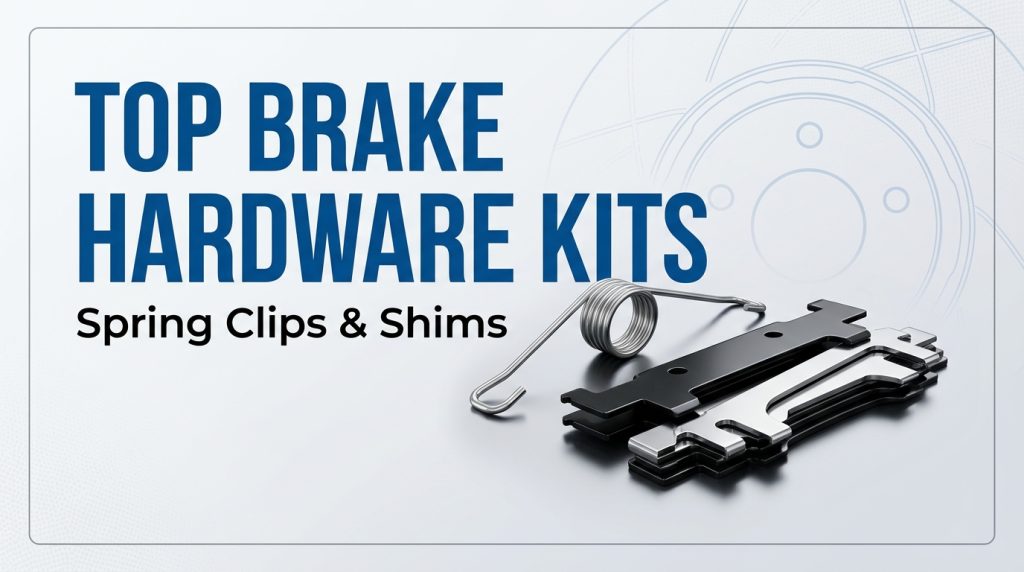
Every brake job has a component that gets overlooked more consistently than any other — not the pads, not the rotors, not even the calipers. It’s the hardware. The small collection of spring clips, anti-rattle shims, guide pins, and pad retainers that hold everything together in the caliper bracket, keep the pads from vibrating, and ensure even contact between pad and rotor across the full service life of the brake job.
Walk into any shop and you’ll see the pattern: a mechanic swaps the pads, installs them into the old corroded clips, and reassembles. Six months later, the customer is back with a brake squeal that wasn’t there when the car left. Two years later, one pad is worn at a diagonal because the clip it was seated in was bent and couldn’t slide freely. The pad replacement that was supposed to last 40,000 miles lasted 20,000, and nobody connected it to the hardware that was left in place.
Brake hardware kits solve this problem at the source. For a few dollars added to any pad replacement, every piece of the hardware that guides, retains, and isolates the pad from the caliper bracket is replaced simultaneously. The result is a brake job that performs as it should — quiet, even-wearing, and consistent — for the full service life of the new pads.
This guide covers the five best brake hardware kits available on Amazon for Honda, Acura, Toyota, Lexus, Subaru, Ford, Mazda, and GM platforms, with picks for both front and rear axle applications across multiple vehicle generations.
Why Brake Hardware Matters More Than Most Drivers Realize
To understand why hardware replacement matters, it helps to know exactly what each component does — and what happens when it fails.
Abutment clips and guide rails. These are the stamped steel clips that line the caliper bracket’s pad slot — the channel the pad slides in as it wears down and the piston extends to maintain contact with the rotor. The clips provide a smooth, corrosion-resistant sliding surface between the pad backing plate and the cast iron bracket. When these clips corrode, the pad no longer slides freely in the bracket. Instead of retracting smoothly when you release the brake pedal, the pad drags slightly against the rotor continuously, generating heat, wearing the pad prematurely, and eventually glazing the rotor surface.
Anti-rattle springs and clips. These small spring steel clips apply a light, consistent preload to the pad, holding it gently against the caliper bracket and preventing the microscopic movement that produces brake rattle — the metallic rattling sound that occurs over rough pavement when the pads are moving freely within their mounting space. Over time, these springs lose their tension through heat cycling and metal fatigue, and the pads begin to rattle.
Noise-dampening shims. Many hardware kits include thin steel or rubber-bonded shims that sit between the pad backing plate and the caliper piston face. These shims interrupt the vibration transmission path between the pad and the caliper body that produces brake squeal. When these shims are absent, degraded, or missing, even premium ceramic pads can produce squealing that has nothing to do with the pad compound itself.
The corrosion problem. Cast iron brackets and steel hardware in the wheel well environment are continuously exposed to road salt, moisture, brake dust, and the heat-cool cycles of normal brake operation. Over 30,000–50,000 miles between brake services, the original hardware corrodes, deforms slightly, and loses its ability to perform any of the functions above. New pads in corroded hardware are the single most common cause of brake noise and uneven wear complaints after a pad replacement.
Top 5 Brake Hardware Kits
1. Dynamic Friction Company Front Disc Brake Hardware Kit 340-59017 — Best for Honda & Acura
Fits: Acura ILX 2013–2015; Honda CR-V 2002–2004; Honda Accord 2003–2017; Honda Element 2003–2011; Honda Civic 2013–2021
The Dynamic Friction Company — better known as DFC — is a respected brake component manufacturer that supplies both the OEM and aftermarket markets with precision brake hardware engineered to application-specific tolerances. Their 340-59017 front hardware kit is one of the most broadly useful Honda and Acura hardware kits available on Amazon, covering a wide range of the brand’s most popular models across nearly two decades of production.
The fitment list reflects the shared front caliper architecture across Honda’s front-wheel-drive platform family — the Accord, Civic, CR-V, and Element share similar caliper bracket designs across multiple generations, and the ILX inherits this architecture from its Civic roots. One hardware kit serving this entire range simplifies parts procurement for Honda-focused shops and multi-Honda households significantly.
DFC’s hardware kit includes all the components needed for a complete front brake hardware refresh: the abutment clips that line the caliper bracket’s pad channel, the anti-rattle springs that eliminate pad movement between stops, and the hardware fasteners needed for reassembly. Everything is manufactured from corrosion-resistant materials — stainless steel for the spring components and coated steel for the bracket clips — that provide significantly better longevity in the salt and moisture environment of the wheel well than the original plated steel hardware typically installed at the factory.
For Honda and Acura owners who’ve experienced brake squeal or rattle after a pad replacement, the cause is almost always the original corroded hardware that was left in place. Installing this kit simultaneously with new pads eliminates that variable entirely — the new pads go into fresh, correctly tensioned, corrosion-resistant hardware from day one.
Best for: Honda Accord, Civic, CR-V, Element owners and Acura ILX owners performing front brake pad replacement who want a complete hardware refresh at a competitive price from a proven OEM-supply brand.
👉 Shop DFC Front Brake Hardware Kit for Honda/Acura
2. Front Brake Hardware Kit — Best for Toyota Tacoma
Fits: Toyota Tacoma 2005–2021 (with 6-Lug Wheels)
The Toyota Tacoma’s front brake hardware — particularly the abutment clips in the front caliper bracket — is one of the most frequently corroded components on trucks used in salt-belt environments or off-road conditions. The Tacoma’s front wheel wells see more road spray, mud, and debris than the average passenger car, and the hardware that sits exposed inside the caliper bracket accumulates corrosion at a rate that often outpaces the pad wear itself.
This front hardware kit covers the 2005–2021 Tacoma generation with 6-lug wheel configurations — the most common Tacoma specification — providing all the abutment clips, anti-rattle springs, and retaining hardware needed to restore the front caliper brackets to clean, correctly functioning condition during a pad replacement.
The 6-lug specification is an important fitment detail. The 2005–2021 Tacoma was sold with both 4-lug (rare, on early base models) and 6-lug configurations, and the front caliper bracket dimensions differ between them. This kit is confirmed for the 6-lug application — the configuration used on the vast majority of Tacomas in this generation, including all 4WD models and most 2WD PreRunner configurations.
For Tacoma owners who have experienced the characteristic front brake noise that develops on higher-mileage trucks — a combination of pad rattle over rough surfaces and the metallic grinding that corroded bracket clips cause as they score the pad backing plate — this hardware kit combined with fresh pads is the complete fix. The new clips restore the smooth sliding surface the pad needs to retract cleanly after each stop, eliminating both the noise and the uneven diagonal wear pattern that corroded clips create.
Best for: Toyota Tacoma owners (2005–2021, 6-lug) doing front brake pad replacement, particularly trucks with 60,000+ miles or significant off-road and winter use.
👉 Shop Front Brake Hardware Kit for Toyota Tacoma
3. Dorman HW13519 Front Disc Brake Hardware Kit — Best for Lexus & Toyota
Compatible with Select Lexus/Toyota Models
Dorman is the gold standard for direct-fit replacement hardware across domestic and import vehicle platforms, and the HW13519 brings their engineering precision to the Lexus and Toyota front brake hardware application. Dorman’s hardware kits are manufactured to OEM dimensional specifications — the clip width, spring rate, and material thickness are matched to the original factory hardware rather than being generic approximations that fit loosely and lose their tension earlier.
This distinction matters more for Lexus applications than for most other platforms. Lexus vehicles — IS, ES, RX, GX, and others depending on the specific fitment confirmed for this part number — are precision-engineered cars where the brake system tuning is calibrated for the original hardware’s spring rates and clip geometry. Installing lower-quality generic hardware on a Lexus front brake creates the brake noise and pad wear issues that Lexus owners find particularly unacceptable in a vehicle positioned at the luxury tier.
Dorman’s OEM-spec hardware also addresses the longevity problem that makes hardware replacement worthwhile in the first place. The corrosion-resistant plating on Dorman’s clips and springs provides a longer service life in the wheel well environment than the original hardware — important for Lexus and Toyota owners who service their vehicles on long intervals and need the hardware to hold up for 30,000–40,000 miles between brake jobs.
The front brake hardware on Toyota and Lexus platforms is particularly prone to one specific failure mode: the abutment clip legs that grip the caliper bracket can spread slightly over time as the pad cycles in and out of the channel with each brake application. Spread clips grip the pad loosely, allowing movement that generates noise. Dorman’s clips are manufactured to the correct grip width that prevents this spreading and maintains proper pad retention throughout the hardware’s service life.
Verify your specific Toyota or Lexus model and year using the Amazon fitment tool to confirm the HW13519 applies to your application before ordering.
Best for: Lexus and Toyota owners wanting OEM-precision front brake hardware from Dorman’s trusted fitment catalog.
👉 Shop Dorman HW13519 Front Brake Hardware Kit for Lexus/Toyota
4. Dynamic Friction Company Rear Disc Brake Hardware Kit 340-54029 — Best Rear Kit for Modern Japanese & American Platforms
Fits: Acura RDX 2019–2025, Acura TLX 2021–2025; Mazda 3 (select years); Subaru Ascent, Crosstrek, Forester 2019–2025; Ford Bronco 2021–2025
The DFC 340-54029 is the rear hardware kit counterpart to the 340-59017 above, and its fitment list is one of the most interesting on this page — spanning three Japanese brands and the Ford Bronco across a contemporary model year range. This reflects the reality that modern vehicle platforms increasingly share caliper bracket architectures across manufacturer lines, and a single hardware kit can correctly serve applications from Acura, Mazda, Subaru, and Ford because their rear caliper designs use compatible bracket geometries.
Rear brake hardware on these platforms requires specific attention because rear caliper brackets on vehicles with integrated parking brakes — which includes all the models listed — see additional mechanical stress from the parking brake actuator mechanism. Every time the parking brake is applied and released, the rear pads are moved by the mechanical actuator in addition to the hydraulic circuit’s normal operation. This additional movement cycle accelerates wear on the abutment clips and adds a torsional load to the anti-rattle springs that front hardware doesn’t experience.
For Subaru owners specifically — Ascent, Crosstrek, and Forester are all listed — rear brake hardware is a particularly important maintenance item. Subaru’s rear caliper design uses a floating caliper that’s sensitive to slide pin and clip condition. Corroded rear clips on a Subaru produce a characteristic rear brake drag that manifests as a slight resistance when rolling the car in a straight line and as uneven rear pad wear that appears as one pad significantly thinner than its partner on the same axle.
The Ford Bronco inclusion is noteworthy. The Bronco’s off-road focus means its rear brake hardware sees trail mud, water, and debris in addition to normal road use — conditions that accelerate clip corrosion faster than a street-only vehicle experiences. Replacing the rear hardware at every pad change keeps the Bronco’s rear brakes performing correctly through the demanding conditions these trucks are specifically built to handle.
Best for: Rear brake pad replacement on Acura RDX/TLX, Subaru Ascent/Crosstrek/Forester, Mazda 3, and Ford Bronco owners who want to simultaneously refresh all rear brake hardware with a complete DFC kit.
👉 Shop DFC Rear Brake Hardware Kit 340-54029
5. Dorman HW5797 Rear Disc Brake Hardware Kit — Best for GM Trucks & SUVs
Compatible with Select Cadillac / Chevrolet / GMC Models
The Dorman HW5797 completes this guide’s coverage with a rear hardware kit for the GM truck and full-size SUV platform — one of the most widely owned vehicle families in North America, encompassing Chevrolet Silverado, Tahoe, Suburban, GMC Sierra, Yukon, and various Cadillac Escalade configurations depending on the specific fitment confirmed for this part number.
GM’s rear disc brake hardware on these full-size platforms is particularly prone to one failure mode that makes hardware replacement especially impactful: the rear pad abutment clips on the Silverado and Tahoe family develop corrosion that bonds the clip to the caliper bracket, preventing the clip from moving freely in the bracket’s clip retention channel. When this happens, the clip no longer functions as a sliding surface — instead, it becomes a fixed abrasive that scores the pad backing plate’s edges, creating a wedging condition that prevents the pad from retracting cleanly after each stop.
The result on a GM full-size truck is a rear brake system that runs hotter than it should, wears the inner pad faster than the outer pad (or vice versa), and produces the brake-dragging-after-release condition that shows up as a hot rear wheel after highway driving. Replacing the corroded clips with fresh Dorman hardware restores the correct sliding function and eliminates the drag condition entirely.
Dorman’s HW5797 includes the complete hardware set for the rear application — abutment clips, anti-rattle springs, and any pad retainers specific to the GM rear caliper design. Dorman’s quality control on GM platform hardware is strong, reflecting their long history as a primary supplier of OEM-replacement parts for Chevrolet, GMC, and Cadillac applications.
For GM truck and SUV owners who routinely service their own brake systems — a common practice among Silverado and Sierra owners comfortable with DIY maintenance — keeping the HW5797 on hand for every rear pad replacement ensures the job is done completely every time.
Best for: Chevrolet Silverado, Tahoe, Suburban, GMC Sierra, Yukon, and Cadillac owners replacing rear brake pads who want factory-correct hardware from Dorman’s proven GM fitment catalog.
👉 Shop Dorman HW5797 Rear Brake Hardware Kit for GM Trucks & SUVs
Quick Comparison: All Five Hardware Kits
| Kit | Brand | Position | Platform | Key Detail |
|---|---|---|---|---|
| DFC 340-59017 | Dynamic Friction | Front | Honda/Acura | Broad Honda family coverage, corrosion-resistant |
| Front Tacoma Kit | — | Front | Toyota Tacoma 2005–2021 | 6-lug spec, off-road and salt-belt use |
| Dorman HW13519 | Dorman | Front | Lexus/Toyota | OEM-precision clip geometry, luxury-grade fit |
| DFC 340-54029 | Dynamic Friction | Rear | Acura/Subaru/Mazda/Bronco | Modern multi-platform rear, parking brake stress |
| Dorman HW5797 | Dorman | Rear | GM Trucks & SUVs | Full-size platform, drag-prevention clip design |
How to Install Brake Hardware Kits: Best Practices
Installing brake hardware correctly is as important as buying quality hardware in the first place. These steps apply to any of the kits above:
Clean the caliper bracket thoroughly first. Before installing new clips, use a wire brush and brake cleaner to remove every trace of rust, old brake dust, and corrosion from the caliper bracket’s pad slot surfaces. New clips installed over corroded bracket surfaces won’t seat correctly, will transfer rust to the clip’s underside quickly, and won’t provide the smooth sliding surface they’re designed for. Take five minutes with the wire brush — it’s the most important step in the process.
Lubricate correctly and sparingly. Apply a small amount of high-temperature brake caliper grease to the back of the pad backing plate — the face that contacts the piston — and to the pad’s lateral edges where they contact the abutment clips. Do not get any lubricant on the pad friction material or the rotor surface. Even trace amounts of grease on a brake pad compound will contaminate the surface and dramatically reduce friction, requiring pad replacement to fix.
Seat the clips firmly and completely. Abutment clips must be fully seated in the caliper bracket’s clip channel before the pads are installed. A clip that’s only partially seated will allow the pad to shift laterally during braking, generating noise and uneven wear. Press each clip firmly into its channel until it clicks or seats flush with the bracket surface.
Replace hardware on both sides of the axle simultaneously. Just as pads should be replaced in pairs on the same axle, hardware should always be replaced across both sides at the same time. Mismatched hardware — one side with new corrosion-free clips, one side with original corroded clips — creates a friction differential between sides that causes brake pull and uneven wear.
Don’t reuse hardware from the old pad set. Many new brake pad sets include hardware. If the new pads came with hardware, use that hardware rather than the kit hardware — one set is sufficient. If the new pads didn’t include hardware, the aftermarket hardware kit is the correct replacement. Never reinstall the original hardware when new hardware is available.
How Often Should Brake Hardware Be Replaced?
The straightforward answer: at every brake pad replacement. Hardware service life is tied to the pad replacement interval — roughly 30,000–50,000 miles depending on driving style and vehicle type. By the time pads have worn to replacement level, the hardware that’s been cycling with them through every brake application has also accumulated corrosion and fatigue.
The cost argument for always replacing hardware is compelling: a hardware kit adds a small amount to the total cost of a brake job but can double the effective service life of the new pads by ensuring they operate in a clean, correctly functioning mechanical environment. A $15–$25 hardware kit that prevents a set of $60 ceramic pads from wearing unevenly and requiring premature replacement at 20,000 miles instead of their rated 45,000 miles is one of the most cost-effective maintenance decisions in automotive ownership.
For vehicles in particularly demanding environments — northern states with aggressive road salt use, off-road vehicles, towing and hauling trucks — consider inspecting hardware at 15,000-mile intervals and replacing if any clip shows corrosion that prevents free sliding.
Final Verdict
Brake hardware is the simplest, most overlooked component in the brake system — and replacing it at every pad service is the single highest-value upgrade most drivers never make. Every kit on this list provides a complete, platform-specific hardware refresh for some of the most popular vehicles on the road today, from Honda Civics and Toyota Tacomas to Subaru Foresters and Chevy Silverados.
Match your vehicle to the correct kit and replace hardware and pads together at every brake service:
- Honda Accord, Civic, CR-V, Element / Acura ILX (front): DFC 340-59017
- Toyota Tacoma front (2005–2021, 6-lug): Front Tacoma Hardware Kit
- Lexus / Toyota front: Dorman HW13519
- Acura RDX/TLX, Subaru, Mazda 3, Ford Bronco (rear): DFC 340-54029
- GM Trucks & SUVs (rear): Dorman HW5797
As an Amazon Associate, we earn from qualifying purchases. Prices and availability are subject to change.

Benjamin Grey is an automotive engineer and writer at Car Parts Advisor. With years of experience in the automotive industry, he shares expert advice on car parts, maintenance, and repairs to help car owners keep their vehicles running smoothly.


