
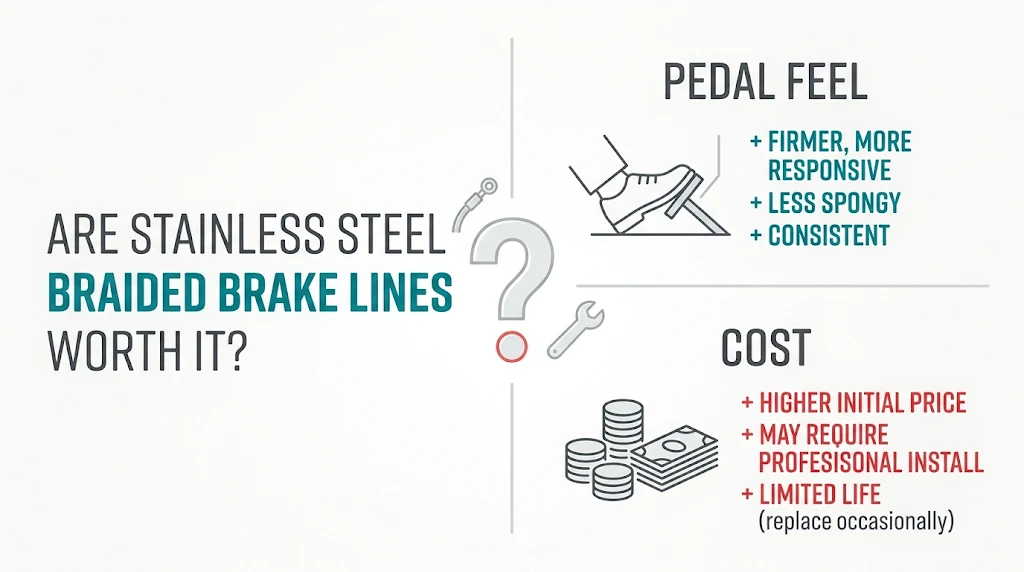
Imagine driving down a twisty mountain road or approaching a tight hairpin on a track day. You press the brake pedal, but instead of an immediate, confidence-inspiring bite, there is a fraction of a second where the pedal feels slightly spongy, mushy, or vague. You push harder, but that initial modulation precision feels lost in translation.
For many driving enthusiasts, this is the exact moment they start researching stainless steel braided brake lines.
Factory rubber brake lines are engineered for cost-efficiency, quietness, and comfort across millions of everyday vehicles. However, under high hydraulic pressure and heat, rubber expands. That microscopic ballooning steals your braking input. Braided steel lines promise a rock-solid pedal feel, but do they live up to the hype, or are they an unnecessary expense for street-driven cars?
Let’s break down the mechanics, compare pedal feel against cost, and help you decide whether this upgrade belongs on your vehicle.
1. Anatomy of a Brake Line: Rubber vs. Stainless Steel Braided
To understand why braided lines change how your car stops, you first need to understand what happens beneath the chassis when you press your foot down on the brake pedal.
The Standard Factory Rubber Line
Every modern vehicle leaves the factory with flexible rubber brake lines connecting the hard metal brake lines on the chassis to the moving brake calipers. These lines are typically constructed of synthetic rubber reinforced with a fabric weave (like cotton or rayon).
While durable and cheap to manufacture, rubber naturally flexes when subjected to internal pressure. When you stomp on the brakes, fluid is forced through the lines at pressures often exceeding 1,000 to 2,000 PSI. As that pressure spikes, standard rubber lines bulge outward slightly.
The Stainless Steel Braided Alternative
Stainless steel braided lines replace that outer rubber layer with a multi-component architecture:
-
PTFE (Teflon) Inner Core: A smooth inner lining made of Polytetrafluoroethylene that resists expansion, handles extreme temperatures, and remains completely compatible with all types of brake fluid (DOT 3, DOT 4, DOT 5.1).
-
Stainless Steel Outer Braid: A tight mesh jacket woven from thousands of individual stainless steel strands. This web prevents the PTFE core from expanding under hydraulic pressure.
-
Protective Outer Coating: A clear or colored PVC/polyurethane sleeve that prevents road grime, salt, and moisture from getting trapped in the braid and causing abrasion or corrosion.
Pro Tip: When shopping for brake lines, always look for DOT certification. Non-certified racing lines may lack the outer protective coating or structural safety margins required for daily street driving.
2. The Physics of Pedal Feel: Why Braided Lines Change Everything
When people upgrade to stainless steel lines, the most common description of the result is a “harder, more immediate pedal.” But why does this happen?
Eliminating Volumetric Expansion
When a rubber line expands under pressure, some of the hydraulic energy generated by your master cylinder is absorbed by the stretching rubber rather than pushing the brake pistons against the pads. This phenomenon is known as volumetric expansion.
By swapping to stainless steel braided lines, volumetric expansion is virtually eliminated. 100% of the fluid displacement generated by your foot goes directly to clamping the brake pads onto the rotors.
The Result on the Track and Street
-
Instant Initial Bite: The moment your foot touches the pedal, the brakes respond. There is no dead travel or “squishy” zone at the top of the pedal stroke.
-
Superior Modulation: Because the pedal resistance scales linearly and instantly with pressure, trail-braking into corners becomes significantly more precise.
-
Reduced Brake Fade: While brake fade is primarily caused by overheating pads and boiling fluid (fluid vapor compression), rubber lines can worsen the feeling of fade as they heat up and become even more pliable. Stainless lines maintain consistent firmness regardless of temperature.
3. Cost vs. Benefit Analysis: Are They Actually Worth the Money?
Upgrading your brake lines is not an arbitrary expense; it requires weighing financial investment against tangible performance gains.
The Financial Breakdown
-
Part Costs: A quality set of four DOT-approved stainless steel braided brake lines typically costs between $120 and $250 depending on the make and model.
-
Installation & Labor: If you take your car to a mechanic, expect to pay 2 to 3 hours of labor for installation and a complete brake system bleed, totaling $200 to $400.
-
Total Investment: $320 to $650.
The Value Proposition: Who Actually Needs Them?
| Driving Profile | Is It Worth It? | Why? |
| Daily Commuter / Grocery Getter | Low Value | Factory rubber lines provide more than enough safety margin for normal stop-and-go traffic. You may notice a slight firmness difference, but it won’t change your daily commute. |
| Enthusiast / B-Road Driver | Moderate Value | If you enjoy spirited driving on twisty backroads, the improved pedal feedback and confidence boost make it a rewarding upgrade. |
| Track Day / Autocross Driver | Essential Upgrade | High heat and heavy braking cycles destroy rubber lines quickly. Stainless lines are a cost-effective safety and performance necessity. |
| High-Mileage / Older Vehicles | High Value (Maintenance) | If your car is 10–15 years old, its factory rubber lines are likely dry-rotting and bulging. Replacing them with stainless lines costs roughly the same as OEM rubber replacements while offering a performance upgrade. |
4. Installation Realities: What to Expect When Upgrading
Installing brake lines requires working directly on your vehicle’s hydraulic system. A mistake here can lead to complete brake failure. If you are comfortable with intermediate mechanical work, it is a manageable weekend project; otherwise, leave it to a professional.
The Step-by-Step Replacement Process
-
Preparation & Safety: Secure the vehicle on jack stands, remove the wheels, and protect painted surfaces from corrosive brake fluid.
-
Disconnecting Old Lines: Use flare-nut wrenches to prevent rounding off the hard line fittings. Have a catch pan ready—brake fluid will leak out.
-
Mounting the New Lines: Secure the new stainless lines using the provided brackets, ensuring zero tension, twisting, or rubbing against suspension components.
-
Brake Bleeding: Flush the entire system with fresh brake fluid to remove all trapped air. Start from the wheel furthest from the master cylinder and work your way closer.
Common Mistake to Avoid: Never let your brake fluid reservoir run completely dry during bleeding, or you will introduce air into the ABS (Anti-lock Braking System) module, requiring a computerized bleeding procedure.
5. Common Pitfalls and Mistakes to Avoid
When upgrading to braided brake lines, enthusiasts and DIY mechanics frequently make a few critical errors:
-
Buying Cheap, Non-DOT Lines: Universal or unbranded kits found online for $30 may use substandard fittings or lack outer coatings. Always buy vehicle-specific kits from reputable brands (such as Goodridge, StopTech, or Russell).
-
Ignoring Clearance Issues: Because braided lines are stiffer than rubber, routing is critical. Ensure the line does not rub against the control arm, wheel barrel, or sway bar during full suspension travel and steering lock.
-
Skipping the Flush: Upgrading lines is the perfect time to flush out old, moisture-contaminated brake fluid. Upgrading your lines while leaving 5-year-old dark fluid in the system defeats half the purpose.
6. Frequently Asked Questions (FAQ)
Do stainless steel braided brake lines shorten stopping distance?
Directly speaking, no. Stopping distance is primarily determined by tire traction, weight, and brake pad/rotor friction. However, because they eliminate pedal mush and provide instant pressure delivery, they reduce reaction time and allow you to threshold-brake more effectively in an emergency.
Are steel braided lines legal for street use?
Yes, provided they are DOT-approved (Department of Transportation). Always verify packaging or manufacturer specifications to ensure they meet federal safety standards for highway use.
Do they need maintenance or replacement over time?
While they last much longer than rubber lines (which typically degrade every 6 to 8 years), the stainless steel braid can still accumulate salt and debris in harsh winter climates. Inspect your lines during every oil change or tire rotation for signs of weeping, fraying, or cracking in the outer protective sleeve.
Will upgrading my brake lines void my factory warranty?
Under the Magnuson-Moss Warranty Act, a manufacturer cannot void your entire vehicle warranty simply because you installed aftermarket brake lines. However, if a poorly installed aftermarket line causes a brake fluid leak or component failure, the dealer can deny warranty coverage for that specific repair.
Conclusion
Are stainless steel braided brake lines worth it? If you are looking for a night-and-day transformation in raw stopping power on a grocery getter, you might be underwhelmed.
However, if you crave a sharper, more communicative brake pedal, enjoy spirited driving, or need to replace aging, spongy factory lines on an older vehicle, stainless steel braided lines offer one of the highest performance-per-dollar upgrades in the automotive enthusiast playbook. They deliver the direct mechanical connection between your right foot and the asphalt that modern cars often mask.

Benjamin Grey is an automotive engineer and writer at Car Parts Advisor. With years of experience in the automotive industry, he shares expert advice on car parts, maintenance, and repairs to help car owners keep their vehicles running smoothly.


