
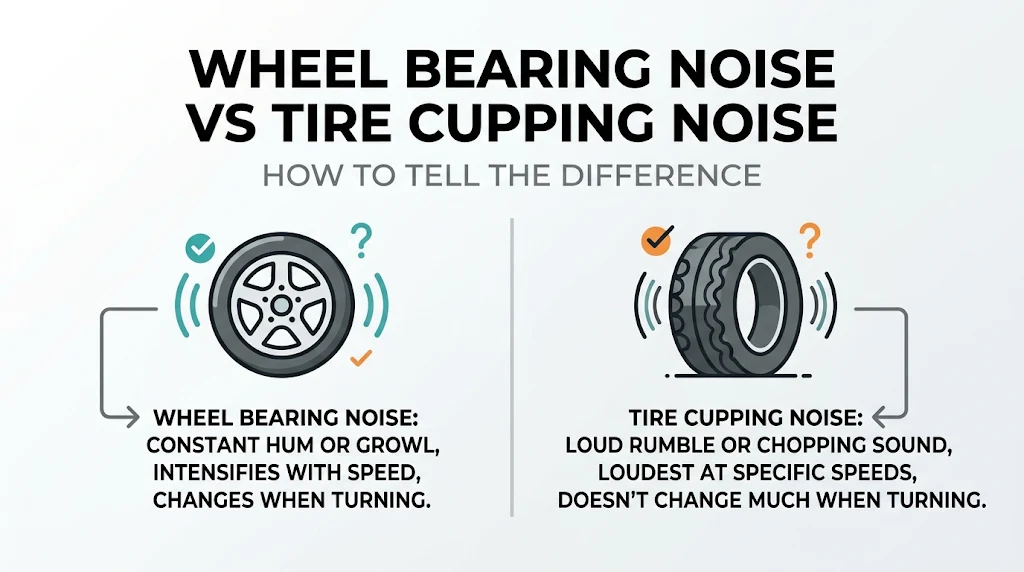
There is few things more frustrating for a driver than an unidentifiable mechanical drone echoing through the cabin at highway speeds. You grip the steering wheel tighter, turn down the radio, and try to isolate the sound. Is it a deep, metallic growl coming from the axle, or is it a rhythmic, thumping hum vibrating up through the floorboards?
Two of the most notorious culprits behind persistent road noise are failing wheel bearings and tire cupping (also known as scalloping or heel-toe wear). Because both issues manifest as loud, speed-dependent humming or buzzing sounds, they are frequently misdiagnosed by DIYers and even professional technicians. Replacing an expensive wheel hub assembly only to realize the noise persists because of a destroyed set of tires is an expensive and preventable mistake.
In this comprehensive guide, we will break down the mechanics, acoustic signatures, and diagnostic testing procedures to help you definitively tell wheel bearing noise apart from tire cupping noise—saving you time, money, and guesswork.
1. Anatomy of the Sound: Understanding How Road Noises Form
Before diving into the specifics of each failure, it helps to understand how rolling components generate acoustic energy inside a moving vehicle.
When your vehicle is in motion, every component attached to the suspension and drivetrain vibrates at specific frequencies. These vibrations travel through the steering knuckle, control arms, suspension bushings, and unibody structure, ultimately entering the cabin as airborne noise.
-
Wheel Bearings rely on precision-machined steel balls or tapered rollers rotating inside hardened steel races. When a bearing begins to pit, spall, or lose lubrication, microscopic metal-on-metal friction generates a high-frequency acoustic wave that presents as a constant metallic drone or roar.
-
Tire Cupping occurs when specific tread blocks wear unevenly in a concave, scalloped pattern around the circumference of the tire. As these deformed tread blocks slap against the pavement at high rotational speeds, they act like a siren, creating a rhythmic, frequency-modulated thumping noise.
Pro Tip: Always diagnose road noise with the windows rolled up and the climate control fan turned off. Try to determine whether the sound changes pitch when you drive over freshly paved asphalt versus coarse, weathered concrete. Tire cupping noise often changes drastically based on surface texture, whereas a failing wheel bearing drone remains relatively constant regardless of pavement quality.
2. Wheel Bearing Failure: The Mechanical Growl
A wheel bearing’s sole purpose is to allow the wheel assembly to rotate smoothly with minimal friction while supporting the entire weight of the vehicle. Modern sealed hub assemblies are engineered to last well over 100,000 miles, but premature failure can be triggered by potholes, curb strikes, oversized aftermarket wheels, or water contamination.
Acoustic Characteristics of a Bad Wheel Bearing
-
Constant Metallic Hum/Growl: It sounds remarkably like an airplane propeller engine starting up or flying alongside your car.
-
Speed-Dependent Pitch: The frequency and volume of the sound rise and fall in direct proportion to vehicle speed. It typically becomes noticeable around 30 to 40 mph and peaks at highway speeds (60–75 mph).
-
Load Sensitivity (The Cornering Test): This is the ultimate telltale sign. When you load and unload the bearing by gently weaving left and right across an open lane, the sound will change. Turning sharply to the left shifts the vehicle’s weight onto the right side tires and bearings. If the growling noise intensifies during a left turn, your right front wheel bearing is failing. If the noise quiets down, you are unloading that specific bearing.
3. Tire Cupping (Scalloping): The Rhythm of Tread Deformity
Tire cupping is rarely a tire defect; rather, it is almost always a symptom of an underlying suspension or alignment failure. When a shock absorber or strut loses its damping efficiency, the wheel loses continuous contact with the road surface, causing it to bounce or hop microscopically at high speeds. Each time the tire leaves and re-enters contact with the asphalt, a localized patch of tread experiences excessive friction and uneven scrubbing, creating a scalloped dip in the rubber.
Acoustic Characteristics of Tire Cupping
-
Rhythmic Thumping or Chopping: Unlike the smooth, continuous roar of a bearing, tire cupping sounds like a helicopter blade chopping the air or a heavy off-road mud tire mounted on a standard passenger sedan.
-
Pitch Tied to Wheel Speed: The frequency of the thumping increases as you accelerate and decreases as you slow down, which frequently leads drivers to confuse it with a failing bearing.
-
Vibration in the Steering Wheel or Floor: Because the contact patch is deformed, you will often feel a low-frequency rumble or pulsation through the steering wheel or seat cushion at moderate speeds (25–50 mph).
4. The Ultimate Diagnostic Checklist: 5 Tests to Tell Them Apart
When visual inspection isn’t enough, systematic diagnostic testing will reveal the true source of your cabin noise. Use this step-by-step framework in a safe, controlled environment:
Test 1: The S-Curve Load Test (Isolates Wheel Bearings)
-
Find a straight, safe, multi-lane stretch of empty road or highway.
-
Accelerate to a steady 45–50 mph where the noise is clearly audible.
-
Gently and safely weave your vehicle back and forth (like a race car warming up its tires).
-
Analysis: If the noise gets louder when turning right and quieter when turning left, your left-side wheel bearing is bad. If the noise gets louder when turning left and quieter when turning right, your right-side wheel bearing is bad. Note: Tire cupping noise does not change significantly or predictably during an S-curve weight transfer.
Test 2: The Tactile Hand Sweep (Isolates Tire Cupping)
-
Safely park your vehicle, set the emergency brake, and turn off the engine.
-
Run your bare palm flat across the tread face of each tire, stroking forward and backward.
-
Analysis: A healthy tire tread will feel smooth and uniform. A cupped tire will feel like a series of waves, steps, or fish-scales. If your hand catches on abrupt steps or scalloped high-and-low spots between tread blocks, you have confirmed tire cupping.
Test 3: The Manual Spin and Shake Test (Jack Stand Method)
-
Lift the suspected corner of the vehicle off the ground using a hydraulic floor jack and secure it with a rated jack stand.
-
Grasp the tire firmly at the 12 o’clock and 6 o’clock positions and rock it back and forth, then repeat at the 9 o’clock and 3 o’clock positions.
-
Spin the wheel aggressively by hand while lightly resting your fingertips on the coil spring or suspension strut housing.
-
Analysis:
-
If there is play or looseness when rocking the wheel at 12 and 6 o’clock, the wheel bearing or ball joint is worn.
-
If you feel a distinct mechanical vibration or grinding sensation humming through the coil spring while spinning the wheel, the wheel bearing internal races are damaged.
-
If the wheel spins quietly and feels tight, but your hand check of the tread revealed scalloping, the issue is strictly tire-related.
-
Test 4: The Speed-Versus-Frequency Ratio Check
Pay close attention to the exact cadence of the sound at low speeds (e.g., coasting down from 20 mph to a stop):
-
Wheel Bearing: Produces a high-speed rotational hum that scales continuously down to a low-pitched whir before stopping.
-
Tire Cupping: Produces a distinct “wompy-wompy-wompy” or thumping frequency that slows down into distinct individual slaps against the road surface just before the vehicle comes to a complete halt.
Test 5: The Cross-Rotation Test (The Definitive Confirmation)
If you suspect tire cupping but want 100% verification before spending money on suspension work or new tires:
-
Rotate your tires from front-to-back or side-to-side (following your vehicle’s proper rotational pattern).
-
Take the car for a test drive.
-
Analysis: If the noise and vibration migrate to a different part of the vehicle (e.g., moving from the front dashboard area to the rear floorboards), you have definitively proven that the noise originates from the tires, not the wheel bearings.
5. Common Pitfalls and Diagnostic Mistakes to Avoid
Even experienced mechanics occasionally misdiagnose these symptoms. Avoid these costly diagnostic blunders:
-
Replacing Bearings Based Solely on Noise: Never replace a wheel hub assembly without performing the jack-stand spin test or checking for play. Changing a bearing that isn’t broken leaves the root cause unaddressed.
-
Ignoring the Root Cause of Cupping: If you replace cupped tires without fixing worn-out shock absorbers, struts, or correcting a severe suspension alignment issue, your new tires will cup and ruin themselves within 5,000 to 10,000 miles.
-
Confusing Brake Rotor Rust with Bearings: A warped or heavily rusted brake rotor rubbing against a brake pad retainer clip can create a squeal or scrape, but it is tied to wheel rotation speed and braking application, not suspension loading.
-
Overlooking CV Axles and Differentials: A failing constant velocity (CV) joint or differential gear wear can also generate humming or clicking noises. However, CV joints typically click or pop during tight low-speed turns, whereas bearings hum continuously.
6. Frequently Asked Questions (FAQs)
Can a bad alignment cause tire cupping?
Yes, extreme toe-out or camber misalignment causes the tires to drag sideways across the pavement rather than roll cleanly. Combined with weak shocks, this scrubbing action rapidly creates scalloped wear patterns and loud road noise.
Is it safe to drive with a bad wheel bearing?
Driving on a severely worn wheel bearing is dangerous. As the internal rollers and races degrade, excessive heat builds up, and the bearing can eventually seize entirely or cause the wheel assembly to separate from the vehicle steering knuckle while driving at high speed. Replace a failing bearing immediately.
Can a bad wheel bearing cause tire cupping?
Indirectly, yes. If a wheel bearing develops severe internal play and looseness, it allows the entire wheel hub assembly to wobble slightly. This uncontrolled motion prevents the shock absorber from properly controlling the tire’s contact patch, which can initiate cupping wear on that specific tire.
How much does it cost to fix tire cupping vs. wheel bearing replacement?
-
Tire Cupping Correction: Replacing a pair of shock absorbers/struts typically costs $400 to $900 including professional wheel alignment. (Note: Severely cupped tires must also be replaced to eliminate the noise).
-
Wheel Bearing Replacement: Modern sealed hub assemblies typically cost $250 to $600 per corner including parts and labor, depending on whether your vehicle is front-wheel drive, rear-wheel drive, or all-wheel drive.
Conclusion & Next Steps
Differentiating between wheel bearing noise and tire cupping noise comes down to analyzing the acoustic signature and performing targeted diagnostic tests. A wheel bearing produces a constant, speed-sensitive metallic growl that changes pitch when you load and unload suspension corners through an S-curve. In contrast, tire cupping produces a rhythmic thumping sound caused by deformed tread blocks, which can be verified by running your hand across the tread or performing a tire rotation test.

Benjamin Grey is an automotive engineer and writer at Car Parts Advisor. With years of experience in the automotive industry, he shares expert advice on car parts, maintenance, and repairs to help car owners keep their vehicles running smoothly.