
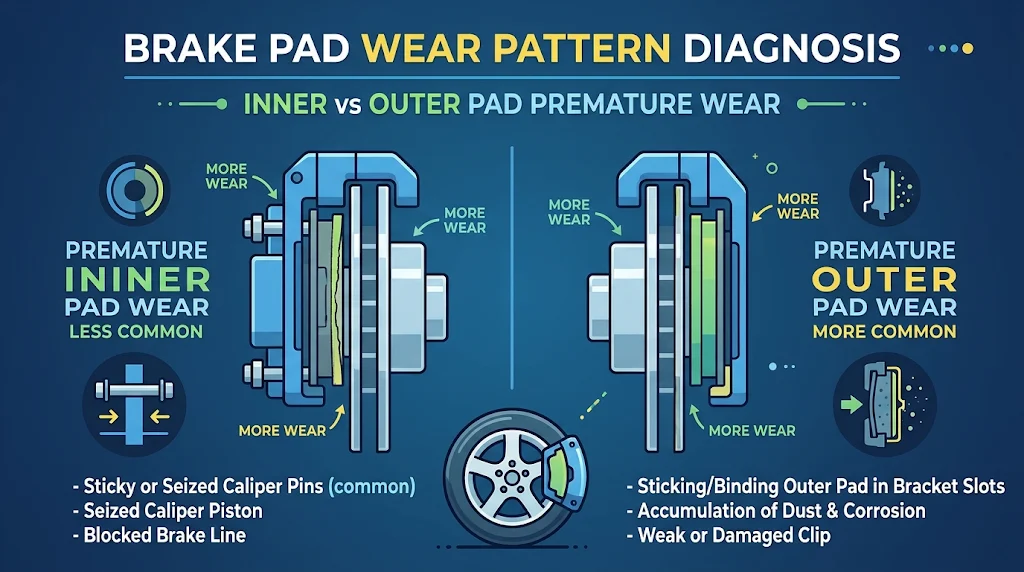
Every time you press your foot down on the brake pedal, you are commanding a complex interplay of hydraulic pressure, friction chemistry, and mechanical leverage to halt a multi-thousand-pound vehicle in seconds. Under normal conditions, both brake pads on a single wheel should wear down at a relatively balanced rate. However, when you lift your vehicle on a jack during a routine tire rotation and discover that the inner brake pad is paper-thin while the outer pad looks nearly brand-new—or vice versa—you are looking at a diagnostic red flag.
Uneven brake pad wear is never just a cosmetic quirk or a minor annoyance; it is a mechanical symptom pointing directly to a compromised braking component. Ignoring this warning sign can lead to catastrophic brake failure, warped brake rotors, compromised handling dynamics, and costly repeat repairs.
In this comprehensive guide, we will break down the mechanics of inner versus outer premature brake pad wear, explore the root causes, walk through a step-by-step diagnostic workflow, highlight common repair mistakes, and answer critical questions to keep your braking system performing at its absolute peak.
1. Anatomy of a Disc Brake: How Inner and Outer Pads Function
Before diagnosing why pads wear unevenly, you must understand how modern automotive disc brakes are designed to distribute clamping force.
Most consumer passenger vehicles utilize floating-pin calipers (sliding calipers) rather than expensive, multi-piston fixed calipers. In a floating caliper system, a single hydraulic piston is housed on the inner side of the brake rotor. When hydraulic fluid pressure surges from the master cylinder, it pushes the inner piston outward, forcing the inner brake pad directly against the interior surface of the rotor.
Simultaneously, the hydraulic pressure causes the entire caliper body to slide inward on lubricated guide pins (slide pins). This sliding action pulls the outer brake pad against the exterior surface of the rotor.
The Golden Rule of Braking Physics: For equal pad wear to occur, the caliper’s sliding mechanism must be completely friction-free, and the hydraulic clamping force must distribute equally across both friction surfaces. Any mechanical binding disrupts this equilibrium.
2. Inner Pad Premature Wear: The Most Common Culprit
If your inner brake pad wears down significantly faster than the outer pad, you are witnessing the single most frequent mechanical failure mode in floating-caliper braking systems.
Root Cause 1: Caliper Slide Pin Seizure (The #1 Offender)
Caliper slide pins (guide pins) live in a harsh environment exposed to road salt, water, brake dust, and high temperatures. Over time, the protective rubber boots degrade or tear, allowing moisture to enter and corrode the metal pins inside their brackets.
-
The Mechanism: When a slide pin seizes or binds, the caliper cannot “float” or slide laterally. When you step on the brakes, the inner piston pushes the inner pad against the rotor. However, because the caliper body is stuck, it cannot pull the outer pad inward with equal force. The inner pad does 100% of the stopping work, wearing out in a fraction of its normal lifespan while the outer pad remains thick.
-
Real-World Analogy: Think of a sliding drawer that has gotten warped on one side. If you push the left side, it cocks sideways and jams instead of sliding smoothly across the track.
Root Cause 2: Caliper Piston Binding
Sometimes, the inner piston itself fails to retract properly inside its bore due to internal corrosion or damaged square-cut rubber piston seals. If the piston remains partially pressurized or fails to slide back when you release the brake pedal, the inner pad drags continuously against the rotor, causing rapid friction material wear and severe overheating.
Pro Tip: The “Slide Pin Check”
Whenever you perform a brake job, never skip servicing the slide pins. Clean them thoroughly with a wire brush, inspect the rubber boots for tiny micro-cracks, and lubricate them using high-temperature silicone brake grease. Never use petroleum-based lubricants (like chassis grease), as they swell and destroy rubber boots.
3. Outer Pad Premature Wear: Less Common, Highly Revealing
While inner pad wear is usually a sliding-pin issue, premature wear concentrated exclusively on the outer brake pad points to a different set of mechanical bottlenecks.
Root Cause 1: Caliper Bracket and Abutment Clip Binding
Brake pads ride on metal abutment clips (hardware clips) inside the cast-iron caliper bracket. If these clips accumulate heavy rust build-up underneath them—a phenomenon known as “rust jacking”—the rust expands and pinches the ends of the brake pad backing plates.
-
The Mechanism: If the outer brake pad binds tightly in the bracket channels due to corrosion, it may get stuck in a partially applied position, pressing against the spinning rotor even when your foot is off the brake pedal. This constant drag causes rapid outer pad wear, glazing, and severe thermal spiking.
Root Cause 2: Deformed or Bent Caliper Brackets
If a vehicle has suffered an impact (such as hitting a deep pothole at high speed, curb check, or suspension collision), the heavy cast-iron caliper bracket can distort by fractions of a millimeter. This microscopic misalignment angles the outer pad so that its leading edge makes heavy contact with the rotor while the rest of the pad floats free.
4. Step-by-Step Diagnostic Workflow for Uneven Wear
When you pull your wheels off to inspect a suspect brake corner, follow this rigorous diagnostic checklist to pinpoint the exact failure point before throwing new parts at the vehicle.
5. Common Pitfalls and Mistakes to Avoid
DIYers and even professional technicians occasionally make critical shortcuts during brake service that guarantee repeat premature wear. Avoid these common mistakes:
-
Mistake 1: Slapping New Pads on Seized Hardware. Replacing worn-out pads without freeing up sticky slide pins or replacing rusted abutment clips guarantees your new pads will wear out unevenly within 5,000 miles.
-
Mistake 2: Using the Wrong Grease. Applying standard multi-purpose chassis grease or petroleum jelly to slide pins or pad ears. Petroleum breaks down under braking heat and turns into a sticky glue that seizes the brakes.
-
Mistake 3: Ignoring Rotor Parallelism and Heat Damage. Uneven pad wear almost always causes localized hot spots and uneven rotor thickness variation. Putting new pads onto an un-machined or warped rotor will cause severe steering wheel vibration and pulsation.
-
Mistake 4: Forgetting to Clean Pad Ears. Brake pads should slide effortlessly in their bracket channels with finger pressure. If you have to hammer them into place, thermal expansion will cause them to bind immediately.
6. Frequently Asked Questions (FAQ)
Is it safe to drive with unevenly worn brake pads?
No. Severely uneven wear means one pad is doing all the work while the other is useless, drastically increasing your stopping distance. Furthermore, once the thinner pad wears down to its steel backing plate, it will score and destroy your brake rotor, potentially locking up the wheel.
Can a bad brake hose cause inner pad wear?
Yes. An aging, collapsed flexible rubber brake line can act like a one-way check valve. Fluid enters under pressure to apply the brakes, but fails to return smoothly when you lift your foot, causing the inner piston to drag and wear out the inner pad prematurely.
Should I replace both calipers if only one side has uneven wear?
While you do not strictly need to replace calipers in axle pairs if only one is failing, it is considered best practice. If one caliper slide pin seized due to corrosion, the opposite side’s pins are exposed to the same environmental wear and will likely fail soon.
How often should brake slide pins be serviced?
Brake slide pins should be cleaned and re-greased at every other brake pad change (roughly every 30,000 to 50,000 miles), or annually if you live in regions that salt roads during winter months.
Conclusion
Diagnosing inner versus outer brake pad premature wear requires looking beyond the consumable friction material and evaluating the entire mechanical ecosystem of the caliper, slide pins, brackets, and hydraulics. By identifying whether your binding is caused by a seized slide pin, rusted abutment hardware, or a stuck hydraulic piston, you can fix the root cause rather than treating the symptoms.
Don’t wait until your brakes start grinding metal-on-metal. Inspect your pad wear patterns during every tire rotation, service your sliding hardware religiously, and ensure your braking system operates with clinical precision.

Benjamin Grey is an automotive engineer and writer at Car Parts Advisor. With years of experience in the automotive industry, he shares expert advice on car parts, maintenance, and repairs to help car owners keep their vehicles running smoothly.