
Meta Title: Quick Strut vs. Bare Strut: Why Complete Assemblies Save DIYers Money Meta Description: Compare quick struts vs. bare struts for your next DIY suspension repair. Discover why complete assemblies save time, labor, and hidden costs.
Quick Strut vs. Bare Strut: Why Complete Assemblies Save DIYers Money
If you have ever experienced a clunking noise when going over speed bumps, noticed your car nose-diving during hard braking, or felt every single crack in the asphalt travel straight up your spine, your vehicle is screaming for a suspension refresh. When it comes time to replace your struts, you will immediately face a critical fork in the road: Should you buy a bare strut or a fully pre-assembled “quick strut”?
At first glance, bare struts look exceptionally budget-friendly. They carry a lower sticker price, making them a tempting choice for any DIYer looking to pinch pennies. However, automotive repair economics are rarely straightforward.
In this comprehensive guide, we will break down the structural differences between quick struts and bare struts, examine the hidden financial and labor costs of both options, and explain why complete assemblies almost always save DIYers time, stress, and money in the long run.
1. Understanding the Anatomy: Quick Strut vs. Bare Strut
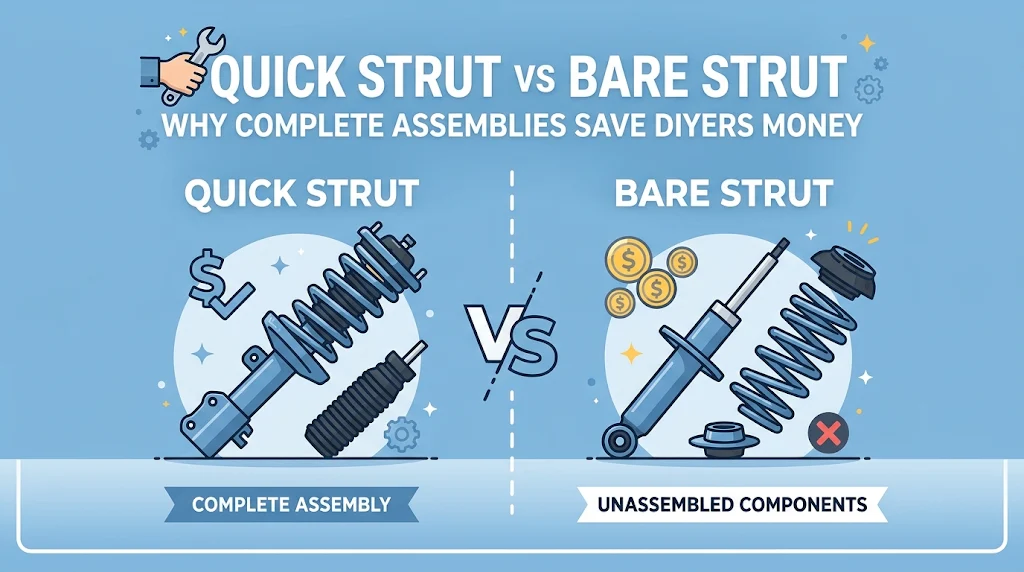
Before analyzing costs, let us clarify what you are actually buying. A modern MacPherson strut suspension is not a single part; it is an integrated modular assembly designed to support the vehicle’s weight, dampen vibrations, and maintain wheel alignment.
The Bare Strut (Loaded Damper)
A bare strut consists of the hydraulic damper cartridge, the piston rod, and the lower mounting brackets. It does not include:
-
The upper coil spring
-
The upper mounting plate / strut mount
-
The rubber spring isolators
-
The dust boot and bump stop
To install a bare strut, you must salvage these existing components from your old vehicle suspension and transfer them over, or purchase them separately.
The Quick Strut (Complete Assembly)
A quick strut (often sold under brand names like Monroe Quick-Strut or FCS Complete Strut Assemblies) is an all-in-one, ready-to-install unit. It comes pre-assembled straight out of the box with a brand-new coil spring, upper strut mount, bearing plate, boot, bump stop, and the damper itself.
Pro Tip: Because the coil spring is pre-matched to the damper unit’s exact damping rates, a quick strut eliminates the guesswork of whether your old, sagging springs can handle a brand-new damper.
2. The Hidden Labor Cost: The Spring Compressor Dilemma
The single biggest argument against bare struts for the average DIYer revolves around one terrifying piece of equipment: the external coil spring compressor.
To replace a bare strut, you must remove the entire assembly from your car, place it on a workbench, attach two heavy-duty mechanical coil spring compressors to the spring coils, and crank them down until the spring tension is fully relieved from the top mount.
Why This is a Danger Zone
-
Massive Stored Energy: A compressed coil spring holds hundreds (sometimes thousands) of pounds of kinetic energy. If a clamp slips or fails, the spring can violently decompress, resulting in severe personal injury, facial trauma, or property damage.
-
Tooling Expenses: While you can rent spring compressors for free from most auto parts stores (via tool deposit programs), standard rental units are often clumsy, frustrating to align, and poorly maintained. Buying a professional-grade wall-mounted spring compressor will cost you anywhere from $150 to $500+.
3. Financial Breakdown: Upfront Cost vs. Total Cost of Ownership
Let us look at a real-world financial comparison for a typical mid-size sedan (e.g., a 2012 Toyota Camry) to see where your hard-earned money actually goes.
| Expense Category | Bare Strut Route | Quick Strut Route |
| Part Cost (Per Corner) | $65 – $90 | $120 – $170 |
| New Mounts & Hardware | $40 – $70 (Required if old are worn) | $0 (Included pre-assembled) |
| New Coil Springs | $50 – $90 (If sagging/cracked) | $0 (Included pre-assembled) |
| Specialty Tool Rental | $0 – $50 (Deposit/Purchase) | $0 (None needed) |
| Time Investment | 2.5 to 4 hours per corner | 45 minutes to 1.5 hours per corner |
| Total Estimated Cost (Pair) | $220 – $300+ | $240 – $340 |
At first glance, the bare strut looks slightly cheaper. However, once you factor in that older upper mounts and rubber isolators are almost always degraded, dry-rotted, or squeaky, you will have to buy them separately anyway. Suddenly, the bare strut price matches—or exceeds—the price of a quick strut.
4. Safety, Quality, and Long-Term Reliability
Saving money upfront means nothing if your car handles poorly or fails prematurely. Consider these crucial operational factors:
-
Component Fatigue: Springs sag over time due to metal fatigue and vehicle weight. Reusing a 10-year-old spring on a brand-new damper creates an uneven suspension geometry, leading to premature tire wear and a subpar ride height.
-
Corrosion and Seized Hardware: Upper strut mounts often accumulate road salt and rust. Trying to disassemble a corroded top nut without pneumatic impact tools can turn a Saturday afternoon job into a multi-day nightmare involving angle grinders and torch heating.
-
Peace of Mind: With a quick strut, every single wear component in the assembly is brand new. You bolt it in, torque everything to factory specs, and drive away knowing you won’t have to tear the suspension apart again next year because a 12-year-old rubber mount tore.
5. Common Pitfalls and Mistakes to Avoid
Even with the convenience of quick struts, DIYers frequently make avoidable mistakes that compromise their suspension upgrade.
-
Skipping the Wheel Alignment: Whenever you unbolt a strut from the steering knuckle, your vehicle’s camber and toe geometry shift. Always schedule a professional wheel alignment immediately after installation. Skipping this will chew through a brand-new set of tires in less than 5,000 miles.
-
Using Impact Wrenches on the Top Nut: While quick struts come pre-torqued, if you ever need to tighten center top nuts, avoid spinning them wildly with an impact gun without holding the strut shaft. Doing so can spin the internal piston and destroy the valving.
-
Forgetting to Preload the Suspension: Never torque suspension bolts while the vehicle is lifted in the air with the wheels hanging. Lower the car back down to the ground under its own weight before final-torquing control arms and lower mounting bolts to prevent premature bushing destruction.
Frequently Asked Questions (FAQ)
1. Do I need to replace all four struts at once?
Not necessarily. If your rear struts are still holding dampening pressure and showing no signs of fluid leaks, you can replace them in axle sets (both fronts together, or both rears together). However, replacing all four ensures balanced handling and ride quality.
2. Can I install quick struts myself without professional tools?
Yes! That is the primary advantage of quick struts. Because the spring is pre-compressed and safely contained, you only need standard hand tools (sockets, wrenches, a torque wrench, and a jack/jack stands). You do not need dangerous coil spring compressors.
3. Are budget quick struts safe to buy?
Stick to reputable automotive brands (such as Monroe, KYB, Gabriel, or FCS). Extremely cheap, unbranded online marketplace struts often feature inferior damping valving, noisy mounts, and substandard steel that can sag within months.
4. How long do quick strut assemblies typically last?
Quality aftermarket quick strut assemblies generally last between 50,000 to 100,000 miles, depending on road conditions, driving habits, and climate.
Conclusion
When weighing Quick Struts vs. Bare Struts, the choice for DIY mechanics is clear. While bare struts carry a lower initial price tag, the hidden costs of extra parts, dangerous spring compressors, rusted hardware, and doubled labor hours quickly erode any savings.

Benjamin Grey is an automotive engineer and writer at Car Parts Advisor. With years of experience in the automotive industry, he shares expert advice on car parts, maintenance, and repairs to help car owners keep their vehicles running smoothly.


