
Brake pads are the most frequently replaced component in your entire braking system — and for good reason. Every time you slow down, a pair of friction pads is being pressed against a spinning metal rotor, converting thousands of pounds of momentum into heat. That process works flawlessly, but it doesn’t come for free. The pads wear down with every stop, and eventually, they need to be replaced.
The question most drivers have isn’t whether brake pads wear out — it’s when. And just as importantly: how do you know when you’re getting close?
This guide answers both questions in full. You’ll learn exactly how long brake pads typically last, what factors make them wear faster or slower, the warning signs that tell you replacement is overdue, and what happens if you ignore those signs. If you’re at or near replacement time, we’ll point you to a trusted option on Amazon that ships fast and fits a wide range of vehicles.
How Long Do Brake Pads Last on Average?
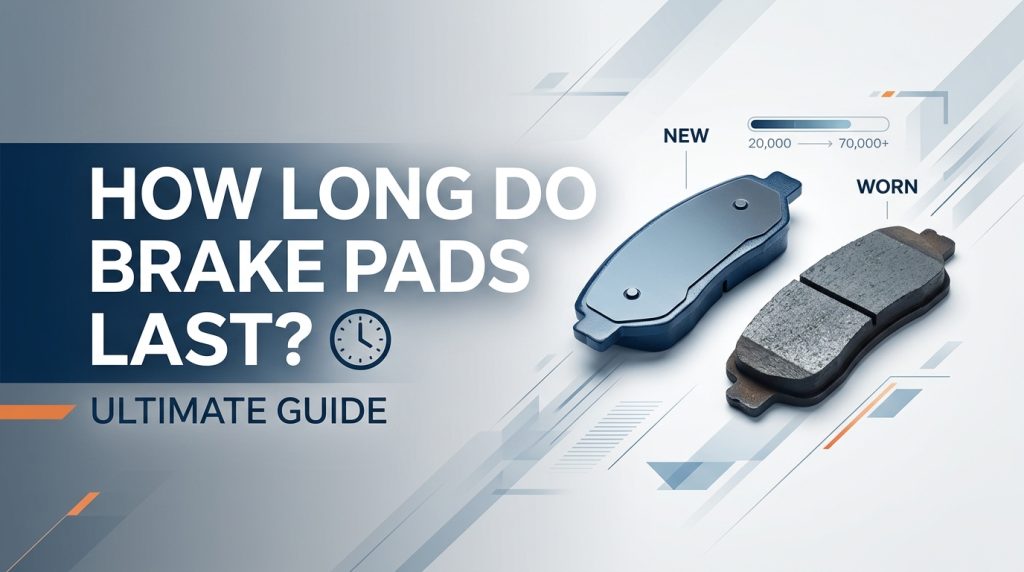
The honest answer: it depends. But the practical range for most drivers is 25,000 to 65,000 miles, with the sweet spot for an average daily driver landing somewhere around 40,000 to 50,000 miles per set.
That’s a wide range, and it’s wide for a reason. Brake pad lifespan is almost entirely determined by how, where, and how much you drive — not just the quality of the pad itself. A premium ceramic pad installed on a highway commuter’s vehicle can outlast a budget pad on a city taxi by a factor of three or more, simply because of the difference in brake usage.
Here’s what the range looks like in practice:
25,000–35,000 miles — typical for high-friction driving: urban commuters making dozens of stops per trip, delivery drivers, ride-share operators, mountainous regions, or drivers with aggressive braking habits.
40,000–50,000 miles — the average for a mix of city and highway driving with moderate braking habits. This is where most daily drivers land.
55,000–70,000 miles — achievable for predominantly highway drivers, light-footed brakers, or vehicles that see regenerative braking assistance (hybrids and EVs), which reduces physical pad wear significantly.
Rear brake pads typically last longer than front pads on front-wheel-drive vehicles. Front brakes handle approximately 70% of total braking force due to forward weight transfer during deceleration, so they wear faster. On rear-wheel-drive trucks and SUVs, the wear distribution is more even, but the fronts still typically lead.
What Makes Brake Pads Wear Faster?
Understanding the factors that accelerate pad wear helps you set realistic expectations — and make smarter choices about when to check and when to replace.
Driving environment. City driving is the single biggest wear accelerator. Stop-and-go traffic means your brakes are engaged continuously throughout every commute. A driver who covers 15,000 miles per year entirely in urban traffic will wear through pads far faster than one who covers the same distance on open highways. If you live in a densely populated area with heavy traffic, plan for the lower end of the mileage range.
Driving style. Hard braking from high speeds generates exponentially more heat and friction than gradual, anticipated stops. Drivers who brake late and firmly — either out of habit or necessity — wear pads two to three times faster than smooth, anticipatory brakers. One of the most effective ways to extend pad life is simply to increase following distance and use engine braking more consistently.
Vehicle weight. Heavier vehicles carry more kinetic energy at any given speed, which means more work for the brakes on every stop. A loaded pickup truck or a full-size SUV carrying seven passengers and cargo will wear through pads noticeably faster than a compact sedan. If you regularly haul or tow, factor that into your replacement timeline.
Brake pad compound. Organic (NAO) pads — the cheapest option — wear the fastest. Semi-metallic pads are durable but harder on rotors. Ceramic pads offer the best balance of lifespan and rotor-friendliness for daily driving. Upgrading to a quality ceramic pad when replacing doesn’t just improve performance — it genuinely extends the time between replacements.
Terrain. Hilly and mountainous areas force more frequent and more sustained braking than flat terrain. Drivers who regularly navigate steep grades — whether for commuting or recreation — should inspect pads more frequently than those in flat regions.
Brake caliper condition. A sticking or seized caliper piston keeps the pad in partial contact with the rotor even when you’re not braking, causing continuous friction that can wear a pad to nothing in a fraction of its normal lifespan. If one pad always wears faster than the corresponding pad on the opposite side, a sticking caliper is often the cause.
The Warning Signs You Need New Brake Pads
Your car communicates brake wear in several unmistakable ways. Here are the signals to watch — and listen — for, in order from early warning to urgent replacement.
1. Squealing or Squeaking
This is typically the first sign, and it’s intentional. Most brake pads include a small steel wear indicator tab that’s designed to contact the rotor and emit a high-pitched squeal when the pad material wears down to approximately 2–3mm remaining. Think of it as a built-in alarm.
The squeal often appears first thing in the morning on cold brakes, or during light braking at low speeds. If it goes away when you press the brakes harder, that’s the wear indicator — not a pad surface issue. Don’t dismiss it as “just moisture” or assume it will resolve itself. It won’t. It’s telling you the clock is running down.
2. Grinding or Growling
Once the squealing phase passes without action, the next sound is grinding — a harsh, metal-on-metal noise that occurs during braking. At this point, the pad material has worn completely through and the steel backing plate is making direct contact with the rotor.
This is an urgent situation for two reasons. First, your stopping distance is compromised — steel on steel provides dramatically less friction than a proper pad compound. Second, the rotor is being scored and damaged with every stop, turning a pad replacement job into a pad-and-rotor replacement job. Driving on grinding brakes costs significantly more money than addressing the squeal when it first appears.
3. Vibration or Pulsation in the Brake Pedal
A pulsating pedal — one that pulses rhythmically underfoot as you brake — usually indicates either uneven pad material deposits on the rotor surface or a rotor that has developed thickness variation from repeated heating and cooling cycles. Both conditions are accelerated by worn pads, because worn pads concentrate pressure on smaller contact areas and deposit material unevenly.
While the rotor may need attention alongside the pads in this scenario, replacing the pads is always part of the fix. Fresh pads on a freshly resurfaced or replaced rotor will eliminate the pulsation entirely.
4. Pulling to One Side During Braking
If your vehicle tracks straight normally but pulls left or right when you apply the brakes, one side’s brake pads are applying more force than the other. This is usually caused by uneven pad wear — one caliper has worn its pads down more than the opposite side — or a sticking caliper that’s keeping one side engaged more aggressively.
Either way, the pulling is a safety concern. Under hard braking, the imbalance becomes more pronounced and the vehicle can become difficult to control. Inspect and replace pads on both sides of the affected axle together — never replace pads on just one corner of an axle.
5. Brake Pedal Feels Soft or Spongy
A soft or spongy pedal that requires more travel before the brakes engage is usually a brake fluid issue — either air in the lines or fluid contaminated with moisture — but severely worn pads can also contribute to a longer pedal throw as the caliper pistons extend further to compensate for the reduced pad thickness.
If your pedal feel has changed noticeably — requiring more pressure to achieve the same deceleration — add a brake inspection to your immediate to-do list, not your eventual one.
6. Visible Wear Through the Wheel Spokes
On most vehicles, you can see the front brake pads through the wheel spokes without removing the wheel. Look for the flat friction material pressed against the outer face of the rotor. If the pad material looks thin — less than a quarter-inch, roughly the thickness of two stacked quarters — replacement is imminent.
This visual check takes 30 seconds and can be done in any parking lot. Make it a habit to glance at your pads every few thousand miles or when you wash the car.
7. Dashboard Warning Light
Many modern vehicles include an electronic brake pad wear sensor that illuminates a dashboard warning light when pads reach minimum thickness. If a brake warning light appears on your instrument cluster — distinct from the parking brake indicator, which is usually a “P” — treat it as immediate, not advisory.
What Happens If You Ignore Worn Brake Pads?
This is worth understanding clearly, because the consequences escalate quickly.
Stage 1 — Reduced stopping performance. Even before pads wear completely through, the reduced pad thickness means less friction material available for each stop. Stopping distances increase gradually, in a way that’s easy to miss day to day but measurable on any emergency stop.
Stage 2 — Rotor damage. Once the pad wears to the metal backing, the rotor begins to be scored and gouged with every stop. What would have been a $50–$80 pad replacement becomes a $150–$300 pad-and-rotor replacement. Every mile driven on metal-to-metal contact deepens the damage.
Stage 3 — Caliper damage. Severely worn pads allow the caliper piston to extend so far that it can become cocked in its bore, leading to uneven pad contact, a stuck caliper, and potential piston seal failure. Caliper replacement adds $100–$300 or more per corner to the repair bill.
Stage 4 — Brake failure. In the most extreme cases — driving for extended periods on completely worn pads — the caliper piston can punch through entirely, causing sudden, catastrophic loss of braking on that wheel. This is rare but not theoretical. It happens.
The pattern is consistent: every stage of delay turns a small, inexpensive maintenance job into a larger, more expensive one. And throughout that progression, stopping distances are increasing and vehicle safety is declining.
How to Check Your Brake Pads at Home
You don’t need to be a mechanic to monitor your brake pad wear. Here’s a simple inspection routine:
Visual check (without removing wheels): Look through the wheel spokes at the rotor and caliper. Find the pad — it’s the flat material sandwiched between the caliper and rotor. Anything less than 3mm (about 1/8 inch) of visible material means replacement is due immediately. Between 3–5mm means you’re getting close and should plan for replacement soon.
Listen during your next drive: Cold-start squeal on the first few stops that disappears as brakes warm up can be normal moisture burn-off. Persistent squealing across all operating temperatures, or squealing that gets louder rather than going away, is a wear indicator.
Feel during braking: Apply moderate, steady brake pressure from 30–40 mph on an empty road. The pedal should feel firm, progressive, and consistent. Any pulsation, sponginess, or pulling is a symptom that warrants inspection.
Check mileage: If you’re approaching 40,000–50,000 miles since your last pad replacement and haven’t had an inspection, schedule one.
Ready to Replace? Here’s a Top-Rated Option on Amazon
If your inspection tells you it’s time — or if you’re approaching the mileage window and want to be proactive — a quality replacement set is one click away.
👉 Shop Top-Rated Brake Pads on Amazon
This highly rated brake pad set delivers ceramic compound performance, quiet operation, and minimal dust at a price that makes staying on top of brake maintenance easy. With fast Prime shipping and a direct-fit design for a wide range of popular vehicles, there’s no reason to delay a job that directly affects your safety and your wallet.
How to Make Your Next Set of Brake Pads Last Longer
Once you’ve replaced your pads, a few habits can meaningfully extend the time before you need to do it again:
Increase following distance. More space ahead means more time to decelerate gradually rather than braking hard at the last moment. This single habit has more impact on pad life than almost any other factor.
Use engine braking. Downshifting on hills and long descents reduces the work your pads have to do. On automatics, using a lower drive range or manual mode achieves the same effect.
Anticipate stops. Lifting off the throttle early and coasting to a lower speed before braking uses kinetic energy dissipation rather than friction braking to slow you down.
Avoid riding the brakes. Light, sustained brake pressure on long descents keeps pads continuously hot without the cooling intervals that normal stop-and-go braking provides. Use engine braking instead and apply firm, brief brake pressure only when needed.
Bed new pads properly. After any pad replacement, perform 8–10 moderate stops from 35 mph with 30 seconds of cooling between each. This deposits an even layer of friction material on the rotor and prevents the uneven deposits that cause premature wear and pedal pulsation.
Final Thoughts
Brake pads are a consumable part of your vehicle — they will always eventually need replacement. The question is whether you replace them on your schedule, at a time and cost that’s convenient, or on the schedule that failing brakes dictate, which is always more expensive and potentially dangerous.
The warning signs are clear: squealing, grinding, pedal pulsation, pulling, and visible wear are all telling you the same thing. Listen to them early, act on them promptly, and your braking system will reward you with decades of safe, reliable stopping power.
👉 Shop Replacement Brake Pads on Amazon — Fast Shipping, Top-Rated
As an Amazon Associate, we earn from qualifying purchases. Prices and availability are subject to change.

Benjamin Grey is an automotive engineer and writer at Car Parts Advisor. With years of experience in the automotive industry, he shares expert advice on car parts, maintenance, and repairs to help car owners keep their vehicles running smoothly.


