
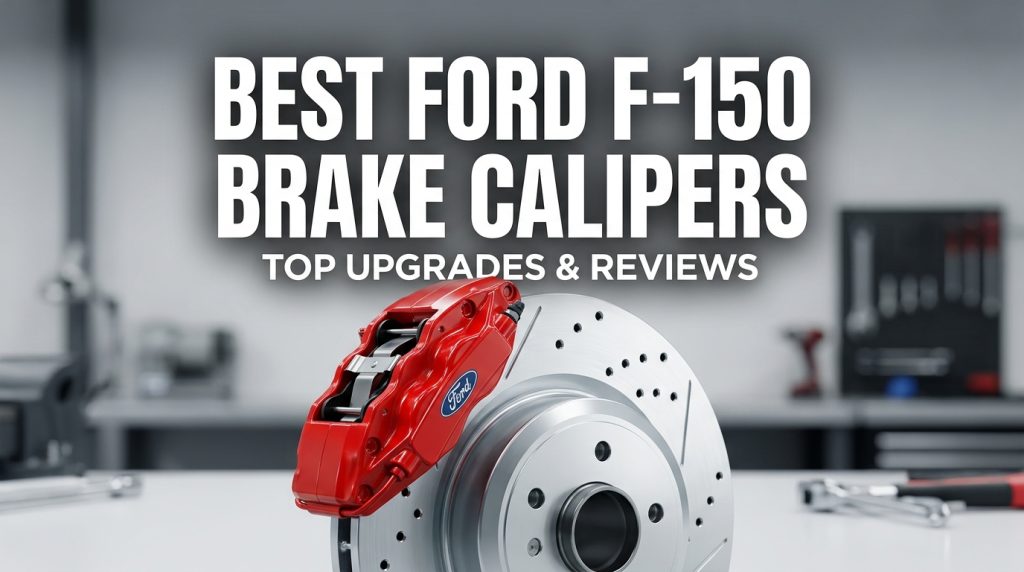
Best Brake Calipers for Ford F-150: Top Picks for Reliable Stopping Power
The Ford F-150 has been America’s best-selling vehicle for over four decades. It hauls, tows, off-roads, commutes, and does everything in between — and through all of it, the brake calipers are working every single time you slow down. They’re one of the most mechanically stressed components on the truck, and when they start to fail, the consequences range from annoying to genuinely dangerous.
Most F-150 owners think about brake pads and rotors when brake performance declines. Calipers get overlooked — right up until one seizes, starts leaking, or begins dragging a pad against the rotor 24 hours a day. At that point, the caliper isn’t just a brake problem anymore. It’s an overheating rotor, a destroyed pad, a pulling truck, and a repair bill that could have been a fraction of the cost with earlier attention.
This guide covers everything F-150 owners need to know about brake calipers — how they work, when they fail, what to look for in a replacement, and the best option available on Amazon right now for your truck.
👉 Shop F-150 Brake Caliper on Amazon
What a Brake Caliper Actually Does
Understanding what a caliper does makes it easier to recognize when one is failing. The brake caliper is the hydraulic clamp that sits over your rotor. When you press the brake pedal, brake fluid pressure travels through the lines to the caliper, pushing one or more pistons outward. Those pistons press the brake pads against both faces of the spinning rotor, creating the friction that slows and stops the truck.
When you release the pedal, the hydraulic pressure drops and the pistons retract slightly, releasing the pads from rotor contact. This retraction is critical — without it, the pads drag continuously against the rotor, generating heat, wearing the pad prematurely, and reducing fuel economy.
The caliper also houses the brake pads in a bracket, maintains proper pad alignment with the rotor, and — on rear calipers of trucks with integrated parking brakes — incorporates a mechanical actuator for the parking brake function.
It’s a simple mechanism in principle, but it operates under enormous pressure, heat, and contamination stress, and it’s expected to function precisely across tens of thousands of actuations spanning years of service.
How Ford F-150 Brake Calipers Fail
Calipers on F-150s fail in predictable ways, and recognizing the failure modes helps diagnose problems early.
Seized piston. The most common failure. The piston bore develops corrosion or rubber seal degradation over time, causing the piston to stick partially extended rather than retracting cleanly after pedal release. A seized piston means the pad is in continuous contact with the rotor — the truck will pull toward the seized side, the affected rotor will run hot, and pad wear on that corner will be dramatically accelerated. You may notice a burning smell after driving, particularly after highway use.
Leaking seal. The piston seal and dust boot prevent brake fluid from escaping and contaminants from entering the piston bore. When these seals degrade — from heat cycling, age, or physical damage — brake fluid leaks past the piston. A brake fluid leak on a caliper manifests as a wet, oily patch behind the wheel, a spongy brake pedal as system pressure drops, and eventually a complete loss of braking on that corner. Any visible brake fluid around the caliper body requires immediate attention.
Sticking slide pins. Floating caliper designs — which F-150s use — depend on two slide pins that allow the caliper body to move laterally as the pads wear down, keeping even pressure on both pad faces. If these pins corrode and seize, the caliper can no longer float, causing one pad to wear dramatically faster than the other and producing uneven rotor wear. This is often mistaken for a rotor problem when the real cause is a seized slide pin.
Cracked or damaged caliper body. Physical damage from road debris, off-road use, or severe corrosion in high-salt environments can crack the caliper body or bracket. A cracked body under hydraulic pressure is a catastrophic failure risk and requires immediate replacement.
Signs Your F-150 Needs New Brake Calipers
Several symptoms point specifically to caliper problems rather than pad or rotor wear. If you notice any of these on your F-150, a caliper inspection is warranted:
Pulling to one side during braking — not just during braking from high speed, but consistently pulling in the same direction every time you apply the brakes. This indicates one caliper is applying more force than the other, usually because of a seized piston or stuck slide pin.
Uneven pad wear between sides — if you inspect your pads and find significantly more wear on one side of an axle than the other, a sticking caliper on the heavily worn side is the most likely cause. Pads don’t wear unevenly on their own without a mechanical reason.
Constant dragging, burning smell, or hot wheel after driving — a seized piston keeps the pad pressed against the rotor even when cruising. Park after a normal drive and carefully hold your hand near (not on) each wheel. If one wheel is dramatically hotter than the others, the caliper on that corner isn’t releasing.
Spongy or soft brake pedal — while this often indicates air in the brake lines or contaminated fluid, a leaking caliper that’s allowing fluid to escape the hydraulic circuit will produce the same symptom and will worsen progressively.
Visible brake fluid behind the wheel — any wet, oily residue on the inner wheel surface or backing plate behind the rotor that isn’t grease or gear oil is almost certainly brake fluid. Trace it to the caliper.
Vehicle doesn’t roll freely — on a flat surface with the truck in neutral, a seized caliper creates noticeable drag. The truck may roll freely to one side but feel restrained. This is particularly noticeable when pushing the truck slightly by hand with the windows down — you can often feel the resistance.
What to Look for When Buying Replacement Calipers for an F-150
The F-150 has been produced across many generations with varying brake specifications, so fitment precision is the first and most important consideration when purchasing a replacement caliper.
Direct OEM fit for your generation. F-150 brake caliper specs vary across the 9th generation (1997–2003), 10th generation (2004–2008), 11th generation (2009–2014), 12th generation (2015–2020), and 13th generation (2021–present). Engine choice (3.5L EcoBoost, 5.0L, 2.7L, etc.) and trim level can further affect brake hardware specs. Always confirm year, engine, and configuration match before ordering.
Remanufactured vs. new. Remanufactured calipers — professionally rebuilt units using reconditioned cores — are the standard option for most replacement applications. Quality remanufactured calipers from reputable suppliers go through inspection, cleaning, new seal kits, new pistons where needed, and testing before leaving the facility. For most F-150 owners, a quality remanufactured caliper is indistinguishable in service from a brand-new unit and costs significantly less. New (non-remanufactured) calipers are available for applications where quality reman units aren’t, but for the F-150’s common brake sizes, reman is the practical choice.
Bracket included or bracket separate. Some caliper listings include only the caliper body; others include the mounting bracket. On F-150s, the bracket is typically reused unless it’s damaged or severely corroded. Confirm what’s included in the listing and whether your existing bracket is serviceable.
Hardware kit included. New slide pins, pin boots, and caliper bolts should ideally come with the replacement. Old slide pins that are corroded or worn will defeat the purpose of replacing the caliper — a new caliper on old, seized pins will fail prematurely in the same way the original did.
Pressure-tested and pre-filled. Some quality replacement calipers come pre-filled with brake fluid and pressure-tested before shipping. This simplifies installation and reduces the risk of introducing air into the system during bleeding.
Our Top Pick: Best Brake Caliper for Ford F-150
👉 Check Price & Fitment on Amazon
For F-150 owners looking for a reliable, direct-fit replacement caliper at a fair price point on Amazon, this listing delivers on the core requirements: precise Ford F-150 fitment across multiple model years, quality remanufactured construction with new seals and hardware, and the convenience of Amazon Prime shipping that gets you back on the road without a prolonged wait for parts.
The caliper is remanufactured to stringent specifications — the core is fully disassembled, cleaned, inspected, and rebuilt with new rubber seals, dust boots, and piston hardware. This process eliminates the degraded components that cause the original caliper failures described above while retaining the precision-machined caliper body that’s already sized and shaped correctly for your F-150’s specific brake architecture.
New slide pin hardware is included, which is the detail that separates a complete caliper job from one that will fail again in 18 months. Replacing the caliper body while leaving in corroded, binding slide pins puts a new component into the same failure condition as the old one. The included hardware ensures the full caliper assembly functions as designed — the body floats correctly, both pads make even contact with the rotor, and wear is distributed evenly across the full pad face.
Before purchase, use the fitment selector on the Amazon listing to confirm your specific F-150 year, engine configuration, and trim — this takes 60 seconds and eliminates any risk of ordering the wrong unit for your truck’s brake specification.
👉 Shop F-150 Brake Caliper on Amazon
Should You Replace One Caliper or Both?
This is a question almost every F-150 owner asks, and the answer depends on context.
Replace in pairs when: The failed caliper is more than 3–4 years old or has 50,000+ miles, the vehicle is used for towing or hauling (which accelerates caliper wear on both sides simultaneously), or the opposite caliper shows any signs of sticking, leaking, or uneven pad wear. Mismatched calipers — one new, one aged — can cause subtle braking imbalance that manifests as pulling or inconsistent pedal feel.
Replace one side when: The caliper failed due to a specific incident (physical damage, a contaminated brake line that affected only one side), the truck is relatively low mileage, and the opposite caliper passes a thorough inspection with clean, free-moving pistons and slide pins and no evidence of leaking seals.
When in doubt, replacing in pairs is the conservative and correct choice. The additional cost of the second caliper is modest compared to the labor you’ve already committed to, and it guarantees balanced braking performance across the axle from day one.
How to Replace a Brake Caliper on a Ford F-150: Overview
Caliper replacement on the F-150 is a DIY-accessible job for anyone comfortable with brake work. It’s more involved than a pad swap but well within reach for a careful, methodical approach.
Tools required: Floor jack and jack stands, lug wrench, socket set (metric and standard), torque wrench, line wrench set for the brake line fitting, brake fluid catch container, brake bleeder kit or helper for bleeding, brake cleaner, caliper grease, and new brake fluid.
The process:
Start by loosening the lug nuts before jacking the truck. Raise and support safely on jack stands — never work under a vehicle supported only by a floor jack. Remove the wheel. Before disconnecting the brake line, use a brake line clamp or close the master cylinder to minimize fluid loss. Use a flare nut (line) wrench — not a standard open-end wrench — to loosen the brake line fitting from the caliper to avoid rounding the soft fitting. Have a container ready to catch fluid.
Remove the caliper slide pin bolts, disconnect the brake line, and slide the caliper off the rotor. Transfer the pads to the new caliper or install new pads. Reconnect the brake line to the new caliper and torque to specification. Reinstall and torque slide pin bolts. Reinstall the wheel and torque lug nuts to spec in a star pattern.
Bleeding is mandatory after any caliper replacement. Air introduced during the line disconnection must be fully purged before the truck is driven. Start at the wheel farthest from the master cylinder (typically right rear) and work toward the closest (front left), bleeding until fluid flows clear and bubble-free at each corner. Confirm pedal firmness before moving the truck.
Top off the brake fluid reservoir to the MAX line with fresh DOT 3 or DOT 4 fluid as specified in your F-150 owner’s manual.
Maintaining Your F-150’s Brake Calipers for Maximum Life
A few maintenance habits dramatically extend caliper service life:
Flush brake fluid on schedule. Brake fluid is hygroscopic — it absorbs moisture from the atmosphere over time. Moisture lowers the fluid’s boiling point and accelerates internal corrosion in the caliper bore. Ford recommends brake fluid inspection every 2 years; most technicians recommend a full flush every 3 years or 45,000 miles regardless of visual appearance.
Lubricate slide pins during every brake service. When replacing pads, pull the slide pins, clean them thoroughly, inspect the pin boots for cracks, and apply fresh high-temperature caliper grease before reinstallation. This five-minute step prevents the seized pin failures that destroy pads and calipers prematurely.
Address brake pulls immediately. A truck that pulls under braking is already in the early stages of a caliper problem. Addressing it at the pulling stage — before the pad is destroyed and the rotor is scored — is always cheaper and simpler than addressing it after those secondary failures have occurred.
Inspect calipers visually with every tire rotation. With the wheel off for a rotation, spend 60 seconds looking at each caliper. Check for fluid seepage around the piston boot, look for uneven pad wear side-to-side, and manually wiggle the caliper to confirm the slide pins are moving freely. This quick check catches developing problems before they become expensive ones.
Final Verdict
The Ford F-150’s brake calipers are robust, well-designed components that last for many years under normal service conditions. But they do wear, they do fail, and when they do, the symptoms are unmistakable: pulling, dragging, uneven wear, fluid leaks, and a truck that simply doesn’t stop the way it should.
Replacing a failed caliper with a quality direct-fit unit — with new seals, new hardware, and proper bleeding — restores full braking performance immediately and comprehensively. It’s one of the most satisfying brake jobs on the F-150 because the improvement in pedal feel, straight-line braking, and overall confidence is immediate and obvious.
👉 Shop the Best Brake Caliper for Ford F-150 on Amazon
As an Amazon Associate, we earn from qualifying purchases. Prices and availability are subject to change.

Benjamin Grey is an automotive engineer and writer at Car Parts Advisor. With years of experience in the automotive industry, he shares expert advice on car parts, maintenance, and repairs to help car owners keep their vehicles running smoothly.


