
Picture this: You are cruising down the highway at 65 miles per hour, but your vehicle feels like it has a mind of its own. It drifts slightly to the left, then to the right, requiring constant micro-corrections at the steering wheel. You hit a small pothole, and a distinct, metallic clunk echoes through the cabin.
Many drivers immediately blame bad tires, uneven road surfaces, or a misaligned steering wheel. But more often than not, the invisible culprits causing this harrowing driving experience are your vehicle’s tie rods.
As a critical link between your steering rack and your front wheels, tie rods bear immense mechanical stress every time you turn the wheel or roll over a bump. When they wear out, your steering loses its precision, your tires wear prematurely, and—in worst-case scenarios—you can lose directional control entirely.
In this comprehensive guide, we will break down the anatomy of your steering system, contrast inner vs. outer tie rod symptoms, explore how to diagnose play, wandering steering, and alignment issues, and provide step-by-step troubleshooting techniques.
1. Understanding Your Steering Anatomy: Inner vs. Outer Tie Rods
Before diagnosing failure, it helps to understand what these components actually do. Modern vehicles utilize a rack-and-pinion steering system. The steering assembly features two primary linkage points on each front wheel: the inner tie rod and the outer tie rod.
-
Inner Tie Rods: These connect directly to the steering gear rack (or center link) on one end and thread into the outer tie rod on the other. They are typically protected by a rubber accordion boot that keeps out dirt and moisture. Because they move within the engine bay, their failure is often masked until severe play develops or the protective boot tears, allowing contaminants inside.
-
Outer Tie Rods: These are the pivot points visible right behind your front wheels. They connect the inner tie rod to the steering knuckle (the spindle attached to your wheel assembly). Outer tie rods look and function much like miniature ball joints, utilizing a ball-and-socket design that pivots as the suspension travels up and down and the wheels turn left and right.
Pro Tip: Think of your tie rods as the wrists of your car’s steering system. The inner tie rod acts like the base of the wrist, while the outer tie rod acts like the hand joint, translating your steering wheel inputs directly to the wheels with zero delay.
2. Outer Tie Rod Symptoms: The Frontline Indicators
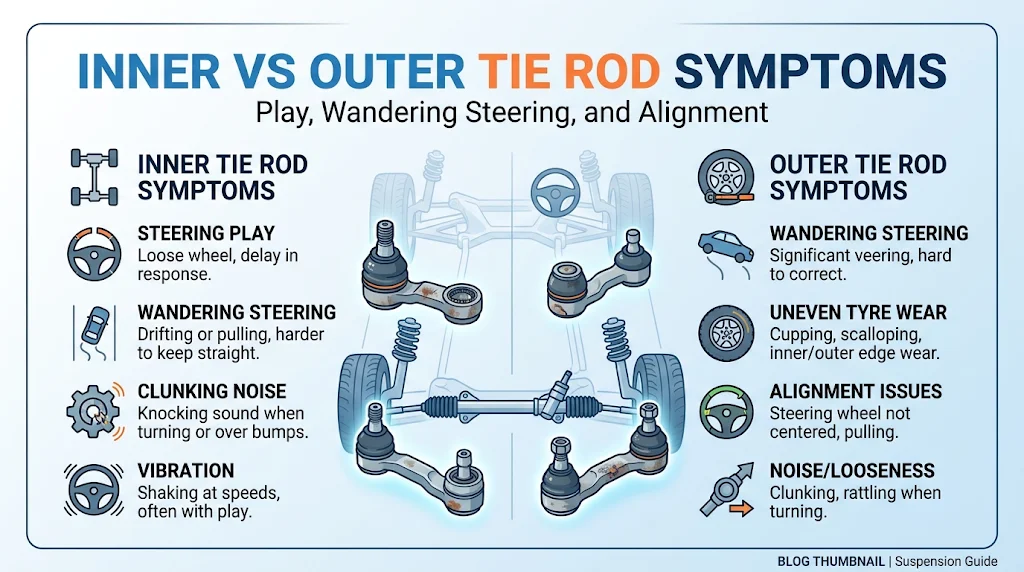
Because outer tie rods are exposed to the elements and bear the brunt of direct wheel impacts (potholes, curbs, debris), they tend to fail more frequently than inner tie rods. When an outer tie rod goes bad, the symptoms are usually distinct and localized to the front corners of the vehicle.
A. Tapping or Clunking Noises When Turning
A failing outer tie rod joint loses its internal tension, creating microscopic gaps in the ball-and-socket joint. When you turn the steering wheel from side to side while parked or at low speeds, or when you drive over a bump, the components bang against each other, producing a sharp clunk, click, or pop.
B. Uneven “Feathering” Tire Wear
If an outer tie rod has loose play, the wheel it controls will constantly wobble slightly inward and outward as you drive down the road. This erratic motion causes the tire tread to wear unevenly, often creating a “feathered” edge (where the tread blocks feel smooth when stroked in one direction and sharp like a saw blade in the other).
C. Loose or Sloppy Steering Response
When you turn your steering wheel, do you notice a dead zone or hesitation before the car actually responds? A worn outer tie rod creates slack in the linkage. You might have to turn the wheel a degree or two further than usual just to get the car to initiate a turn.
3. Inner Tie Rod Symptoms: The Hidden Culprits
Inner tie rods are shielded inside rubber boots, making their physical wear harder to spot visually. However, because inner tie rods connect directly to the steering rack, their failure manifests in subtle, systemic steering anomalies.
A. Vibrating or Shaking Steering Wheel
If your inner tie rod joint wears out, it allows the steering rack and the wheel assembly to oscillate independently at highway speeds. This translates into a persistent vibration or shudder in the steering wheel, often mistaken for unbalanced tires or warped brake rotors.
B. Excessive Steering Wheel Play (The “Loose” Feel)
While outer tie rod wear creates slight sloppiness, inner tie rod wear causes significant steering play. If you can wiggle your steering wheel back and forth an inch or more while the vehicle is stationary with the engine running without the tires actually moving, your inner tie rods are prime suspects.
C. Steering Binding or Resistance
Conversely, if an inner tie rod joint becomes dry, contaminated, or rusted (often due to a torn rubber bellows boot), it can seize up. This results in stiff, heavy steering, or a steering wheel that refuses to return smoothly to the center position after completing a turn.
4. Shared Symptoms: Wandering Steering, Pulling, and Alignment Failure
While inner and outer tie rods have distinct primary symptoms, they overlap heavily when it comes to overall vehicle dynamics. If either tie rod fails, your vehicle’s geometry collapses.
| Symptom | Primary Cause | What It Feels Like |
| Wandering Steering | Both Inner & Outer | The car drifts unpredictably across lanes, forcing constant steering corrections. |
| Pulling to One Side | Severe Outer Tie Rod Play | The vehicle tracks heavily to the left or right under acceleration or braking. |
| Sudden Loss of Control | Catastrophic Tie Rod Separation | The wheel completely detaches from the steering rack, resulting in zero steering control. |
The Alignment Connection
Your tie rods are the literal adjustment tools used by technicians to set your vehicle’s toe alignment (the angle at which your tires point inward or outward relative to each other). When a tie rod wears out or develops play, it changes your toe setting while driving. Even if you get a professional wheel alignment, a worn tie rod will immediately knock the car back out of alignment the moment you hit a bump, destroying expensive tires in thousands of miles.
5. Step-by-Step Diagnostic Guide: How to Check Your Tie Rods at Home
You don’t need a professional garage to determine if your tie rods are failing. With a reliable floor jack, jack stands, and a helper, you can perform a definitive tie rod test in your driveway.
Step 1: Secure the Vehicle
Park on a flat, level surface, engage the parking brake, and safely lift the front end of the vehicle using a hydraulic floor jack. Secure the vehicle firmly on jack stands. Never rely solely on a jack.
Step 2: The “3 and 9 O’Clock” Shake Test
-
Grasp the front tire firmly at the 3 o’clock and 9 o’clock positions (sides of the tire).
-
Push and pull alternatingly (pushing in with your right hand while pulling out with your left, then reversing).
-
Pay close attention to how the wheel feels. If there is noticeable play, looseness, or a clunking sensation, it typically indicates tie rod failure (whereas play at the 12 and 6 o’clock positions usually points to a bad wheel bearing or ball joint).
Step 3: Visual Inspection Underneath
-
Look behind the wheel at the outer tie rod end. Check the rubber dust boot for cracks, tears, or grease leaks.
-
Have your helper wiggle the tire while you watch the tie rod joints. Any visible gap, vertical play, or delayed movement in the ball joint socket means the tie rod must be replaced immediately.
-
Slide underneath (with proper eye protection) and inspect the inner tie rod boots near the steering rack. If the boot is torn and leaking thick gear grease, the inner joint is compromised.
6. Common Pitfalls and Mistakes to Avoid
When diagnosing and replacing tie rods, DIYers and amateur mechanics frequently make costly errors. Avoid these common mistakes:
-
Replacing Only One Side: Tie rods wear out at similar rates due to road conditions and age. If the passenger side outer tie rod has failed, the driver’s side is likely right behind it. Always replace tie rods in axle sets (both left and right).
-
Skipping the Post-Repair Wheel Alignment: Whenever you replace an inner or outer tie rod, your front-end geometry is fundamentally altered. Driving without an immediate professional alignment will shred your new tires in less than 1,000 miles.
-
Using Improper Tools: Trying to hammer out an outer tie rod taper without a proper pickle fork or tie rod separator tool can damage your steering knuckle or control arms. Use the right puller tool for a clean, damage-free removal.
-
Neglecting the Inner Boot: When replacing an inner tie rod, ensure the accordion boot is replaced or re-secured with heavy-duty zip ties or factory clamps. Allowing water or road salt into a new inner joint will destroy it within months.
7. Frequently Asked Questions (FAQ)
Can I drive with a bad tie rod?
No, it is extremely dangerous. A failing tie rod can experience catastrophic separation at any moment. If a tie rod breaks completely while driving, you will instantly lose steering control of that wheel, leading to a high-speed loss of vehicle control or a severe accident.
How much does tie rod replacement cost?
On average, replacing a single outer tie rod costs between $150 and $300 including parts and labor. Inner tie rods are slightly more labor-intensive, typically costing between $200 and $400. Always budget an additional $80 to $150 for a mandatory four-wheel alignment afterward.
What is the difference between inner and outer tie rod symptoms?
Outer tie rod failure typically causes localized clunking noises over bumps, uneven tire wear, and minor loose steering. Inner tie rod failure tends to cause systemic steering play, heavy vibration in the steering wheel, and a loose, wandering feeling at highway speeds.
How long do tie rods typically last?
Most factory tie rods last anywhere from 70,000 to 100,000 miles. However, their lifespan is heavily influenced by driving habits, hitting potholes, driving on rough unpaved roads, and running oversized wheels or aggressive suspension modifications.
Conclusion
Your vehicle’s steering system is a finely tuned mechanical network where every component relies on absolute precision. Recognizing the early symptoms of inner and outer tie rod wear—such as wandering steering, uneven tire wear, clunking noises, and steering wheel play—allows you to address problems before they escalate into dangerous failures.
By performing routine suspension checks and replacing worn components promptly, you ensure safe handling, protect your tire investment, and restore that tight, responsive factory feel to your drive.
Take Action Today: If your vehicle is exhibiting wandering steering or clunking noises when turning, safely jack up your front end and perform the 3-and-9 o’clock shake test, or schedule an inspection with a certified mechanic to verify your tie rod integrity before your next road trip.

Benjamin Grey is an automotive engineer and writer at Car Parts Advisor. With years of experience in the automotive industry, he shares expert advice on car parts, maintenance, and repairs to help car owners keep their vehicles running smoothly.


