
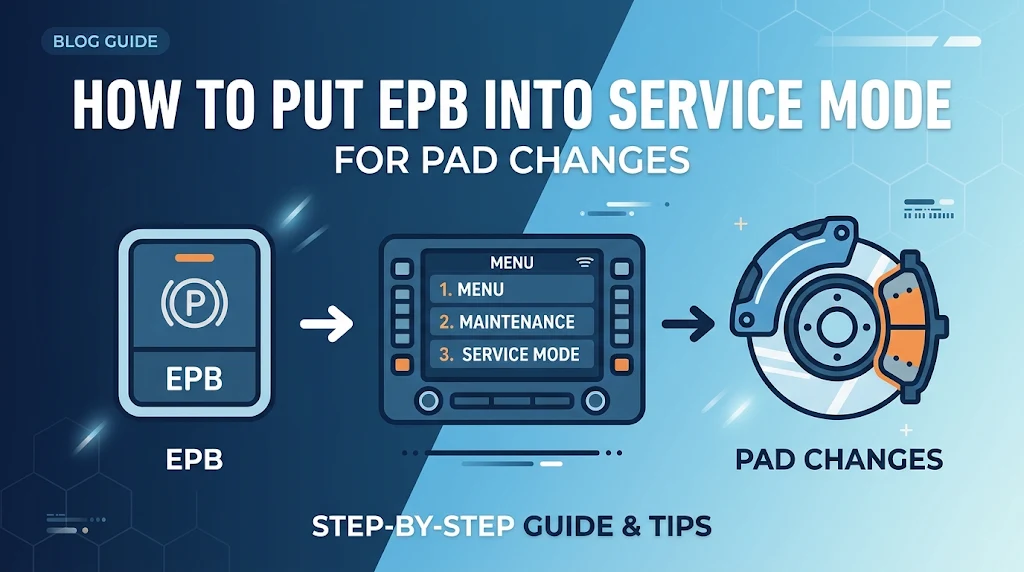
If you have ever attempted a routine rear brake job on a modern vehicle only to find your brake caliper pistons locked tightly in place, you have run into one of modern automotive engineering’s most common hurdles: the Electronic Parking Brake (EPB) system.
Gone are the days when you could simply grab a C-clamp, open the brake fluid reservoir cap, and force a rear brake piston back into its bore. Modern cars, SUVs, and trucks utilize integrated electronic brake actuators attached directly to the rear brake calipers. If you force these pistons back manually without retracting the motor, you will strip internal gears, fry electronic control units (ECUs), and face repair bills running into hundreds or thousands of dollars.
Whether you are a seasoned DIYer or a professional technician looking to streamline your workflow, mastering EPB service mode is non-negotiable. This comprehensive guide breaks down everything you need to know about putting electronic parking brakes into service mode, performing the pad change safely, and recalibrating the system afterward.
1. Understanding the EPB System and Why Service Mode is Required
To appreciate why service mode is mandatory, you first need to understand how electronic parking brakes operate. Traditional parking brakes relied on a mechanical cable pulling a lever on the caliper. Modern EPB systems eliminate the cable entirely, replacing it with an electric motor and a gear reduction assembly mounted directly onto the rear brake caliper housing.
When you engage your dashboard parking brake switch, the control module sends a signal to these electric motors. The motor turns a fine-pitch lead screw mechanism, driving the piston forward to clamp the brake pads against the rotor. When you disengage it, the motor spins in reverse, backing the mechanism off.
[Dashboard Switch] ➔ [EPB Control Module] ➔ [Caliper Electric Motor] ➔ [Lead Screw & Piston Mechanism]
The Risk of Manual Retraction
When brake pads wear down, the piston advances outward. To install new, thick brake pads, the piston must be pushed all the way back into the caliper body.
-
Without Service Mode: The electric motor’s lead screw acts as a rigid mechanical block. Applying a traditional wind-back tool or C-clamp forces the screw against its internal stops, stripping the delicate plastic or brass gears inside the EPB actuator assembly.
-
With Service Mode: Activating service mode commands the car’s computer to spin the electric motor in reverse, fully unscrewing and retracting the internal mechanism away from the piston. This leaves the piston free to be compressed safely.
Pro Tip: Never apply 12 volts directly from a jump box or wire harness to “jumper” an EPB motor backward. Doing so can cause over-travel, damage internal limit switches, or spike voltage into sensitive body control modules. Always use proper software or factory-specified manual procedures.
2. Methods to Activate EPB Service Mode
Depending on the make, model, and year of your vehicle, you generally have two primary pathways to enter EPB service mode: Diagnostic Scan Tools or Manual Pedal-and-Switch Procedures.
Method A: OBD2 Diagnostic Scan Tools (Recommended)
Using a bi-directional OBD2 diagnostic scan tool is the safest, most reliable, and universally accepted method across virtually all modern vehicle brands (including BMW, Audi, Volkswagen, Ford, Toyota, Honda, and GM).
-
Connect the Scan Tool: Plug your diagnostic tool into the OBD2 port (typically located underneath the driver’s side dashboard).
-
Turn Ignition ON: Switch the ignition to the “ON” position (engine off, or accessory mode where all dash lights illuminate).
-
Navigate Software Menu: Select your vehicle’s make and model, then navigate to Service Functions, Chassis, Brake System, or EPB Maintenance Mode.
-
Select “Pad Change” or “Retract”: Choose the command to open or retract the electronic parking brake for rear pad replacement.
-
Verify Completion: Listen for the distinct whirring or buzzing sound of the electric motors winding back. Once the scan tool displays a “Service Mode Active” confirmation message, it is safe to lift the vehicle and remove the wheels.
Method B: Manual Pedal-and-Switch Sequences (Manufacturer-Specific)
Some vehicle manufacturers (such as certain Honda, Acura, and Volkswagen models) allow technicians to enter service mode using a specific combination of accelerator pedal, parking brake switch, and ignition manipulation. While convenient, these sequences can be finicky and require precise timing.
-
Example (Generic VW/Audi Pattern): Often involves holding the accelerator pedal to the floor, holding the EPB switch down (release position), cycling the ignition on and off twice, releasing the accelerator, and pressing the footbrake while holding the EPB switch down.
-
Limitation: Always consult your specific factory service manual (FSM) or repair database (like AllData or Mitchell 1) for the exact sequence. A mistimed step will fail to trigger the mode, risking hardware damage if you proceed.
3. Step-by-Step Guide: Changing Rear Brake Pads with EPB
With service mode successfully engaged, you can now execute the physical brake replacement. Ensure you have your tools ready: a floor jack, jack stands, wheel chocks, a socket set, a brake caliper wind-back tool, a torque wrench, and new brake pads and hardware.
4. Common Pitfalls and Mistakes to Avoid
Even experienced DIYers can run into trouble when dealing with electronic parking brakes. Keep these common traps in mind:
-
Failing to Maintain Battery Voltage: EPB motors draw significant electrical current. If your battery drops below 12.0 volts during service mode retraction or re-engagement, the module may abort the operation, triggering an electronic parking brake fault light on your dash. Always use a battery tender.
-
Forcing the Piston Straight Back: If you attempt to use a straight C-clamp to push a rear EPB piston in without first placing it in service mode, you will instantly snap the internal plastic gears or bend the lead screw. Replacement calipers are expensive—don’t skip service mode!
-
Forgetting to Pump the Pedal After Service: After exiting service mode, the caliper piston has a slight air gap or needs to take up slack against the new pads. If you shift into drive and press the brakes without pumping the pedal first, your first press will go straight to the floor, resulting in zero braking power.
-
Ignoring Caliper Slider Pin Maintenance: EPB systems rely heavily on balanced clamping force. If your slider pins are seized or dry, the inner and outer pads will wear unevenly, triggering premature brake wear alerts and potential electronic faults.
5. Frequently Asked Questions (FAQ)
Can I use a 12V battery directly to retract the EPB motor?
No. While some technicians attempt to unscrew the external motor housing from the caliper and apply 12V leads directly to spin the internal screw, this is highly discouraged. Without computer limits, you can easily over-wind the mechanism, damage internal position sensors, or ruin the waterproof seal on the motor housing.
What happens if I forget to exit service mode?
If you finish the brake job and forget to command the scan tool to exit service mode, your electronic parking brake will remain disabled. You will likely see a warning message on your instrument cluster (e.g., “Parking Brake Failure” or “Service Parking Brake”), and engaging the parking brake switch will yield no response. Simply plug your scan tool back in and complete the exit routine.
Do front brakes require EPB service mode?
No. Front brake systems on passenger vehicles do not feature electronic parking brake actuators (parking brakes act exclusively on the rear wheels). Front brake pad changes can be performed using traditional mechanical compression methods without any scan tool intervention.
How do I know if my scan tool supports EPB retraction?
Basic code readers that only read and clear engine check-lights (P0xxx codes) generally do not support EPB service mode. You will need a mid-tier to advanced diagnostic tool (such as scanners from Autel, Launch, Innova, or Foxwell) that offers bi-directional control and special service functions (often listed under “SAS,” “Oil Reset,” “EPB,” or “BMS”).
Conclusion
Mastering the process of putting electronic parking brakes into service mode transforms a potentially intimidating repair into a straightforward weekend project. By respecting the vehicle’s onboard computer, utilizing the correct diagnostic tools, and following a methodical step-by-step approach, you can protect delicate actuator hardware and ensure your braking system operates at peak performance.

Benjamin Grey is an automotive engineer and writer at Car Parts Advisor. With years of experience in the automotive industry, he shares expert advice on car parts, maintenance, and repairs to help car owners keep their vehicles running smoothly.


