
Driving down an open interstate should feel effortless, like your vehicle is effortlessly gliding over the asphalt rather than fighting every minor seam and expansion joint. Yet, if your daily commute or cross-country road trip leaves you fatigued, bouncing excessively over bridge transitions, or floating through high-speed sweepers, the culprit is almost always your vehicle’s shock absorbers.
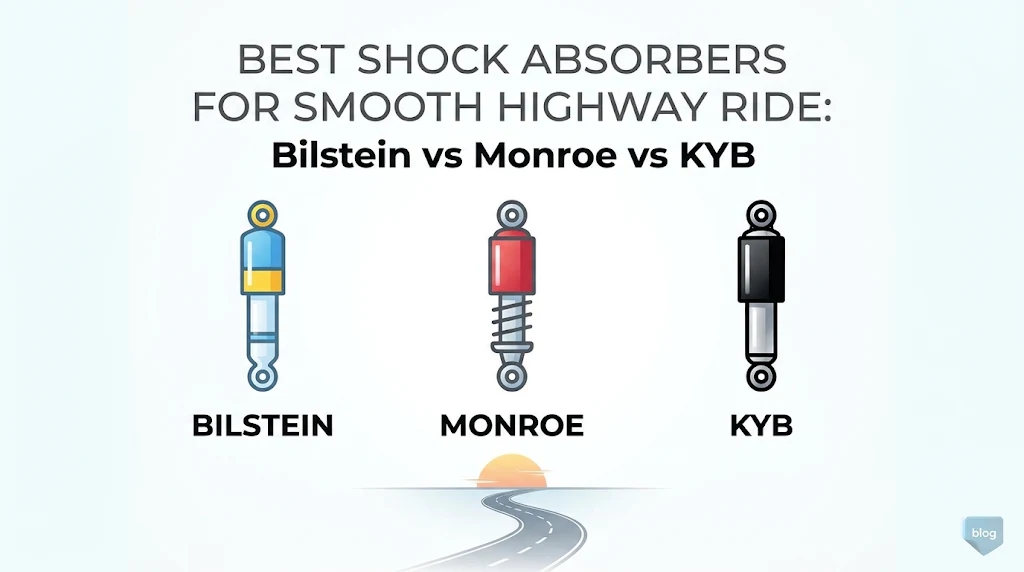
When it comes to upgrading or replacing your suspension for the ultimate highway cruiser experience, three legendary brands dominate the conversation: Bilstein, Monroe, and KYB. Each manufacturer approaches damping technology with a distinct philosophy—ranging from race-proven German monotube engineering to comfort-oriented American heritage and Japanese OEM precision.
In this exhaustive, master-level guide, we will break down how these industry giants compare, examine their flagship highway-friendly product lines, and help you choose the exact shock absorber to transform your ride quality.
1. The Physics of a Smooth Highway Ride: Why Shocks Matter
Many drivers mistakenly believe that springs absorb bumps. In reality, steel coil springs or leaf springs store energy when your tires hit a bump, compressing and rebounding uncontrollably if left unchecked. Without shock absorbers (dampers), your car would bounce endlessly like a pogo stick.
How Shocks Create Comfort
Shock absorbers convert kinetic energy into thermal energy by forcing hydraulic fluid through tiny valving orifices inside a sealed cylinder.
-
Compression Stroke: When a wheel hits a pothole or dips into a trough, the shock compresses, managing the upward force of the wheel.
-
Rebound Stroke: As the wheel returns to ground level, the shock controls the extension speed, preventing the chassis from oscillating or floating.
On the highway, smooth ride quality is defined by high-frequency damping control—the ability to instantly neutralize tiny road vibrations, ripples, and patch-work asphalt without transmitting harshness into the cabin. At the same time, it requires low-frequency stability to prevent body roll during lane changes and nose-diving when braking.
Pro Tip: Worn shock absorbers don’t fail overnight; they degrade gradually. Because drivers unconsciously adjust their driving habits over months to compensate for a sagging suspension, many don’t realize how harsh or floaty their highway ride has become until they install a fresh set of dampers.
2. The Contenders: Brand Overviews and Philosophies
Before pitting them head-to-head, it is crucial to understand the corporate DNA and engineering focus of Bilstein, Monroe, and KYB.
Bilstein: The Monotube Master of Precision
Founded in Germany, Bilstein is globally renowned for inventing the monotube gas-pressure shock absorber. Unlike traditional twin-tube designs, Bilstein uses a single cylinder containing hydraulic oil and a floating dividing piston pressurized with nitrogen gas.
-
Engineering Philosophy: Uncompromising performance, fade-free damping, and crisp handling response.
-
Highway Characteristics: Bilsteins are famously firm. While they offer exceptional high-speed stability and eliminate highway float entirely, aggressive monotubes can sometimes feel slightly stiff over sharp, jagged highway expansion joints, particularly on lighter passenger cars.
Monroe: The King of Comfort and Value
An American household name with over a century of history, Monroe is the undisputed giant of the aftermarket replacement industry, focusing heavily on everyday comfort and broad vehicle coverage.
-
Engineering Philosophy: Restore original factory ride quality, maximize passenger comfort, and deliver exceptional value.
-
Highway Characteristics: Monroe shocks lean heavily toward plushness. Their flagship comfort lines absorb highway ripples and minor bumps with ease, making them a favorite for daily commuters who prioritize a soft, buttery ride over aggressive cornering dynamics.
KYB: The Japanese OE Titan
KYB (Kayaba) is one of the world’s largest suppliers of original equipment (OE) shock absorbers to vehicle manufacturers like Toyota, Honda, Nissan, and Subaru. If your car rolled off a Japanese assembly plant with a smooth, compliant ride, it likely left the factory wearing KYB dampers.
-
Engineering Philosophy: OE-matching quality, multi-stage valving precision, and balanced everyday performance.
-
Highway Characteristics: KYB strikes a harmonious middle ground. They offer better body control than standard comfort replacements while maintaining a supple, forgiving feel that banishes highway fatigue.
3. Head-to-Head Product Line Comparison
To make an accurate comparison, we must evaluate the specific highway-oriented product lines from each manufacturer.
| Feature / Metric | Bilstein B6 Performance / B4 OE | Monroe OESpectrum / Reflex | KYB Excel-G / Gas-a-Just |
| Design Type | Monotube (High-Pressure Gas) | Twin-Tube (Low-Pressure Gas) | Twin-Tube (Excel-G) / Monotube (Gas-a-Just) |
| Highway Ride Feel | Firm, planted, ultra-stable, controlled | Plush, forgiving, smooth, compliant | Balanced, crisp OE-style damping, comfortable |
| Body Roll Control | Exceptional | Moderate (Comfort-focused) | Very Good |
| Longevity / Durability | Exceptional (High-end German metallurgy) | Good (Standard aftermarket lifespan) | Excellent (OEM factory-grade durability) |
| Best Suited For | SUVs, trucks, European sedans, enthusiasts | Budget-conscious daily commuters, older sedans | Japanese/Asian imports, general daily drivers |
4. Deep-Dive Brand Analysis: Which One Delivers the Smoothest Highway Ride?
Bilstein B4 & B6: For the Driver Who Wants Unshakable Stability
If your highway complaint is that your car feels loose, “swims” in crosswinds, or bounces twice after hitting an overpass bridge joint, Bilstein is the gold standard upgrade.
-
The B4 OE Replacement: Designed to replicate or slightly improve original factory ride characteristics using Bilstein’s monotube technology. It provides superior high-speed tracking without making your luxury sedan feel like a race car.
-
The B6 Performance: A heavy-duty upgrade designed for stock ride heights. It shines brightest on full-size SUVs, trucks, and European performance sedans. On long highway stretches, the B6 eliminates float completely, planting the vehicle securely to the road.
Example: Driving a Ford F-150 or RAM 1500 on the interstate often results in rear-end hop over concrete seams. Installing Bilstein B6 shocks instantly dampens this oscillation, turning a choppy truck ride into a composed, Cadillac-like highway cruise.
Monroe OESpectrum & Reflex: For Maximum Cushion and Budget-Friendly Comfort
Monroe targets drivers who want to eliminate harsh impacts and enjoy a relaxed, cloud-like commute.
-
OESpectrum: Utilizes Monroe’s patented Intelligent Valving Technology (IMV), which reacts instantly to road surface changes. It filters out high-frequency road chatter—the constant micro-vibrations from rough asphalt—yielding an exceptionally smooth highway ride.
-
Reflex: Engineered with impact control valves that engage faster during sudden maneuvers, enhancing safety without sacrificing straight-line highway comfort.
While Monroe may not offer the razor-sharp cornering agility of Bilstein, it excels at isolating the cabin from broken, patched-up highway surfaces.
KYB Excel-G: The Factory-Fresh Highway Standard
If you want your vehicle to feel exactly like it did the day you drove it off the dealership lot, KYB Excel-G is the industry benchmark.
-
Calibrated to OE Specs: KYB explicitly restores original equipment performance rather than altering it. Because modern vehicles are engineered by automotive manufacturers to balance ride comfort and high-speed stability, KYB’s calibrated valving ensures optimal highway composure.
-
Nitrogen Gas-Charged: Prevents fluid aeration and fading during prolonged high-speed driving, ensuring consistent damping performance whether you are 10 miles or 500 miles into your road trip.
5. Common Pitfalls and Mistakes to Avoid When Upgrading Shocks
Replacing shock absorbers is a critical mechanical investment. Avoid these frequent mistakes to ensure you get the smooth highway ride you are paying for:
-
Replacing Only One Pair (Front or Rear): Never replace just a single shock or only the front two shocks. Suspension components wear at roughly equal rates. If you install brand-new, stiff Bilsteins in the front and leave worn-out, spongy 100,000-mile shocks in the rear, your weight transfer dynamics will be dangerously unbalanced, resulting in unpredictable highway handling and erratic braking. Always replace shocks in complete axle sets (both fronts or both rears)—or ideally, all four at once.
-
Ignoring Supporting Suspension Hardware: Shocks do not work in isolation. Worn strut mounts, brittle bump stops, cracked rubber bushings, and sagging coil springs will ruin a new shock absorber’s performance. Always inspect and replace upper mount bearings and hardware during installation.
-
Choosing the Wrong Damping Profile for Your Vehicle Weight: Installing a stiff, heavy-duty monotube shock on a lightweight economy hatchback driven primarily on cracked urban highways can result in an overly jarring ride. Match the shock’s design philosophy (comfort vs. performance) to your vehicle class and driving environment.
-
Failing to Perform a Wheel Alignment: Whenever you disassemble front strut assemblies or alter suspension geometry during a shock replacement, your wheel alignment specs can shift. Neglecting a post-installation alignment leads to uneven tire wear, pulling on the highway, and a degraded steering feel.
6. Frequently Asked Questions (FAQ)
Which shock absorber brand lasts the longest?
Bilstein shock absorbers generally outlast the competition due to their robust German monotube construction, high-grade materials, and resistance to heat fade. While Monroe and KYB offer excellent longevity that easily matches or exceeds standard OE expectations (typically 50,000 to 80,000 miles), Bilsteins are frequently praised for maintaining their damping performance well past 100,000 miles.
Will stiff shocks ruin my highway ride comfort?
It depends on the brand and design. Stiff performance monotubes (like the Bilstein B6) firm up chassis movements, which some drivers interpret as a firmer ride over sharp bumps. However, true ride comfort is about control, not just softness. Shocks that are too soft allow excessive bouncing and floating, causing driver fatigue on long highway trips. If you prefer a plush ride, choose Monroe OESpectrum or KYB Excel-G. If you prefer European highway stability and zero float, choose Bilstein.
Do I need a wheel alignment after changing shock absorbers?
If you are replacing standard standalone shock absorbers (where the shock and coil spring are separate units, common on most trucks and rear suspensions), an alignment is usually not required. However, if you are replacing struts (where the shock absorber is an integral structural part of the front suspension holding the coil spring), you must get a professional wheel alignment immediately afterward.
Are gas-charged shocks better than hydraulic shocks for highway driving?
Yes. Virtually all modern replacement shocks (including Monroe, KYB, and Bilstein) utilize low-pressure or high-pressure nitrogen gas. The gas pressurizes the hydraulic fluid, preventing it from foaming (aeration) during continuous high-speed movement over highway ripples. This eliminates “shock fade,” ensuring consistent, smooth damping performance mile after mile.
Conclusion & Next Steps
Achieving the ultimate smooth highway ride comes down to matching your personal comfort preferences with the right engineering philosophy:
-
Choose Bilstein if you want German engineering precision, zero highway float, and exceptional high-speed stability.
-
Choose Monroe if your primary goal is maximizing plush comfort, isolating road harshness, and getting great value.
-
Choose KYB if you want to restore original factory ride quality, balanced handling, and OEM reliability.
Don’t let worn suspension compromise your safety and comfort on your next road trip.
Call to Action: Check your vehicle’s mileage and suspension health today. If your car has crossed the 60,000-mile mark or bounces more than once after hitting a speed bump, browse our recommended catalog, select the brand that fits your driving style, and schedule an upgrade to experience a brand-new, silky-smooth highway ride!

Benjamin Grey is an automotive engineer and writer at Car Parts Advisor. With years of experience in the automotive industry, he shares expert advice on car parts, maintenance, and repairs to help car owners keep their vehicles running smoothly.


