
Imagine pressing your brake pedal and feeling a slight pull to the left, followed by a burning smell as you pull into your driveway. When you inspect the wheel, one brake pad is worn down to bare metal while the other still has half its life left.
The culprit? A seized or sticking brake caliper sliding pin.
Brake caliper pins (often called slider pins or guide pins) are the unsung heroes of your braking system. They allow the caliper to float smoothly, ensuring that both the inner and outer brake pads apply even pressure to the rotor. Without proper lubrication, these pins bind up, leading to uneven brake pad wear, reduced braking efficiency, dragged brakes, and even warped rotors.
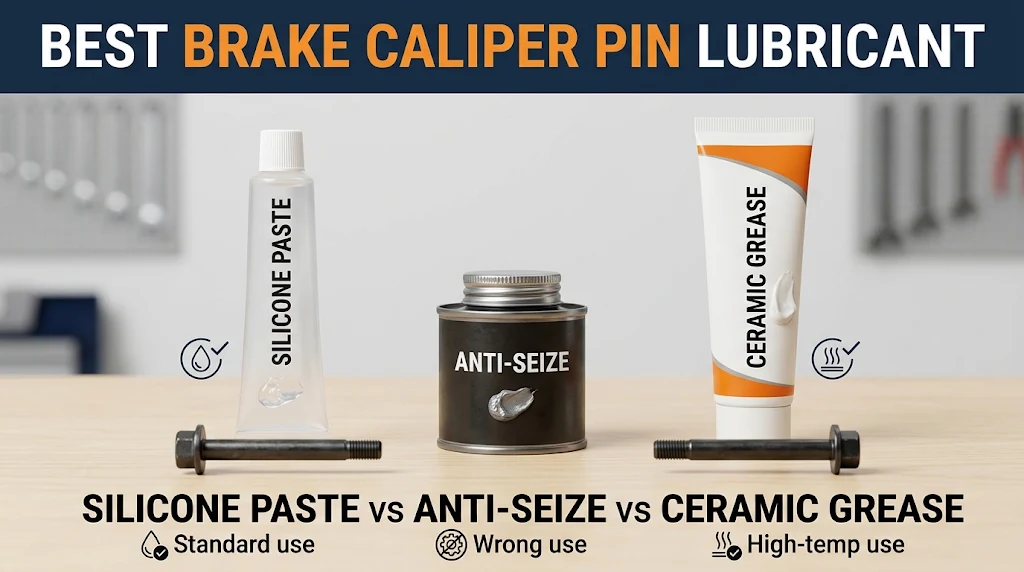
However, walking into an auto parts store reveals a dizzying array of brake lubricants: high-temp silicone paste, traditional metallic anti-seize, and modern ceramic grease. Choosing the wrong one can cause rubber boots to swell, grease to melt down onto your friction surfaces, or your pins to lock up completely.
This comprehensive guide breaks down the science, performance, and best applications for silicone paste, anti-seize, and ceramic grease so you can make the right choice for your vehicle.
1. Understanding Brake Caliper Pins and Why Lubrication Matters
Before diving into the chemical differences of each lubricant, it is essential to understand the mechanical environment these products must endure. Brake systems generate immense thermal energy through friction. Temperatures at the caliper bracket can easily exceed $400^\circ\text{F}$ ($200^\circ\text{C}$) during normal driving and push past $800^\circ\text{F}$ ($425^\circ\text{C}$) during heavy braking or towing.
Furthermore, slider pins operate within tight tolerances inside rubber or polyurethane dust boots. These boots keep out moisture, road salt, and brake dust, but they also mean the lubricant must be chemically compatible with elastomer materials. If a grease contains petroleum distillates that attack rubber, the boot will swell, tear, and let moisture in, causing the pin to rust and seize.
Pro Tip: Never use standard chassis grease, wheel bearing grease, or multi-purpose lithium grease on brake caliper pins. These conventional petroleum greases have low dropping points, meaning they liquefy under high heat, run out of the pin bore, contaminate your brake pads, and destroy rubber boots.
2. Contender 1: Silicone Paste – The OEM Gold Standard
Silicone-based brake lubricants (often sold as silicone brake caliper grease or dielectric silicone paste) are formulated using a silicone oil base thickened with silica. They contain no petroleum oils, making them uniquely suited for automotive braking systems.
Key Characteristics & Performance
-
Rubber Compatibility: Exceptional. Silicone paste does not degrade, swell, or dissolve rubber or EPDM dust boots. In fact, most Original Equipment Manufacturers (OEMs) specify pure silicone paste for slider pins.
-
Temperature Stability: Excellent high-temperature resistance. High-grade silicone pastes maintain their viscosity and lubricating properties well past $400^\circ\text{F}$ to $500^\circ\text{F}$ without melting or carbonizing.
-
Water Resistance: Completely waterproof. Silicone is hydrophobic, meaning road spray, puddles, and salty winter slush will not wash it away.
When to Use Silicone Paste
Silicone paste is the undisputed champion for rubber-bushed sliding caliper pins. If your caliper design features a pin sliding inside a rubber sleeve or bushing (common on many modern Asian and European vehicles), silicone paste is virtually mandatory. Using anti-seize in these applications will destroy the rubber bushing within weeks.
Example: On a modern Honda Civic or Toyota Camry front brake assembly, the lower slider pin often features a small rubber dynamic damper ring. If you apply petroleum-based or metallic anti-seize to this pin, the rubber ring will swell up like a sponge, jamming the pin and causing the brake pad to drag constantly against the rotor. Pure silicone paste prevents this entirely.
3. Contender 2: Anti-Seize (Copper vs. Nickel) – The Heavy-Duty Choice
Metallic anti-seize lubricants consist of a petroleum or synthetic grease carrier heavily loaded with microscopic metallic flakes—typically copper, nickel, or aluminum. When the base carrier oil eventually burns off under extreme heat, the metallic flakes remain behind to prevent metal-to-metal welding and galvanic corrosion.
Key Characteristics & Performance
-
Extreme Heat Tolerance: Outstanding. Nickel anti-seize can withstand temperatures up to $2400^\circ\text{F}$ ($1300^\circ\text{C}$), making it ideal for exhaust bolts, spark plug threads, and extreme-duty racing applications.
-
Corrosion Resistance: High resistance to rust and seizing in high-moisture environments.
-
The Fatal Flaw for Calipers: The petroleum carrier oil in traditional anti-seize will attack and swell rubber boots. Furthermore, the solid metallic particles can act as an abrasive paste inside tight slider pin bores if contaminated with grit.
When to Use Anti-Seize (and Where NOT To)
-
WHERE TO USE: Use copper or nickel anti-seize exclusively on metal-to-metal contact points outside the pin bore—such as the caliper bracket abutment clips where the brake pad ears slide, the backside of brake pads, and the hub-to-rotor mating surface to prevent wheels from sticking.
-
WHERE NOT TO USE: Never use anti-seize on rubber-enclosed slider pins. While some older heavy-duty trucks with entirely bare steel pins and no rubber boots could tolerate high-temp anti-seize, modern vehicles will suffer severe boot degradation and pin binding.
4. Contender 3: Ceramic Grease – The Modern High-Performance Solution
Ceramic brake grease is a newer generation of synthetic lubricant infused with ceramic solids (such as boron nitride or titanium compounds) suspended in a high-temperature synthetic base. Unlike anti-seize, ceramic grease contains no metals (copper or aluminum), meaning it is completely non-conductive and won’t cause galvanic corrosion on aluminum caliper brackets.
Key Characteristics & Performance
-
Thermal Performance: Exceptional. Designed to handle extreme braking temperatures without melting, drying out, or washing away.
-
Versatility: Can typically be used on both metal-to-metal contact points (abutment clips, pad backs) and select slider pins (provided the manufacturer or product specs confirm rubber compatibility).
-
Noise Dampening: The ceramic solids help dampen high-frequency vibrations that cause brake squeal.
When to Use Ceramic Grease
Ceramic grease is an excellent all-in-one shop lubricant if you work on a wide variety of vehicles. It excels on brake pad backing plates, pad abutment clips, and pin surfaces where a high-temp synthetic formulation is required. However, always check the product label to ensure it is explicitly rated as “safe for rubber boots” before applying it directly inside sliding pin channels.
5. Head-to-Head Comparison: Silicone vs. Anti-Seize vs. Ceramic
To help you choose the right product for your specific maintenance task, review the comparison matrix below:
| Feature / Property | Silicone Paste | Metallic Anti-Seize | Ceramic Grease |
| Rubber Boot Safety | 100% Safe (Won’t swell rubber) | Unsafe (Degrades/swells rubber) | Safe (Most modern formulations) |
| Max Temperature | High (~$500^\circ\text{F}$) | Extreme ($1400^\circ\text{F}$ to $2400^\circ\text{F}$) | Very High (~$2800^\circ\text{F}$) |
| Primary Metal Protection | Resists moisture & oxidation | Prevents galling via metal flakes | Prevents binding via ceramic solids |
| Best Application | Rubber-bushed slider pins | Wheel hubs, exhaust bolts, pad clips | Pad abutment clips, pin sliders, pad backs |
| Conductivity | Non-conductive | Highly Conductive (Contains metal) | Non-conductive (Safe for ABS sensors) |
6. Common Pitfalls and Mistakes to Avoid When Lubricating Brake Calipers
Even experienced DIYers sometimes make critical errors during a brake job. Avoiding these common pitfalls will save you from premature brake wear and costly repairs:
-
Mixing Different Greases: Never mix silicone grease with petroleum- or metallic-based greases inside a pin bore. Chemical reactions can turn the mixture into a sticky, gum-like varnish that locks the caliper solid. Always clean out old grease completely with brake cleaner before applying a new type.
-
Over-Lubricating Slider Pins: Applying a thick glob of grease inside a blind-hole caliper pin bore creates hydraulic pressure. When you push the pin in, that trapped pressure can push the rubber boot off its seat or prevent the pin from bottoming out fully, causing uneven braking. Use a thin, uniform film around the pin shaft.
-
Neglecting the Pin Bores: Cleaning the outside of the slider pin is not enough. You must use a wire brush or a specialized bore cleaning brush to clean out old, hardened carbon and grit from inside the caliper bracket bore before relubricating.
-
Using Petroleum Grease on ABS Sensors: Metallic anti-seize near wheel speed sensors can interfere with magnetic signals or short out sensor wiring. Ceramic or silicone greases are non-conductive and much safer around modern electronic brake systems.
7. Frequently Asked Questions (FAQ)
Can I use anti-seize on my brake caliper slider pins?
No, you should avoid using traditional metallic anti-seize on modern slider pins enclosed by rubber boots. The petroleum carrier oil will cause the rubber boots to swell and tear, leading to trapped moisture, rust, and seized calipers. Use silicone paste or rubber-safe ceramic grease instead.
What is the best lubricant for high-performance track driving?
For extreme track conditions where temperatures soar, high-temperature ceramic synthetic greases or specialized high-temp racing silicone compounds are preferred. They resist thermal breakdown much better than standard consumer-grade lubricants.
How often should brake caliper slider pins be lubricated?
Slider pins should ideally be serviced and lubricated every time you replace your brake pads (typically every 30,000 to 50,000 miles), or at least once a year if you live in the “rust belt” where winter road salt accelerates corrosion.
Can I use brake grease on the brake pad friction material?
Absolutely not. Never get grease, oil, or lubricant on the friction face of the brake pads or the rotor surfaces. Grease on pads will ruin the friction material, drastically reducing stopping power and causing dangerous brake fade.
Conclusion & Actionable Next Steps
Selecting the right lubricant for your brake caliper pins is a small detail that makes a massive difference in your vehicle’s safety, fuel economy, and brake longevity. To recap:
-
Silicone paste is your go-to choice for rubber-bushed slider pins due to its unmatched elastomer compatibility and water resistance.
-
Ceramic grease offers a versatile, high-temp synthetic alternative for both pins and pad abutment hardware.
-
Anti-seize belongs strictly on metal-to-metal contact points like wheel hubs and pad clips—never inside rubber-sealed pin bores.

Benjamin Grey is an automotive engineer and writer at Car Parts Advisor. With years of experience in the automotive industry, he shares expert advice on car parts, maintenance, and repairs to help car owners keep their vehicles running smoothly.


