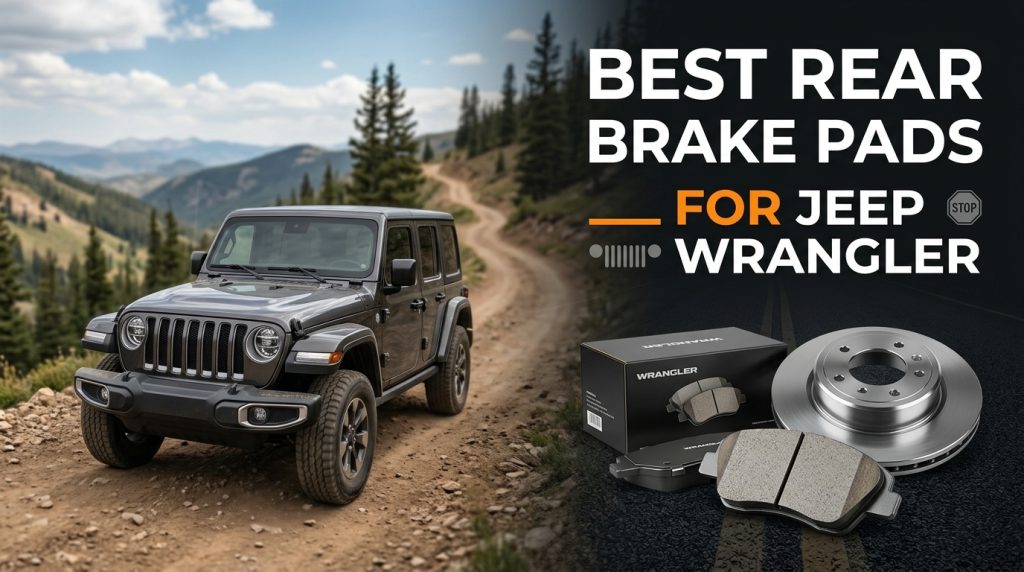
The Jeep Wrangler is one of the most capable off-road vehicles ever built — and also one of the heaviest for its size, especially in Unlimited four-door form. Add a lift kit, larger tires, a full-size spare on the rear, heavy aftermarket bumpers, and the kind of loaded camping gear a Wrangler was born to carry, and you’ve got a vehicle that can push well past its stock curb weight on any given weekend.
All of that weight has to stop. And stop reliably, whether you’re hauling down a highway at 75 mph, descending a rocky trail where brake control means the difference between a smooth line and a rollover, or navigating a loaded vehicle through stop-and-go traffic in a city that has no idea what a Rubicon Trail is.
Rear brake pads on a Wrangler carry more responsibility than rear pads on the average crossover or sedan. The solid rear axle, the RWD-biased power delivery, and the sheer mass of a lifted, accessorized JK or TJ means the rear brakes are working hard every time you slow down. Cheap, poorly specified replacement pads show up immediately as noise, fade, uneven wear, and a Wrangler that doesn’t stop as confidently as it should.
This guide covers the five best rear brake pad options for the Jeep Wrangler — specifically the TJ/JK generation from 2007 through 2018 — available on Amazon right now. Every pick uses ceramic compound, fits directly to the Wrangler’s rear caliper specification, and is priced to make responsible brake maintenance accessible for every Wrangler owner.
What Makes Rear Brake Pads on a Wrangler Different?
The Jeep Wrangler’s rear brake system has a few characteristics that make pad selection more nuanced than on a typical passenger car.
Solid rear axle architecture. The Wrangler’s Dana solid rear axle puts the braking hardware in a more exposed, more vibration-intensive environment than an independent rear suspension setup. The caliper and pad interface experiences more shock loading over rough terrain than equivalent hardware on a unibody crossover. Pads with robust backing plates and quality shim construction handle this vibration environment better than bare-bones economy alternatives.
Heavy-duty use patterns. A Wrangler used for off-roading frequently encounters situations that stress the rear brakes specifically — trail descents where the driver needs precise rear brake control, loaded approaches where the rear axle carries significant weight, and recovery situations where braking forces are applied unevenly. The rear pads need to perform reliably in these non-standard scenarios, not just in highway commuting.
Integrated parking brake. The Wrangler’s rear calipers incorporate the parking brake mechanism. When replacing rear pads, the caliper piston must be retracted by rotating it clockwise simultaneously with compression — a standard C-clamp won’t work and can damage the piston. This is a platform-specific installation detail that every Wrangler owner should be aware of before attempting a DIY rear brake job.
Lifted and accessorized weight. A stock JK Wrangler Unlimited weighs around 4,400 lbs. Add a 4-inch lift, 35-inch tires, steel bumpers, a full-size spare, and expedition camping gear, and you’re moving significantly more mass with every stop. Ceramic pads with high heat tolerance and consistent friction coefficients handle this additional load more reliably than organic or budget semi-metallic alternatives.
Dust sensitivity. Black metallic brake dust on the Wrangler’s wheels — especially popular aftermarket wheels with open spoke designs — looks terrible and is stubborn to clean. Ceramic compound produces dramatically less dust, and what dust it does produce is light-colored and far less adhesive to wheel surfaces.
Top 5 Rear Brake Pads for Jeep Wrangler
1. Rear Ceramic Brake Pads Set — Best Budget Direct-Fit Option
Fits: Jeep Wrangler 2007–2017, Wrangler JK 2018, Jeep Liberty 2008–2012, Dodge Nitro 2007–2011 — 4PCS
For the Wrangler owner who needs a reliable, no-frills rear ceramic pad replacement at the most accessible price point on this list, this direct-fit four-piece set covers the complete JK generation with confirmed fitment across the 2007–2018 production span. It’s the straightforward answer to a straightforward question: what’s the most cost-effective quality ceramic rear pad available for my JK?
The ceramic compound delivers the core benefits that matter for everyday Wrangler use — quiet operation, minimal dust, and consistent friction characteristics across the operating temperature range. For a JK used primarily on the street and mild trails, with a standard lift and stock-sized tires, this compound handles the thermal demands of normal use comfortably without requiring the price premium of dedicated performance formulations.
The four-piece set — two inner and two outer pads covering the rear axle — is dimensionally spec’d to fit the Wrangler’s rear caliper bracket directly. No trimming, no shimming, no clearance issues with lifted suspension. The pad dimensions match the caliper slot precisely, which is the foundation of even contact pressure, consistent pad wear, and a brake job that stays quiet through the life of the pad.
The cross-fitment with Jeep Liberty and Dodge Nitro reflects the shared Chrysler chassis architecture between these vehicles — all three use the same rear brake caliper and rotor specification, which means parts availability is high and pricing is competitive across the platform.
Best for: Budget-conscious JK Wrangler owners doing a standard rear brake replacement on a stock or mildly modified daily-driven Wrangler.
👉 Shop Rear Ceramic Pads for Jeep Wrangler
2. Bendix Priority1 CFC1274 Ceramic Rear Brake Pads — Best Entry-Level Bendix Pick
Fits: Jeep Wrangler 2007–2017, Wrangler JK 2018, Jeep Liberty 2008–2013, Dodge Nitro 2007–2012
Bendix has been supplying brake components to OEM manufacturers and the aftermarket for decades, and the Priority1 line represents their entry-level offering — a step above generic alternatives while keeping pricing accessible. For Wrangler owners who want the confidence of a recognized brand name behind their rear brake pads without spending premium dollars, the CFC1274 is a genuinely solid choice.
The Priority1 designation in Bendix’s lineup indicates a compound engineered to OEM match standards — meaning the friction coefficient, wear rate, and thermal profile are calibrated to replicate the behavior of the original factory pads rather than attempting to exceed them. For a Jeep Wrangler used in stock or near-stock configuration for daily driving and weekend trails, matching OEM performance reliably and quietly is exactly the right specification.
The ceramic compound keeps the Priority1 in the low-dust, low-noise category that makes a daily-driven Wrangler pleasant to live with. Black metallic dust on aftermarket wheels is one of the most common complaints from Wrangler owners who’ve had budget semi-metallic pads installed — switching to a full ceramic compound immediately eliminates this problem.
Bendix’s quality control across the Priority1 line is notably consistent. A common failure mode with budget brake pads is batch-to-batch variation in compound hardness and friction coefficient — one set performs well, the next set from the same listing squeals or fades earlier. Bendix’s manufacturing standards minimize this variability, which means the pads you install should perform consistently with what the reviews describe.
Best for: JK Wrangler owners who want an established brand name and OEM-match compound quality at an accessible price, with no surprises in installation or daily use.
👉 Shop Bendix Priority1 CFC1274 for Jeep Wrangler
3. PowerStop Z17 Ceramic Rear Brake Pads — Best Upgrade Ceramic for Everyday JK Use
Fits: Jeep Wrangler 2007–2017, Wrangler JK 2018, Jeep Liberty 2008–2012, Dodge Nitro 2007–2011
PowerStop’s Z17 Evolution line is the brand’s entry-level ceramic offering, and for the Jeep Wrangler platform it represents one of the most thoughtful value propositions on this list. PowerStop is one of the most trusted names in direct-fit brake upgrades for trucks and SUVs — their Z23 and Z36 lines are well-known among enthusiasts — and the Z17 brings that engineering approach to a more affordable price point specifically for daily driving applications.
The Z17’s ceramic compound is tuned for consistent everyday performance rather than extreme heat management. For a JK Wrangler doing the majority of its miles on street and highway — commuting, road trips, occasional light trail use — this is precisely the right specification. The compound bites cleanly from cold in the morning, stays consistent through a full day of mixed urban and highway driving, and produces very little dust on the wheel surface regardless of how many miles accumulate.
The installation hardware included with the Z17 is a standout detail at this price point. PowerStop includes new caliper hardware — the clips and shims that hold the pads in the bracket — with every Z17 kit. This is significant for Wrangler owners because the JK’s rear caliper hardware is exposed to significant road contamination, trail mud, and moisture, and corrodes faster than equivalent hardware on a street-only vehicle. Installing new pads into corroded, binding hardware creates noise and uneven wear within the first few thousand miles. The included hardware eliminates this variable entirely.
The Z17 also benefits from PowerStop’s application-specific engineering. Rather than producing a single pad to fit a range of caliper sizes, PowerStop validates the Z17’s dimensions against the specific Wrangler rear caliper specification, ensuring correct contact pressure distribution and even wear from the first stop.
Best for: JK Wrangler daily drivers who want a genuine upgrade over OEM-match pads with included hardware, from one of the most trusted names in the truck and SUV brake market.
👉 Shop PowerStop Z17 Rear Pads for Jeep Wrangler
4. Bendix Premium SBC1274 Ceramic Rear Brake Pads — Best Mid-Range Bendix Upgrade
Fits: Jeep Wrangler 2007–2017, Wrangler JK 2018, Jeep Liberty 2008–2013, Dodge Nitro 2007–2012
The Bendix Premium SBC1274 is Bendix’s upper-tier offering for this application — a step above the Priority1 entry-level pad in compound quality, hardware quality, and overall refinement. For a Wrangler owner who sees more varied and demanding use than the average commuter — loaded camping trips, regular trail use, towing a small trailer — the Premium line’s higher-spec ceramic compound is worth the modest additional investment over the Priority1.
The distinction between Bendix’s Priority1 and Premium lines comes down to compound formulation depth. The Premium SBC1274 uses a more sophisticated ceramic matrix with a higher concentration of ceramic fibers that extend the compound’s consistent friction performance across a wider temperature range. In practice, this means the SBC1274 maintains a more predictable pedal feel when brakes are repeatedly cycled — a loaded Wrangler on a long trail descent, for example, will find the Premium compound more consistent through successive brake applications than an OEM-match formulation designed primarily for street use.
Bendix’s Premium line also includes higher-quality shim construction on the backing plate. The noise-dampening shims on the SBC1274 are thicker and more precisely fitted than those on the Priority1, which translates to quieter operation specifically in the conditions where Wranglers are most often driven — low-speed trail use, parking, and the kinds of slow, controlled braking that emphasize brake noise more than highway driving does.
For Wrangler owners in environments with significant road salt, the Premium compound’s enhanced corrosion inhibitors in the pad backing plate coating provide better long-term protection for the metal components against the combined assault of trail mud, salt, and moisture that Wranglers accumulate in the rear wheel wells.
Best for: Wrangler owners with moderate to heavy use patterns — frequent trail days, loaded camping trips, or towing — who want the next level of Bendix compound quality over the entry-level Priority1.
👉 Shop Bendix Premium SBC1274 for Jeep Wrangler
5. Bosch BC1274 QuietCast Premium Ceramic Rear Brake Pads — Best Premium Brand Pick
Fits: Jeep Wrangler, Wrangler JK, Jeep Liberty, Dodge Nitro — REAR
Bosch’s QuietCast Premium Ceramic line is the most refined, most engineering-intensive option on this list — and the name is genuinely earned. Bosch is not only one of the world’s largest automotive suppliers but a company with deep OEM brake engineering relationships across virtually every major manufacturer. The QuietCast Premium line applies that OEM engineering heritage to a replacement pad designed specifically to exceed factory performance rather than simply match it.
The “QuietCast” designation reflects Bosch’s specific engineering focus on noise elimination. The BC1274 uses a multi-layer rubber core shim that’s integral to the pad assembly — not a separate insert that can shift during installation or compress unevenly over time, but a bonded component that becomes part of the pad structure itself. This construction approach is the reason QuietCast pads have one of the strongest reputations for noise-free operation in the industry. The multi-layer shim dampens vibration at every frequency that produces audible brake noise, from the low-frequency groaning of cold-weather pad vibration to the high-frequency squeal that ceramic pads can occasionally produce in certain temperature conditions.
For a Jeep Wrangler, where the solid rear axle transmits more vibration to the caliper-pad interface than an independent suspension setup would, this enhanced vibration damping is particularly valuable. A standard aftermarket shim may control vibration adequately on a smooth road surface; the Bosch multi-layer integral shim handles the additional harmonic complexity of a solid-axle vehicle driving on rough terrain.
The ceramic compound in the BC1274 is formulated around Bosch’s global compound database, developed from decades of OEM pad supply contracts across American, European, and Asian vehicle platforms. The friction coefficient is precise and consistent batch to batch — which addresses one of the less-discussed failure modes of budget brake pads: the replacement set that performs differently from the previous one because compound consistency wasn’t maintained in manufacturing.
The QuietCast Premium also includes chamfered edges on the pad face — angled cuts at the leading and trailing edges that eliminate the abrupt contact edge that causes squeal at initial pedal application. Combined with the integral shim, this gives the BC1274 the most comprehensive noise elimination package of any pad on this list.
Best for: Wrangler owners who want the best brake pad engineering money can reasonably buy for this application, with maximum noise elimination, premium compound consistency, and Bosch’s OEM-grade engineering behind every stop.
👉 Shop Bosch QuietCast BC1274 for Jeep Wrangler
Side-by-Side Comparison
| Pad | Brand | Tier | Key Feature | Best For |
|---|---|---|---|---|
| Rear Ceramic Set | Generic | Budget | Direct-fit value | Stock daily drivers on a budget |
| Bendix Priority1 CFC1274 | Bendix | Entry | OEM-match compound, brand reliability | Brand-conscious buyers, stock use |
| PowerStop Z17 17-1274 | PowerStop | Mid | Hardware included, trusted truck brand | Daily JK drivers wanting an upgrade |
| Bendix Premium SBC1274 | Bendix | Mid-Premium | Higher-spec ceramic, better shims | Trail/loaded use, Bendix loyalists |
| Bosch QuietCast BC1274 | Bosch | Premium | Integral multi-layer shim, OEM engineering | Maximum noise elimination, best overall |
How to Replace Rear Brake Pads on a Jeep Wrangler JK
The JK’s rear brake job has one critical difference from most passenger cars that catches first-timers off guard: the rear caliper piston must be retracted by rotating it clockwise while compressing it inward simultaneously. Pushing the piston straight in with a C-clamp — as you would on a front caliper — will damage the piston’s internal threads and require caliper replacement.
Tools you need: Dedicated rear caliper piston tool (cube-style with multiple pins to fit the piston face notches), floor jack and jack stands, lug wrench, socket set, torque wrench, brake cleaner, caliper grease, and fresh brake fluid.
Step-by-step process:
Loosen the lug nuts before jacking the vehicle. Raise and support on jack stands — never work under a vehicle supported only by a floor jack. Remove the rear wheel. Unbolt the caliper (two slide pin bolts), hang it safely from the spring with a wire hook, never by the brake line. Remove the old pads from the bracket.
Before retracting the piston, crack open the brake fluid reservoir cap. Use the piston tool to simultaneously push in and rotate the piston clockwise until it’s fully retracted. Many JK pistons have two notches on the face — fit the tool’s pins into these notches for a secure grip before applying force.
Install the new hardware from the kit, then install the new pads. Reinstall the caliper and torque the slide pin bolts to the Jeep specification (typically 17–22 ft-lbs for the JK rear). Reinstall the wheel and torque lug nuts in a star pattern to 95–100 ft-lbs.
Pump the brake pedal firmly multiple times before moving the Jeep — the piston needs to re-seat against the new pads before brakes will engage. Check the fluid level and top off as needed. Verify pedal firmness before driving.
Bed the pads: Make 8–10 moderate stops from 35 mph with 30 seconds between each. This establishes even pad material contact with the rotor face and prevents the uneven deposits that cause early pulsation.
Signs Your Wrangler’s Rear Brake Pads Need Replacing Now
Wrangler owners sometimes discover rear pad wear later than they should because the rear brakes are less immediately obvious in daily driving than the fronts. Watch for:
- Squealing on the first stops of the day that doesn’t resolve after brakes warm up — the wear indicator tab is contacting the rotor
- Grinding from the rear when braking — metal-on-metal contact means the pads are gone and the rotor is being damaged right now
- Wrangler pulling or yawing under braking — uneven rear pad wear between sides creates a braking imbalance that’s particularly noticeable on a rear-wheel-drive platform
- Visible thin pads through the wheel spokes — less than 3mm of remaining pad material is immediate replacement territory
- Brake warning light (on JK models with pad wear sensors) — act on this immediately
If any of these symptoms are present, don’t delay. Rear brake failure on a heavily loaded or lifted Wrangler in a trail situation or highway emergency stop is significantly more dangerous than on a lighter, lower-center-of-gravity vehicle.
Final Verdict
The Jeep Wrangler deserves rear brake pads that match its capability, its weight, and the varied and demanding conditions it’s used in. Every pad on this list delivers ceramic compound quality and direct-fit installation for the JK and related platforms, at price points ranging from accessible budget to premium engineered.
Choose based on your driving style and what you ask of your Wrangler:
- Tightest budget, daily street use: Rear Ceramic Set
- Brand-name reliability, OEM match: Bendix Priority1 CFC1274
- Best mid-range with included hardware: PowerStop Z17
- Trail use, loaded camping, moderate performance: Bendix Premium SBC1274
- Maximum noise elimination, premium engineering: Bosch QuietCast BC1274
As an Amazon Associate, we earn from qualifying purchases. Prices and availability are subject to change.

Benjamin Grey is an automotive engineer and writer at Car Parts Advisor. With years of experience in the automotive industry, he shares expert advice on car parts, maintenance, and repairs to help car owners keep their vehicles running smoothly.