
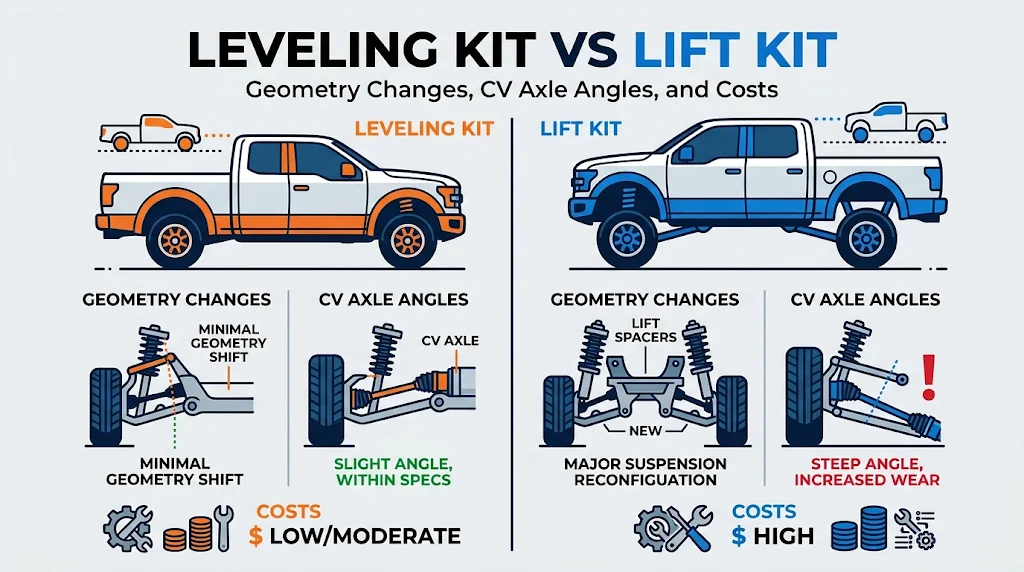
Driving off the dealership lot in a brand-new or late-model pickup truck is exhilarating, but factory stances rarely satisfy enthusiast expectations. Most trucks roll off assembly lines with a noticeable factory rake—the front end sits one to three inches lower than the rear. While this rake serves a practical purpose—preventing severe sagging when towing heavy loads or filling the truck bed—it leaves many owners staring at an unsightly wheel gap up front and a lack of clearance for larger, aggressive off-road tires.
To correct this, truck owners almost universally turn to two primary suspension upgrades: leveling kits and suspension lift kits.
However, bolting on metal spacers or dropping crossmembers is not merely an aesthetic choice. Modifying your truck’s ride height fundamentally alters its factory engineering, throwing off suspension geometry, straining CV axle angles, accelerating component wear, and impacting your wallet differently.
If you are trying to decide whether a budget-friendly leveling kit or a comprehensive suspension lift kit is right for your rig, this guide breaks down the engineering mechanics, long-term trade-offs, financial investments, and real-world impacts of both options.
1. Understanding the Anatomy of Factory Suspensions and Rake
Before evaluating aftermarket modifications, it is crucial to understand why manufacturers design trucks with a rake.
When a truck is unladen, the weight distribution heavily favors the front steering axle. When you hitch a 7,000-pound travel trailer or toss a pallet of concrete blocks into the bed, the rear leaf springs or coil springs compress under the dynamic load. If the truck were completely level when empty, adding tongue weight or bed cargo would cause the rear end to squat significantly. This squat unloads the front tires, degrades steering response, blinds oncoming traffic with misaligned headlights, and ruins handling stability.
Factory Suspension Layouts
-
Independent Front Suspension (IFS): Most modern half-ton and mid-size trucks (like the Ford F-150, Ram 1500, Toyota Tacoma, and Chevy Silverado) utilize IFS with upper and lower control arms, coil-over shock assemblies (struts), and Constant Velocity (CV) axles.
-
Solid Front Axle (SFA): Heavy-duty trucks (like the Ford F-250/F-350 Super Duty or Ram 2500/3500) frequently use solid front axles with coil springs or leaf springs, offering immense durability for heavy towing and rock crawling.
2. Leveling Kits: Mechanics, Geometry, and Cost
A leveling kit is designed for one specific purpose: to raise the front end of the truck by 1 to 3 inches to match the height of the rear, eliminating the factory rake and creating a flat, aggressive stance.
Types of Leveling Kits
-
Strut Spacers (Top-Mount or Pre-Load Spacers): Bolted directly onto the top of the factory strut assembly or placed inside the spring to compress the coil. These are the most common and affordable options for IFS trucks.
-
Torsion Key Replacements: Common on older GM and Ford trucks with torsion bar suspension. Replacing factory keys with indexed aftermarket keys twists the torsion bars higher, raising the front ride height.
-
Coil Spring Spacers: Used on solid-axle trucks (like front-coil Jeeps and Ram heavy-duty trucks), these sit on top of or beneath the factory front coil springs.
Suspension Geometry & CV Axle Angle Impact
When you install a leveling kit on an IFS truck, you push the lower control arm downward relative to the chassis while the upper control arm pushes up against the extended strut.
-
CV Axle Angles: Because the differential remains bolted in its factory position while the wheel hub is pushed downward, the CV axle operating angle increases sharply. Steep CV angles create constant boot friction, accelerated joint wear, and eventual premature failure of the inner and outer CV joints.
-
Ball Joint Binding: The factory upper control arm is forced closer to its maximum downward angle limit. Over rough terrain, the ball joint stud can bind against the control arm housing, leading to torn dust boots and catastrophic ball joint failure.
-
Wheel Alignment Changes: Raising the front end changes caster and camber geometry. Without an alignment, your truck will pull to one side, experience twitchy high-speed steering, and feather the outer edges of your front tires within thousands of miles.
Cost Breakdown for Leveling Kits
Leveling kits represent the most cost-effective entry point for truck modifications.
-
Parts Cost: $50 to $400 (depending on whether you buy simple top spacers or complete replacement upper control arms with corrected ball joint angles).
-
Installation Labor: $200 to $500 (typically 2 to 4 hours of shop time).
-
Professional Wheel Alignment: $100 to $150 (mandatory after installation).
-
Total Estimated Investment: $350 to $1,050.
Pro Tip: If you install a leveling kit taller than 2 inches on an IFS truck, always invest in aftermarket upper control arms (UCAs) with corrected ball joint angles. This single upgrade relieves severe ball joint binding and preserves factory steering geometry.
3. Lift Kits: Comprehensive Engineering, Geometry, and Cost
A suspension lift kit is a much more thorough, comprehensive engineering overhaul. Rather than simply packing spacers onto factory struts, a full lift kit (ranging from 3 to 6+ inches of lift) raises both the front and the rear of the truck proportionally, preserving the factory rake or leveling it slightly while dramatically increasing ground clearance.
Key Components of a Quality Lift Kit
A proper lift kit does not just stack parts; it re-engineers the entire suspension geometry to restore factory-like driving dynamics:
-
Dropped Crossmembers: On IFS trucks, a quality lift kit includes steel drop crossmembers that lower the front differential housing. By lowering the differential, the kit keeps CV axle angles near factory specs, preventing extreme joint strain.
-
New Knuckles / Spindles: Extended steering knuckles maintain proper steering geometry and prevent bump steer.
-
New Lifted Springs and Shocks: Replacing factory struts and rear leaf springs or blocks with matched, valved suspension components ensures ride quality is maintained rather than rendered jarringly stiff.
-
Extended Control Arms and Track Bars: Keeps axle alignment centered and caster angles correct.
Suspension Geometry & CV Axle Angle Impact
Because premium lift kits lower the front differential alongside the control arms, CV axle angles remain relatively flat. This is the hallmark engineering difference between a 3-inch leveling kit and a 4-to-6-inch suspension lift kit:
-
Preserved CV Lifespan: Because the CV joints do not operate at extreme, acute angles, rubber boots don’t pinch and crack, saving you from constant axle replacements.
-
Driveshaft Angle and Slip Yoke Splines: On lifted trucks with taller tail-shaft drops, rear driveshaft angles increase, occasionally requiring a slip-yoke eliminator or custom cardan (double-cardan) driveshaft to prevent annoying high-speed vibrations.
-
Center of Gravity: Raising the entire vehicle by 4 to 6 inches raises the center of gravity, increasing body roll in sharp cornering maneuvers. Stiffer sway bar links and performance shock absorbers are mandatory to counteract this shift.
Cost Breakdown for Lift Kits
Lift kits are premium, labor-intensive investments that require specialized mechanical expertise.
-
Parts Cost: $1,000 to $5,000+ (depending on lift height, brand reputation, and whether premium reservoir shocks are included).
-
Installation Labor: $1,200 to $3,000 (typically 8 to 16 hours of complex mechanical labor, including frame cutting on certain modern truck models).
-
Professional Wheel Alignment: $150 to $250 (specialized heavy-duty alignment rack required).
-
Tire and Wheel Upgrades: $1,500 to $3,500 (larger lifts require 33-inch to 37-inch tires and wider wheels with appropriate backspacing).
-
Total Estimated Investment: $3,850 to $11,500+.
4. Head-to-Head Comparison: Leveling Kit vs. Lift Kit
To crystallize the differences, examine how leveling kits and lift kits stack up across critical performance and ownership metrics:
| Feature / Metric | Leveling Kit (1″ – 3″) | Suspension Lift Kit (3″ – 6″+) |
| Primary Goal | Remove factory rake; clear 33″ tires | Massive ground clearance; clear 35″+ tires |
| Front Differential Drop | None (Differential stays bolted high) | Yes (Dropped crossmembers keep CVs flat) |
| CV Axle Angle Stress | High (Steep angles on IFS trucks) | Low to Moderate (Corrected via dropped diff) |
| Ride Quality Impact | Minimal to slightly stiffer (if pre-load spacers) | Varies (Can maintain or improve ride with quality shocks) |
| Towing / Hauling Capacity | Reduced rear capacity if overloaded; prone to squatting | Preserved (Rear springs/blocks matched to lift height) |
| Total Cost (Installed) | $350 – $1,050 | $3,850 – $11,500+ |
| Installation Time | 2 to 4 hours | 1 full day to 2 days |
5. Common Pitfalls and Mistakes to Avoid
Modifying truck suspension is a precise science. Skipping steps or cutting corners leads to dangerous handling, expensive repairs, and a ruined driving experience. Avoid these frequent mistakes:
Mistake #1: Installing Budget Spacer Lifts on IFS Trucks Without Upgraded UCAs
Many owners purchase the cheapest 3-inch top-strut spacer kit online. Without upgraded upper control arms, the factory ball joints operate at a severe bind angle. Within 15,000 miles, the ball joints fail, leaving your front wheel sheared or canted at an unsafe angle on the highway.
Mistake #2: Neglecting Post-Installation Headlight Realignment
When you lift the front end of your truck, your low-beam and high-beam headlight projectors are suddenly pointed upward into the eyes of oncoming traffic rather than down at the asphalt. Always recalibrate and adjust your headlight housing angles immediately after installation.
Mistake #3: Ignoring Electronic Safety Systems (ADAS)
Modern trucks (Ford Co-Pilot360, Chevy Safety Assist, Ram Safety Group) rely on forward-facing cameras, radar sensors in the grille, and electronic stability control (ESC) calibrated strictly to factory ride heights. Altering vehicle height without recalibrating steering angle sensors and ADAS modules can trigger erratic traction control braking or false collision warnings.
Mistake #4: Forgetting Speedometer and Transmission Shift Calibration
Slapping on 35-inch mud-terrain tires after a lift kit changes your final drive gear ratio. Your speedometer will read slower than your actual speed, and your automatic transmission will “hunt” for gears on the highway because the shift points no longer align with tire circumference. Reprogramming your ECU with a programmer is essential.
6. Frequently Asked Questions (FAQ)
Will a leveling kit void my truck’s factory warranty?
Under the Magnuson-Moss Warranty Act, simply installing an aftermarket leveling kit or lift kit does not automatically void your entire factory warranty. However, if a dealership can prove that premature failure of a component—such as a CV axle, wheel bearing, or steering rack—was directly caused by the geometry stress of your aftermarket kit, they can deny warranty coverage for that specific repair.
Can I install a leveling kit or lift kit myself in my garage?
A leveling kit can be installed at home with basic hand tools, a floor jack, jack stands, and a spring compressor (if using pre-load spacers), provided you have mechanical aptitude. However, full suspension lift kits require cutting factory crossmember brackets, dropping heavy differential housings, and torqueing critical suspension fasteners to exact factory specs. These are best left to professional off-road installation shops.
Which option is better for towing heavy trailers?
A leveling kit is generally counterproductive for heavy towing because it removes the factory rake; when you hook up a heavy trailer, your rear end will squat heavily, blinding drivers and destabilizing steering. A lift kit that maintains a proportional rake (or is paired with rear airbags/helper springs) is vastly superior for heavy towing while maintaining lifted stance aesthetics.
7. Conclusion: Making Your Final Decision
Choosing between a leveling kit and a suspension lift kit comes down to balancing your aesthetic desires, functional needs, and budget:
-
Choose a Leveling Kit if: You want a clean, level stance, need just enough extra front clearance to fit 33-inch all-terrain tires for light off-roading or daily driving, and want to keep your modification budget under $1,000.
-
Choose a Suspension Lift Kit if: You demand true off-road articulation, want to run 35-inch or 37-inch monster tires, require maximum ground clearance for rocky trails or deep mud, and are prepared to invest in a properly engineered, comprehensive suspension overhaul.
Ready to transform your truck’s capability and stance? Consult with a certified local suspension specialist today to inspect your vehicle’s specific drivetrain layout, review component options, and get an accurate, professional installation quote tailored to your truck.

Benjamin Grey is an automotive engineer and writer at Car Parts Advisor. With years of experience in the automotive industry, he shares expert advice on car parts, maintenance, and repairs to help car owners keep their vehicles running smoothly.


