
Every time you replace brake pads, swap calipers, or flush old fluid, you introduce one unavoidable problem into your brake system: air. Air in brake lines is compressible. Brake fluid is not. When air gets into the hydraulic circuit — even a small bubble — the result is a soft, spongy pedal that travels further than it should before the brakes engage. In a worst-case scenario, enough air in the lines means the pedal goes straight to the floor with almost no braking response.
Bleeding the brakes is the process of purging that air. It’s a mandatory step after any brake service, and it’s one of the skills that separates a DIY mechanic who can do complete brake jobs from one who can only change pads.
The traditional two-person method — one person pumping the pedal while another opens and closes bleeder screws at each corner — works, but it requires a helper, good communication, and careful timing to avoid pulling air back into the system. A dedicated brake bleeding kit makes the job faster, more reliable, and in most cases achievable by a single person working alone.
This guide covers the five best brake bleeding kits available on Amazon right now — from budget-friendly manual gravity bleeders to professional-grade pneumatic vacuum tools — with a pick for every skill level, budget, and use case.
Types of Brake Bleeding Kits: What’s Available
Before diving into the picks, it helps to understand the different bleeding methods, since each kit type works differently and suits different situations.
Gravity bleeding. The simplest method — open the bleeder screw, let fluid flow out under its own weight, close it when bubbles stop. No tools required beyond a wrench and a catch bottle, but it’s slow and inconsistent. Gravity kits add one-way valves and hoses to automate the process while preventing backflow.
Manual pressure bleeding. A helper pumps the brake pedal to push fluid (and air) out through the open bleeder screw. The fastest method when done correctly with two people. Many of the kits in this guide include one-way check valve hoses that make this achievable solo.
Vacuum bleeding. A handheld pump creates negative pressure at the bleeder screw, drawing fluid and air out of the system. Highly effective for solo operation and gives excellent visual feedback through a transparent reservoir. The most popular method for DIY mechanics working alone.
Pneumatic (air-powered) vacuum bleeding. Uses shop air to generate suction rather than a hand pump. Faster than manual vacuum bleeding and requires less physical effort, but needs a compressor. Best for mechanics with air tools already in their shop.
Reverse (pressure injection) bleeding. Pushes fresh fluid in from the bottom (bleeder screws) upward, pushing air up and out through the master cylinder reservoir. Very effective at removing stubborn air pockets but requires a specific kit and more preparation.
Top 5 Brake Bleeding Kits for DIY Mechanics
1. OFBAND 2-Set Brake Bleeder Kit — Best Budget Manual Kit for Beginners
For the DIY mechanic who’s new to brake bleeding, working on a single vehicle, or simply wants a reliable backup kit to keep in the toolbox, the OFBAND two-set bleeder kit is the most accessible entry point on this list. The value proposition is immediately obvious: you get two complete sets of bleeding hardware — four brake bleeder hoses and two one-way check valves — at a price that makes it essentially a no-cost addition to any brake job.
The one-way check valve is the key component in any gravity or manual bleed kit. It allows fluid and air to flow out of the bleeder screw when the pedal is pumped or gravity draws it down, but prevents the fluid from being sucked back into the system when pressure reverses. Without a one-way valve, every pedal return stroke risks pulling air back in through a partially opened bleeder — exactly what you’re trying to eliminate.
The OFBAND’s check valves are designed for the critical seal quality that prevents bypass leakage. The bleeder hoses are transparent, which is one of the most practically useful features a budget kit can offer — you can watch the fluid flowing through and see clearly when the stream transitions from bubbly to clean, consistent fluid with no visible air. That visual confirmation is how you know each corner is done.
The universal fit covers the bleeder nipple sizes found on the vast majority of passenger cars, trucks, motorcycles, and bicycles. For a kit that costs less than a lunch, it handles the core job reliably and gives a new DIY mechanic a frustration-free introduction to brake bleeding.
The kit is best suited for gravity bleeding and assisted single-person operation — open the bleeder, attach the hose, pump the pedal slowly from inside the car, watch the bubbles clear, and close the bleeder. Clean, simple, and effective for any standard brake service.
Best for: First-time brake bleeders, budget-conscious DIYers, beginners learning brake system maintenance, or anyone who needs a simple universal gravity/manual kit.
👉 Shop OFBAND Brake Bleeder Kit
2. Luney Pneumatic Brake Fluid Bleeder Kit — Best for Solo One-Person Operation
The Luney pneumatic brake bleeding kit is the most capable tool on this list for a solo DIY mechanic who wants to do complete, professional-quality brake bleeds without a helper. This is a pressure-based system powered by shop air — connect the included adapter to your compressor’s air supply, attach it to the brake fluid reservoir, and use air pressure to push fluid through the system and out through the bleeder screws one corner at a time.
The one-person operation capability is the defining feature. Traditional pedal-pump bleeding requires a helper inside the car to pump the pedal on command while you manage the bleeder screw outside — timing, communication, and the risk of the helper releasing the pedal too quickly all become variables that affect the quality of the bleed. With pressure bleeding, there’s no pedal involved. Steady pressure in the reservoir continuously pushes fluid toward and out of the bleeder you have open. You work alone, move at your own pace, and watch the fluid until it runs clean.
The 1-liter refilling bottle is a genuinely useful inclusion. During a complete four-wheel flush on a vehicle with a larger brake system — a full-size truck, an SUV, or a performance car with large-volume calipers — you’ll move through more than a standard reservoir of fresh fluid. The refilling bottle lets you continuously replenish the reservoir without stopping the job to prevent it from running dry, which would introduce air back into the master cylinder and defeat the purpose of the bleed.
The 16-adapter set is the widest adapter range in this guide, covering an enormous range of reservoir cap styles across American, European, and Asian passenger cars and trucks. Compatibility is one of the most common frustration points with pressure bleeding kits — having 16 options essentially eliminates the chance of opening the box and finding nothing that fits your specific reservoir cap.
The pressure gauge allows you to set and monitor the working pressure during the bleed. Most systems work best at 10–15 PSI — enough to move fluid steadily without stressing rubber brake lines or seals. The gauge removes the guesswork and protects against overpressure that could damage older brake hoses.
Best for: Solo DIY mechanics doing complete brake system flushes, multi-car household mechanics, and anyone who wants to eliminate the need for a helper on brake jobs entirely.
👉 Shop Luney Pneumatic Brake Bleeder Kit
3. Brake & Clutch Bleeding Kit with 100ml Syringe — Best for Motorcycles & Small Systems
Not every brake bleeding job involves a full-size car with large reservoir volumes and four corners to service. Motorcycles, bicycles with hydraulic disc brakes, ATVs, and small vehicles with compact brake systems have their own requirements — and the oversized, multi-adapter kits designed for passenger cars often provide more hardware than the job needs while being awkward to use in the tight spaces around motorcycle brake systems.
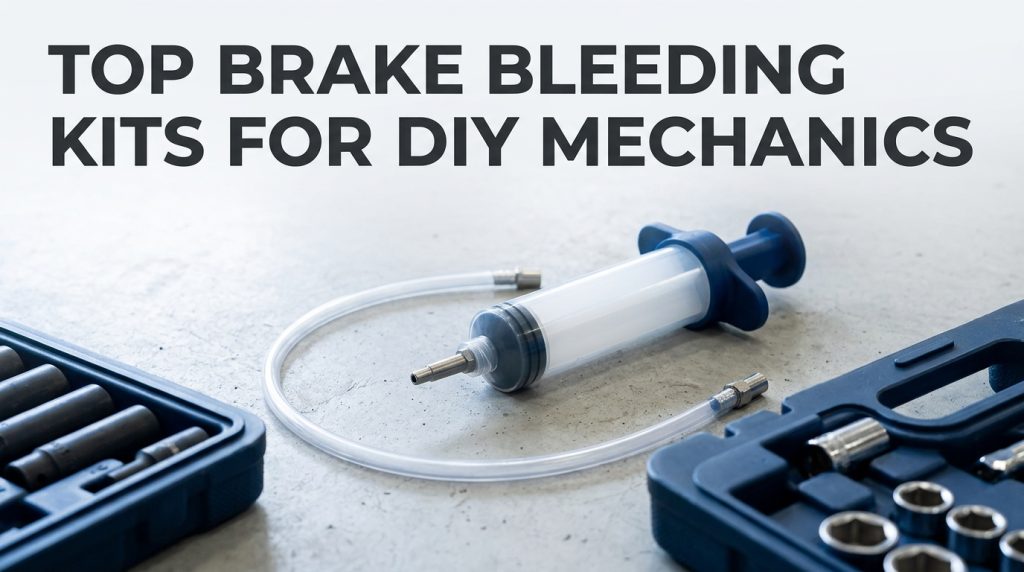
This syringe-based kit is designed for exactly these smaller-scale applications. The 100ml syringe at the center of the kit is used for reverse bleeding — drawing fluid and air up from the bleeder screw by creating suction with the syringe plunger. For a motorcycle with a single front caliper and a small reservoir, this method is fast, clean, and provides excellent visual feedback. The syringe body is transparent, so you can watch the fluid and air entering it in real time and stop when the flow runs clean.
The one-way check valve tube prevents the classic reverse-flow problem that ruins manual syringe bleeds — without the check valve, releasing the syringe plunger can push fluid back into the system along with any air it picked up. The valve ensures fluid flows only in the intended direction, toward the syringe, for a clean, bubble-free result.
Spring clamps are included to secure the hose connections at both the bleeder screw end and the syringe end, preventing the minor leaks and disconnections that can introduce air during the bleed. These small details — the check valve, the spring clamps, the transparent syringe body — reflect a kit that was designed by someone who has actually bled motorcycle brakes and knows where the frustrations occur.
For cars, this kit works well for top-up bleeds after small repairs — replacing a single caliper, fixing a leaking fitting — where you need to purge air from one specific point rather than flush the entire system. The 100ml volume handles these targeted bleeds efficiently.
Best for: Motorcycle owners, bicycle hydraulic disc brake maintenance, ATV and small vehicle brake service, and targeted single-point bleeds on cars after caliper or line repairs.
👉 Shop Brake & Clutch Syringe Bleeding Kit
4. Orion Motor Tech Vacuum Brake Bleeder Kit — Best Hand Vacuum Pump Kit
The Orion Motor Tech vacuum brake bleeder is the most complete hand-operated vacuum bleeding kit in this guide. Where the syringe kit above uses manual draw for targeted bleeds and the Luney uses air pressure for large-volume flushing, this kit occupies the middle ground — a handheld vacuum pump that creates consistent negative pressure at the bleeder screw, drawing fluid and air out one corner at a time. No compressor required. No helper required. Just you, the pump, and a wrench.
The hand vacuum pump is the functional heart of the kit. Squeeze the handle to generate suction, attach the hose to the bleeder screw, open the nipple, and watch fluid flow into the transparent collection chamber. The pump’s pressure gauge is visible throughout the process, allowing you to maintain a consistent vacuum level — typically 20–25 inHg for brake bleeding — that draws fluid steadily without pulling so much suction that it ingests air past the bleeder screw threads.
The transparent fluid collection chamber is one of this kit’s most useful design elements. It holds enough fluid to complete a corner or two before needing to be emptied, and the transparent walls let you see exactly what’s coming out — heavy bubbles early in the bleed transitioning to a clear, bubble-free stream that tells you the corner is done. This visual feedback is more reliable than trying to judge by pedal feel alone, especially for newer DIY mechanics.
The included adapter set covers the most common bleeder nipple sizes across passenger cars, trucks, and light commercial vehicles. The adapters create a sealed connection between the hose and bleeder nipple that prevents air ingestion past the threads — a critical detail that cheaper vacuum kits omit, resulting in a stream of bubbles that never clears because you’re pulling in as much air as you’re removing.
Beyond brake bleeding, this kit handles power steering fluid changes, fuel system service, and other automotive fluid extraction tasks. For a DIY mechanic building out a toolkit, a vacuum pump with multiple applications offers better value than a single-purpose tool.
Best for: Solo DIY mechanics without a compressor who want a professional-quality vacuum bleeding experience, versatile fluid service tasks, and comprehensive adapter coverage for multi-vehicle households.
👉 Shop Orion Motor Tech Vacuum Brake Bleeder Kit
5. Enhon Master Cylinder Bleeder Kit — Best for Master Cylinder Service & Bench Bleeding
Most brake bleeding kits focus on the wheel end of the system — the caliper bleeder screws. The Enhon Master Cylinder Bleeder Kit fills a different but equally important role: bench bleeding a replacement master cylinder before installation, and servicing the master cylinder end of the brake hydraulic circuit after any repair that opens that portion of the system.
Bench bleeding is a mandatory step when installing a new or rebuilt master cylinder. If you bolt a dry master cylinder into the car without pre-filling and bleeding it first, the master cylinder will contain an air column that’s nearly impossible to purge through normal wheel-end bleeding. The internal valves and chambers in a master cylinder trap air in ways that won’t respond to pedal pumping or vacuum bleeding at the calipers.
Bench bleeding solves this by filling the master cylinder on the workbench before installation, running hoses from the outlet ports back into the reservoir, and slowly cycling the piston until all air is expelled and only fluid flows through the return hoses. The Enhon kit includes the 22-inch hose, fittings, and check valve components needed to set up this bench bleed correctly.
The SAE and metric fittings cover the thread specifications found across domestic and import vehicle master cylinders, and the PTFE tape included in the kit provides the thread seal needed at each fitting connection to prevent air ingestion during the bleed process. The 22-inch hose length gives enough reach to route cleanly from the outlet ports back into the reservoir without kinking.
For a DIY mechanic doing a complete master cylinder replacement — one of the more involved brake jobs — having this kit on hand is the difference between a professional installation and a frustrating afternoon of pedal pumping that never fully firms up because the master cylinder was never properly bench bled.
Best for: Master cylinder replacement jobs, full brake system rebuilds, DIY mechanics tackling advanced brake system repairs, and anyone replacing a master cylinder for the first time who wants to do it correctly.
👉 Shop Enhon Master Cylinder Bleeder Kit
Side-by-Side Comparison
| Kit | Type | Solo Use | Best Application | Compressor Needed |
|---|---|---|---|---|
| OFBAND 2-Set | Manual / Gravity | With helper or solo | Budget pad swaps, first-time bleeders | No |
| Luney Pneumatic | Pressure (air-powered) | Yes — fully solo | Complete system flushes, multi-car garages | Yes |
| Syringe Kit | Reverse syringe | Yes — fully solo | Motorcycles, small systems, targeted bleeds | No |
| Orion Motor Tech | Vacuum (hand pump) | Yes — fully solo | General passenger car bleeds, fluid service | No |
| Enhon Master Cylinder Kit | Bench bleed / master cylinder | Yes | Master cylinder replacement, system rebuilds | No |
Which Kit Is Right for Your Situation?
Just changed pads and need a quick bleed with a friend helping? The OFBAND one-way valve kit handles this cleanly and costs almost nothing.
Doing a full brake flush alone with no helper and no compressor? The Orion Motor Tech vacuum pump kit is your tool — professional vacuum bleeding, complete adapter set, no air required.
Working alone with a compressor in the shop? The Luney pneumatic kit is the fastest, most complete solo flushing tool available at this price.
Bleeding motorcycle or bicycle hydraulic brakes? The syringe kit is purpose-built for compact systems and tight spaces.
Replacing a master cylinder? The Enhon bench bleeding kit is the specific tool for that specific job — don’t attempt a master cylinder swap without it.
Common Brake Bleeding Mistakes to Avoid
Even with a good kit, a few errors can turn a straightforward bleed into a frustrating job:
Letting the reservoir run dry. This introduces air directly into the master cylinder — far harder to purge than air at the wheel end. Keep the reservoir topped up throughout the bleed, checking it frequently.
Working in the wrong order. Start at the wheel farthest from the master cylinder (typically right rear on most vehicles) and work toward the closest (front left). This pushes air toward and out of the system in the correct direction.
Over-tightening bleeder screws. Bleeder screws are soft, hollow, and easily snapped. Snug is enough — do not torque them like a lug nut. If a bleeder screw is seized, apply penetrating oil and let it soak before attempting to open it.
Not checking for leaks after bleeding. Before driving, pump the pedal firmly several times and hold steady pressure. Any drop in pedal height over 30 seconds indicates a leak or residual air. Inspect all bleeder screws and fittings before the vehicle moves.
Mixing brake fluid types. DOT 3, 4, and 5.1 are glycol-based and compatible. DOT 5 (silicone) is NOT compatible with any of the others. Confirm your vehicle’s specification and use only the correct fluid.
Final Verdict
Brake bleeding is a non-negotiable step in any complete brake service, and having the right kit makes it a manageable, satisfying DIY job rather than a frustrating guessing game. Every kit in this guide solves the core problem — purging air from your brake system — but each one is optimized for a different mechanic, vehicle type, and working situation.
Choose the kit that matches your tools, your vehicle, and how you work:
- Budget / beginner: OFBAND 2-Set Bleeder Kit
- Solo full-system flush (with compressor): Luney Pneumatic Kit
- Motorcycle / small system / targeted bleeds: Syringe Bleeding Kit
- Solo vacuum bleeding (no compressor): Orion Motor Tech Vacuum Kit
- Master cylinder replacement: Enhon Master Cylinder Bleeder Kit
As an Amazon Associate, we earn from qualifying purchases. Prices and availability are subject to change.

Benjamin Grey is an automotive engineer and writer at Car Parts Advisor. With years of experience in the automotive industry, he shares expert advice on car parts, maintenance, and repairs to help car owners keep their vehicles running smoothly.


