
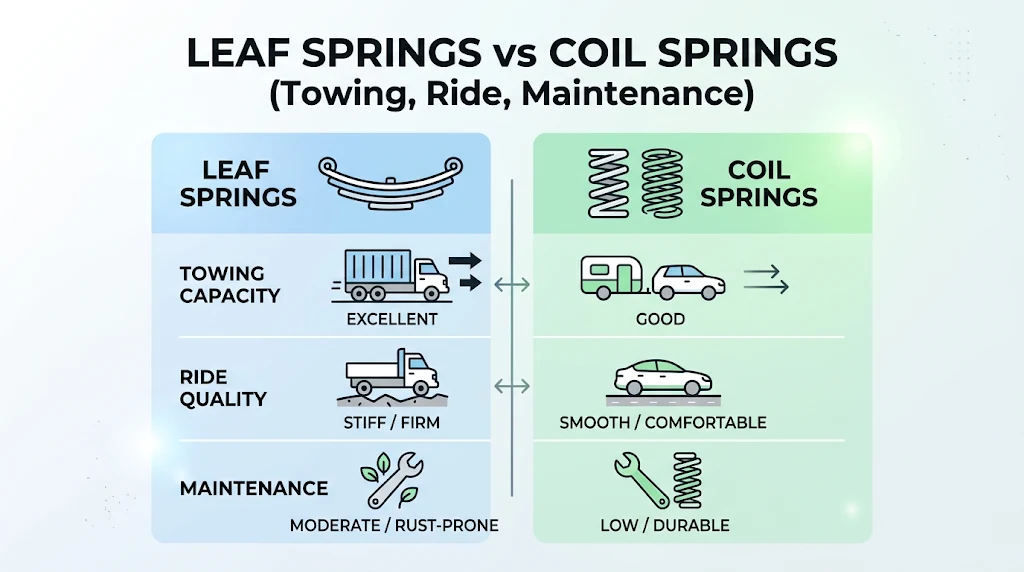
Choosing the right truck or SUV often boils down to a single, critical mechanical debate: Leaf Springs vs. Coil Springs. Whether you are setting up a rig for heavy-duty commercial towing, outfitting an overlanding vehicle for rugged trails, or simply trying to figure out why your daily driver rides like a hay wagon, understanding suspension architecture is essential.
For decades, automotive engineers have balanced three competing priorities: load-bearing capacity, ride comfort, and manufacturing cost. While traditional leaf springs built the American trucking industry, modern engineering has given rise to sophisticated multi-link coil setups and air-assisted systems that blur the lines between heavy-duty work and luxury comfort.
In this comprehensive guide, we will break down the mechanics, performance metrics, pros and cons, and maintenance requirements of both suspension systems so you can make an informed decision for your vehicle.
1. Understanding the Mechanics: How They Work
Before evaluating performance, it is vital to understand how each system stores and dissipates energy when interacting with road imperfections and cargo weight.
Leaf Springs: The Time-Tested Workhorse
A leaf spring consists of several curved layers of spring steel (known as leaves or leaves in a “pack”) bound together by a center bolt and alignment clips. The longest leaf (the main leaf) attaches to the vehicle frame via shackles and hangers, while the axle housing is clamped directly to the center of the spring pack using heavy-duty U-bolts.
-
How it handles force: When the wheel hits a bump or carries weight, the steel leaves flex and flatten, distributing the load across the entire length of the spring and into the frame mounting points.
-
Axle location: In a traditional leaf-spring setup, the springs themselves act as the locating arms for the axle, eliminating the need for complex control arms or panhard bars.
Pro Tip: If you notice your leaf springs starting to invert (bend upward in the middle instead of downward), your pack has lost its temper and structural arch, requiring immediate re-arching, helper additions, or replacement.
Coil Springs: The Helix of Comfort
A coil spring is a heavy-gauge steel rod wound into a helical cylinder. Unlike leaf springs, which rely on inter-leaf friction and multi-point frame contact, coil springs are dedicated solely to vertical suspension movement and energy absorption.
-
How it handles force: When compressed, the steel twists along its length, storing energy smoothly before rebounding. Because they cannot locate an axle on their own, vehicles utilizing coil springs require additional structural components—such as control arms, trailing links, and track bars—to keep the axle centered and aligned.
-
Progressive vs. Linear Rates: Most modern coil springs are wound progressively, meaning the spacing between coils varies. Closer coils compress easily for a soft ride over small bumps, while widerly spaced coils stiffen up under heavy loads or deep compression.
2. Head-to-Head Comparison: Towing Capacity and Payload Performance
When it comes to hauling heavy equipment, fifth-wheel trailers, or max-capacity payload beds, suspension design dictates safety and stability.
| Performance Metric | Leaf Springs | Coil Springs |
| Max Payload Support | Exceptional (Inherently progressive load handling) | High (Dependent on auxiliary air bags or progressive tuning) |
| Trailer Sway Resistance | High (Stiff lateral rigidity and multi-point frame mounting) | Moderate (Requires sway bars and robust control links) |
| Tongue Weight Sag | Minimal (Distributes weight across a broad footprint) | Higher (Softer initial spring rate allows rear squat) |
| Cost & Simplicity | Low cost, highly robust, fewer moving parts | Higher cost, complex multi-link geometry |
Why Leaf Springs Dominate Heavy-Duty Towing
Heavy-duty trucks (like Ford F-350s, RAM 3500s, and Chevrolet Silverado 3500HDs) rely on rear leaf springs because of their inherent load distribution properties. As cargo weight presses down on the truck bed, the upper helper leaves in a multi-leaf pack engage progressively. This means the spring rate automatically increases as the load gets heavier, preventing catastrophic rear squat and maintaining predictable steering geometry.
The Modern Coil-Spring Revolution in Half-Ton and HD Trucks
For years, coil springs were dismissed as incapable of heavy towing. However, modern engineering has rewritten the rules.
-
RAM’s Multi-Link Rear Coil Setup: RAM introduced a five-link rear coil suspension on its 1500 series (and later optional auxiliary auto-leveling air suspension on 2500 models), proving that coil springs could handle heavy tongue weights while delivering a ride quality previously reserved for luxury sedans.
-
The Trade-Off: While modern heavy-duty coil setups offer incredible ride quality, they often require factory or aftermarket air bags (
air helper springs) to eliminate squat when hooking up a heavy multi-ton camper or construction trailer.
3. Ride Quality, Handling, and Comfort: The Daily Driver Experience
If your vehicle spends 80% of its life empty—commuting, grocery shopping, or road-tripping—ride quality becomes a paramount concern.
The Leaf Spring “Empty Bed Bounce”
Traditional leaf springs are optimized for weight. When a one-ton truck bed is empty, the stiff spring pack doesn’t flex easily over minor road ripples. Instead, the rear end tends to jitter, skip, or bounce (“trampoline effect”) over potholes and expansion joints.
-
Friction Factor: The friction between individual steel leaves in a traditional pack creates resistance to movement (stiction), which further degrades small-bump compliance unless high-end parabolic leaf springs or specialized sliders are used.
The Plushness of Coil Springs
Coil springs offer superior independent or multi-link articulation because they lack inter-leaf friction. They compress smoothly in any direction, reacting instantly to micro-undulations in the pavement.
-
Real-World Scenario: Driving over a series of corrugated dirt washboards or highway speed bumps highlights the difference. A coil-sprung rear suspension isolates the cabin far more effectively, keeping the tires firmly planted on the road surface without transferring jarring impacts directly into the chassis and driver’s lower back.
4. Maintenance, Durability, and Longevity
Suspension components take a relentless beating from road salt, moisture, heavy impacts, and constant cyclic loading. How do leaf and coil setups hold up over time?
Leaf Spring Maintenance & Wear Points
-
Inter-Leaf Rust & Squeaking: Moisture creeps between the steel leaves, causing rust oxidation (“rust jacking”) that fuses the leaves together, stiffening the ride and creating obnoxious squeaking noises.
-
Bushing Wear: Polyurethane or rubber bushings at the shackle and frame eyes dry out, crack, and wear down, leading to axle wander and clunking sounds.
-
U-Torque Checks: Factory leaf spring U-bolts must be re-torqued periodically, especially on lifted or heavily loaded trucks, to prevent axle wrap and shifting.
Coil Spring Maintenance & Wear Points
-
Corrosion and Snapping: While single-piece coil springs have fewer contact points than leaf packs, a chip in the protective powder coating allows rust to take hold, eventually leading to sudden spring fracture under full compression.
-
Shock Absorber Dependency: Coil springs store energy efficiently, but they rely entirely on healthy shock absorbers to damp oscillation. If your shocks wear out, a coil-sprung vehicle will bounce uncontrollably, whereas a leaf spring’s natural inter-leaf friction provides some built-in damping (though worn shocks still ruin leaf setups).
5. Common Pitfalls and Mistakes to Avoid
Whether you are modifying your suspension, upgrading for a new camper, or performing routine upkeep, avoid these frequent errors:
-
Exceeding Gross Vehicle Weight Rating (GVWR): Assuming that adding heavy-duty helper springs or air bags increases your vehicle’s legal or mechanical towing capacity. Suspension upgrades help manage weight and stabilize handling, but they do not alter the structural limits of your axles, brakes, and transmission.
-
Ignoring Axle Wrap: Upgrading horsepower without addressing leaf spring wind-up (axle wrap). Under hard acceleration, high-torque engines can cause leaf springs to twist into an “S” shape, leading to wheel hop and damaged driveshafts. Installing traction bars prevents this.
-
Mismatched Lift Components: Lifting a leaf-sprung vehicle with cheap lift blocks without checking pinion angles, which causes severe driveline vibration and premature U-joint failure.
-
Neglecting Bushings and Shackles: Replacing worn springs while leaving old, degraded rubber bushings in place, rendering the new suspension loose and unresponsive.
6. Frequently Asked Questions (FAQs)
Can you convert coil springs to leaf springs (or vice versa)?
Yes, custom off-road shops and suspension manufacturers offer conversion kits for both directions. Leaf-to-coil conversions are popular among Jeep and classic truck enthusiasts seeking superior articulation and ride comfort. Conversely, coil-to-leaf conversions are occasionally performed on work trucks converted into dedicated heavy haulers, though they require extensive custom frame fabrication.
Do coil springs sag faster than leaf springs?
Not necessarily. High-quality coil springs maintain their height and spring rate for hundreds of thousands of miles unless subjected to chronic overloading or severe corrosion. Leaf springs, however, are more prone to progressive sagging over time due to metal fatigue and continuous multi-leaf friction wear.
Why do heavy-duty commercial dump trucks still use leaf springs?
Leaf springs are preferred in commercial applications because of their unmatched mechanical simplicity, roadside repairability, and extreme resistance to lateral loads when dumping heavy uneven payloads on unstable job sites.
How do helper springs affect everyday ride quality?
Standard add-a-leaf kits or mechanical helper springs will slightly stiffen the rear ride when the truck bed is empty because they increase the baseline spring rate. However, progressive helper springs and adjustable air helper systems allow you to dial in firmness only when towing, preserving your factory empty ride.
Conclusion
The choice between leaf springs and coil springs comes down to your primary use case. If your daily routine involves hauling heavy payloads, managing commercial construction loads, and prioritizing maximum lateral stability under heavy tongue weight, leaf springs remain the gold standard of rugged reliability.
On the other hand, if your priority is daily driving comfort, superior highway manners, articulation on rocky trails, and smooth energy absorption, coil springs (especially when paired with modern adaptive or air-ride assistance) deliver an unbeatable driving experience.
Ready to upgrade your rig? Evaluate your actual towing weights and daily driving habits before making a purchase. Explore our comprehensive suspension parts reviews or consult with a certified technician to find the ideal spring rate and configuration for your vehicle today.

Benjamin Grey is an automotive engineer and writer at Car Parts Advisor. With years of experience in the automotive industry, he shares expert advice on car parts, maintenance, and repairs to help car owners keep their vehicles running smoothly.


