Walk through the performance brake aisle on Amazon — or peer through the spokes of any enthusiast’s wheels — and you’ll quickly notice that not all rotors look the same. Some have rows of holes punched through the swept surface. Others have angled grooves cut across the face. Some have both. And the factory blank rotors that came on most vehicles have neither.
The drilled vs slotted debate is one of the most common questions in the automotive world, and it generates strong opinions on both sides. Street drivers swear by drilled rotors for cooler braking and cleaner looks. Performance drivers insist slotted rotors bite harder and last longer under real stress. Track enthusiasts often go with a combination of both.
The truth is more nuanced than either camp admits — and the right answer depends almost entirely on how, where, and how hard you drive.
This guide breaks down exactly how each rotor design works, where each one excels, where each one falls short, and how to choose the right option for your specific driving situation. Both options are available right now on Amazon, and we’ll link you directly to each.
👉 Shop Drilled Rotors on Amazon
👉 Shop Slotted Rotors on Amazon
Starting Point: What’s Wrong With Blank Rotors?
Before comparing drilled and slotted designs, it’s worth understanding why they were developed in the first place — and what problem they’re solving that blank rotors create.
A blank rotor is a solid, smooth iron disc. When a brake pad presses against it, friction converts kinetic energy into heat. Under normal driving conditions, the heat generated per stop is modest and the rotor dissipates it easily between brake applications. Blank rotors are adequate, cost-effective, and what the majority of passenger vehicles ship with from the factory.
The problem emerges under sustained or aggressive braking. As heat builds faster than it can escape, rotor surface temperature rises dramatically. Two things happen at this point. First, the brake pad compound can begin to transfer a thin layer of material onto the rotor surface in an uneven pattern — these deposits create thickness variations that produce the pulsating pedal most drivers associate with “warped rotors.” Second, off-gassing begins: as the pad compound heats, it releases gases that form a thin compressible layer between the pad and rotor surface, reducing the friction coefficient. This is brake fade — the terrifying experience of pressing the pedal and feeling the brakes respond less than expected.
Drilled and slotted rotor designs both exist to address these problems, but they do it in different ways.
How Drilled Rotors Work
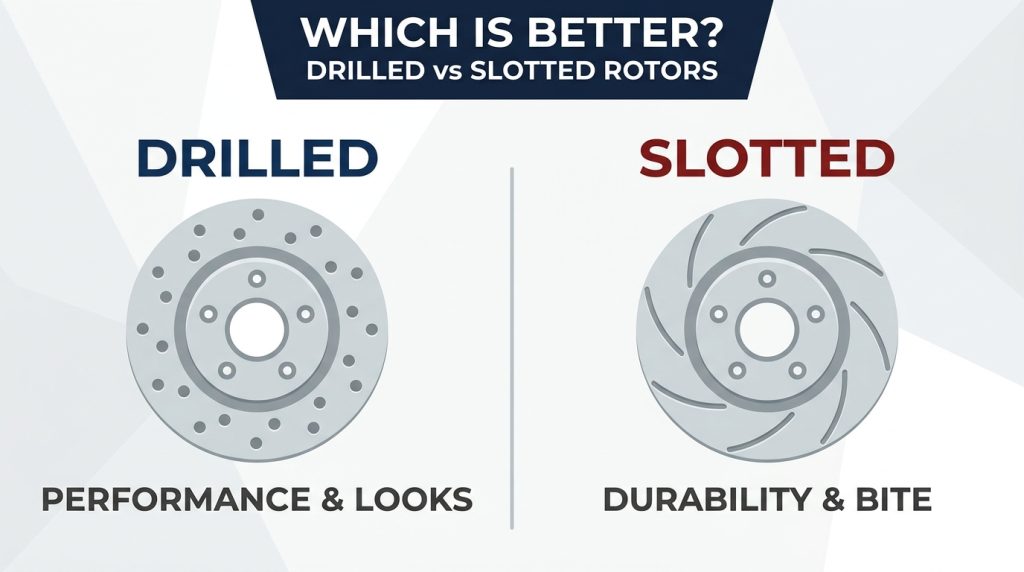
Drilled rotors have holes — typically arranged in a curved pattern across the swept surface — that pass completely through the rotor face. The holes serve two purposes.
Heat dissipation. The additional surface area created by the holes allows more heat to radiate away from the rotor during and after braking. More surface area means faster cooling, which keeps rotor temperatures lower during repeated stops.
Gas and water evacuation. The holes provide escape paths for the gases generated by brake pad off-gassing at high temperatures. Rather than accumulating between pad and rotor as a compressible layer that reduces friction, the gases can exit through the holes. The same principle applies to water — on a wet road, standing water on the rotor surface reduces pad contact and extends stopping distances. Drilled holes allow that water to evacuate from the contact zone faster than it can on a blank surface.
The result is a rotor that runs cooler, maintains more consistent friction during spirited driving, and recovers faster after hard stops. The holes also give drilled rotors their distinctive high-performance appearance — a purely cosmetic benefit that nevertheless matters to many buyers.
👉 Shop Drilled Rotors on Amazon
Where Drilled Rotors Excel
Drilled rotors are genuinely excellent for street performance driving, sporty daily drivers, and vehicles that see occasional aggressive use without reaching the sustained extreme heat of a track environment. If your driving involves spirited mountain roads, occasional hard braking from highway speed, or a mix of city and canyon driving, drilled rotors deliver a noticeable improvement over blank factory units.
They’re also the better aesthetic choice for drivers who care about wheel appearance. The pattern of drilled holes visible through alloy spokes looks purposeful and performance-oriented in a way that neither blank nor slotted rotors quite match.
For wet-weather commuters, the water evacuation benefit of drilled rotors provides a genuine safety advantage. The initial brake application after driving through standing water or heavy rain bites harder on drilled rotors than on equivalent blank surfaces because the water is displaced from the contact zone faster.
Where Drilled Rotors Fall Short
The holes that make drilled rotors effective also create a structural weakness. Cast iron — the material almost all rotors are made from — is strong under compression but relatively brittle under tension and stress cycling. The edges of each drilled hole become stress concentration points as the rotor goes through repeated heat-and-cool cycles. Under extreme, sustained heat — the kind generated by lap after lap on a race circuit, or repeated high-speed stops with minimal cooling intervals — these stress points can develop microcracks that propagate over time.
This is why drilled rotors are typically not recommended for dedicated track use or for heavy towing and hauling applications where sustained thermal stress is the norm rather than the exception. For street use and occasional performance driving, the loads involved are well within the safety margin of any quality drilled rotor. But push those loads into true racing territory and the holes become a liability.
Drilled rotors also tend to wear brake pads slightly faster than slotted designs, because the leading edge of each hole acts as a mild cutting surface that abrades the pad material as it passes over. For street use, this difference is minor. For track use where pad consumption is already high, it’s a consideration.
How Slotted Rotors Work
Slotted rotors have linear grooves — typically angled at 30 to 45 degrees across the swept surface — machined into the rotor face. They don’t penetrate through to the other side of the rotor; they’re surface channels cut to a specific depth.
The mechanism is different from drilled rotors, and in some respects more mechanically robust.
Continuous pad surface refresh. As the pad sweeps across the rotor, the slots act like a file on the pad face, continuously cutting away a thin layer of glazed or gas-impregnated pad material and exposing fresh, uncontaminated compound. This is the primary advantage of slotted rotors: they maintain a consistently fresh pad contact surface that provides reliable friction throughout a driving session, even as pad temperatures rise.
Gas and debris channeling. The slots create channels through which gases generated at the pad-rotor interface are swept outward by the rotation of the rotor rather than allowed to accumulate. The effect is less dramatic than the through-holes of drilled rotors but continuous and consistent — the slots are constantly moving the interface boundary outward as the rotor spins.
Rotor structural integrity. Because the slots don’t penetrate through the rotor face, they don’t create the stress concentration points that drilled holes do. A slotted rotor retains far more of its original structural integrity than a drilled one, making it the safer choice under sustained high-heat conditions.
👉 Shop Slotted Rotors on Amazon
Where Slotted Rotors Excel
Slotted rotors are the preferred choice for serious performance driving, track use, towing, hauling, and any application where the brakes see sustained, repeated stress. The structural integrity advantage over drilled rotors is meaningful when rotors are being cycled through high-temperature extremes repeatedly, and the continuous pad surface refresh function keeps friction levels consistent through hard driving sessions in a way that drilled rotors can’t match.
For trucks and SUVs used for towing or hauling, slotted rotors are the superior choice. The heat generated by a loaded truck making repeated stops — especially on grades — is exactly the kind of sustained thermal stress that exposes the structural weakness of drilled designs. Slotted rotors handle this environment more reliably.
Performance drivers who spend time at autocross events, track days, or on open mountain roads with sustained braking zones will find slotted rotors maintain more consistent bite lap after lap than drilled alternatives. The pad refreshing function becomes most valuable precisely when pads are hottest, which is when consistent friction is most critical.
Slotted rotors also tend to produce a more aggressive initial brake pedal feel — the slot edges provide a slightly more immediate bite as the pad first contacts the rotor surface. Drivers coming from blank stock rotors often describe this as a firmer, more confidence-inspiring pedal.
Where Slotted Rotors Fall Short
The slot edges that keep the pad surface fresh also consume pad material faster than either blank or drilled rotors. Slotted rotors are harder on brake pads than any other rotor design, which means higher ongoing pad costs for drivers who use them daily. For a committed track driver who’s already expecting to burn through multiple sets of pads per season, this is an accepted trade-off. For a daily driver who wants the performance benefits of a non-blank rotor, it’s worth factoring into the long-term cost calculation.
Slotted rotors are also louder than drilled or blank designs in normal street use. The slot edges interacting with the pad surface create a mild whooshing or grinding sound at low speeds and during light brake applications that some drivers find intrusive in a daily driver context. It’s not a sign of a problem — it’s the normal acoustic signature of the design — but it can be off-putting if you’re not expecting it.
Finally, slotted rotors don’t offer the same wet-weather water evacuation benefit as drilled designs, since the channels are surface-level rather than through-holes. In heavy rain, the initial bite on slotted rotors is slightly less than on drilled equivalents, though this difference is modest in practice.
Drilled vs Slotted: Direct Comparison
| Feature | Drilled | Slotted |
|---|---|---|
| Heat dissipation | Excellent | Good |
| Gas evacuation | Excellent | Good |
| Water evacuation | Excellent | Moderate |
| Structural integrity under heat | Moderate | Excellent |
| Pad wear rate | Moderate | Higher |
| Rotor wear rate | Low–Moderate | Moderate |
| Noise level | Quiet | Moderate |
| Best use case | Street performance, wet climates | Track, towing, sustained hard braking |
| Appearance | Highly distinctive | Clean, purposeful |
| Price range | Moderate–High | Moderate–High |
What About Drilled AND Slotted Rotors?
Combination drilled-and-slotted rotors — which feature both holes and surface slots — are widely available and represent the most popular aftermarket choice for street performance drivers. The combination captures the water and gas evacuation benefits of drilling alongside the pad-refreshing consistency of slotting, while accepting the trade-offs of both (higher pad wear than blank, slightly reduced structural margin versus pure slotted).
For a daily driver that occasionally sees spirited use — canyon runs, track days once or twice a year, performance-oriented street driving — drilled-and-slotted is often the most practical choice. It’s an upgrade over blank in every measurable way for street use, and it looks the part.
For dedicated track use or heavy-duty towing, pure slotted remains the technically superior choice because it retains better structural integrity at the sustained temperature extremes those applications create.
Which Should You Choose? A Simple Decision Guide
Choose drilled rotors if:
- You drive primarily on the street with occasional spirited use
- Wet weather performance matters to you
- You want the performance appearance benefit on your alloy wheels
- Your vehicle is a passenger car, crossover, or light SUV without heavy towing
- Noise level is a priority in your daily driving experience
👉 Shop Drilled Rotors on Amazon
Choose slotted rotors if:
- You track your vehicle or attend autocross events
- You tow or haul regularly with a truck or SUV
- You drive in mountainous terrain with long, sustained braking descents
- You want maximum rotor structural integrity under repeated hard use
- You prioritize consistent brake feel over outright water evacuation
👉 Shop Slotted Rotors on Amazon
Choose drilled-and-slotted if:
- You want the best all-around street performance upgrade
- You drive a mix of daily commuting and occasional spirited or track use
- You want one rotor type that covers most situations reasonably well
Do Upgraded Rotors Require Upgraded Pads?
Not necessarily — but they perform best when matched appropriately. A drilled or slotted rotor will work with your existing pads if they’re still in good condition. However, if you’re investing in performance rotors, pairing them with a quality ceramic or performance semi-metallic pad compound that matches the rotor’s operating temperature range will give you the most from both components.
Avoid running very soft organic (NAO) pads on slotted rotors — the slot edges will consume them rapidly. Ceramic and carbon-fiber ceramic compounds are ideal matches for both drilled and slotted designs in street applications.
Does Rotor Material Matter?
All rotors in this discussion are cast iron — the industry standard for passenger vehicles and light trucks. Within cast iron, G3000 grade alloy is the benchmark for aftermarket performance rotors. It offers better thermal stability and crack resistance than lower-grade iron, and it’s what reputable performance rotor manufacturers specify for their drilled and slotted products.
Two-piece floating rotor designs — with a separate iron ring and aluminum hat — are used in high-end track applications but are overkill and cost-prohibitive for street and light performance use. For the vast majority of drivers considering drilled vs slotted, G3000 cast iron is the right material choice.
Final Verdict
Neither drilled nor slotted rotors is objectively better than the other — they’re better at different things for different drivers.
Drilled rotors win on wet-weather performance, cooling efficiency in moderate use, and street appearance. They’re the right choice for performance-oriented street drivers who aren’t pushing their brakes to sustained extreme temperatures.
Slotted rotors win on structural integrity, consistent high-heat performance, and pad contact consistency under sustained stress. They’re the right choice for track drivers, towers, and anyone whose brakes see repeated, demanding use.
If you’re still deciding, drilled-and-slotted gives you a practical best-of-both for everyday performance driving.
Whatever you choose, both represent a genuine, meaningful upgrade over the blank factory rotors on most vehicles — and both are available on Amazon with fast shipping.
Drilled: 👉 Shop Drilled Rotors on Amazon
Slotted: 👉 Shop Slotted Rotors on Amazon
As an Amazon Associate, we earn from qualifying purchases. Prices and availability are subject to change.

Benjamin Grey is an automotive engineer and writer at Car Parts Advisor. With years of experience in the automotive industry, he shares expert advice on car parts, maintenance, and repairs to help car owners keep their vehicles running smoothly.